
Google launches four Tensor Processing Unit models in a single year as it escalates competition with Nvidia.
Google adds two eighth-generation Tensor Processing Unit systems for confidential computing and memory-heavy inference, boosting external AI use.
Key Takeaways
- Google added TPU 8tx and TPU 8i Max to its eighth-generation TPU lineup, marking the first time it has shipped four TPU systems within a single year.
- The two new models are not new chip generations, but modular system configurations built on existing silicon to deliver faster hardware updates.
- TPU 8tx targets confidential AI workloads by keeping data and model weights protected during active processing, while TPU 8i Max focuses on memory-intensive inference tasks.
- Google is increasingly positioning TPUs as an external AI platform, with nearly 100 outside customers and improved support for tools like PyTorch, vLLM, and SGLang.
- The move intensifies competition with Nvidia and other AI chip makers as demand shifts from large-scale training toward specialized, efficiency-focused inference systems.
Meta description: Google adds TPU 8tx and TPU 8i Max to its eighth-generation lineup, targeting confidential AI workloads, memory-heavy inference, and external customers.
Tags: Google TPU 8tx, Google TPU 8i Max, confidential computing, AI inference, eighth-generation TPU
Featured image: Abstract technology style illustration of encrypted AI accelerator racks and memory bandwidth flows, with no real people, no company logos, and no text.
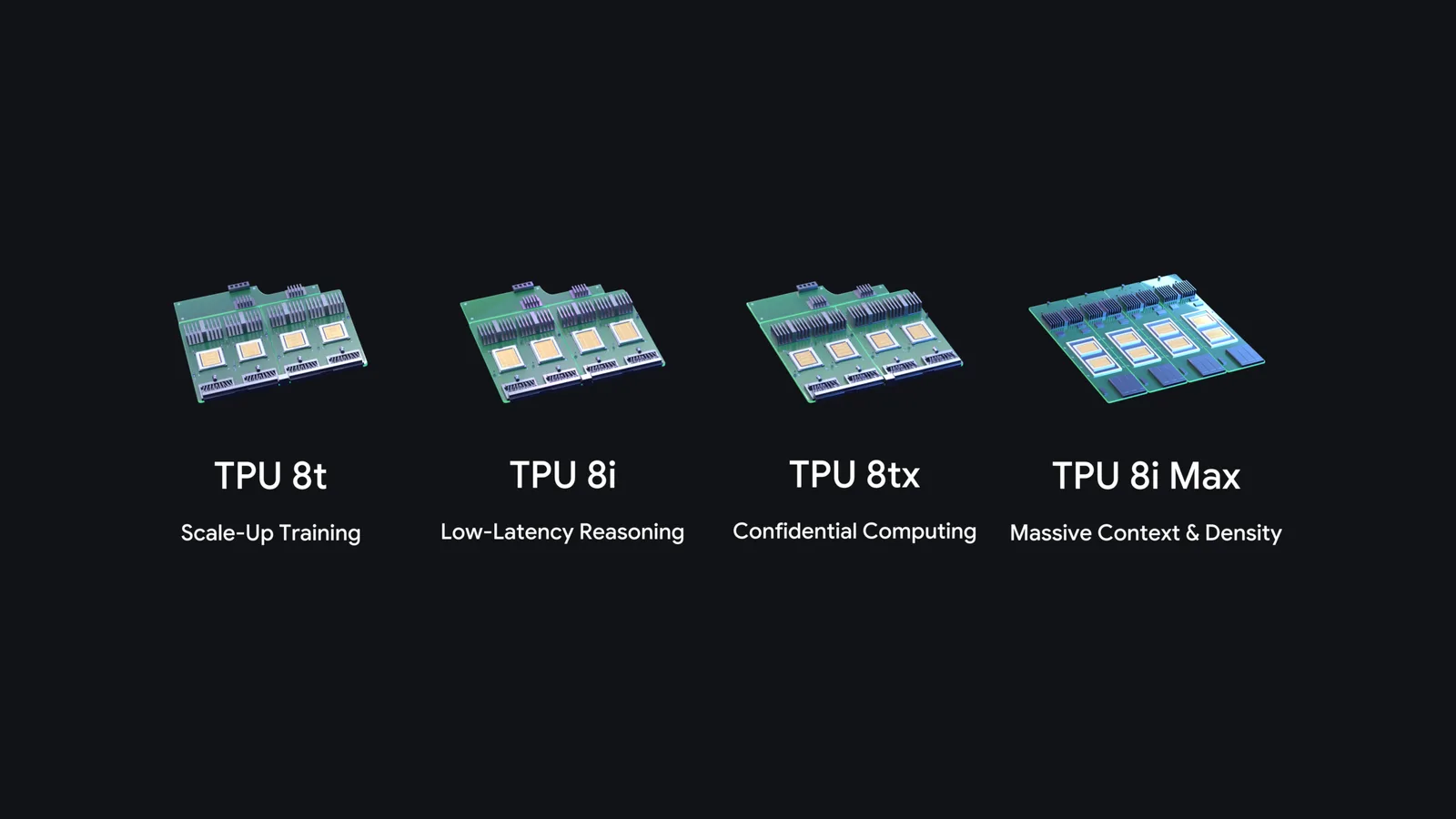
Google TPU 8tx and TPU 8i Max are the two new systems Google has added to its eighth-generation AI accelerator lineup: TPU 8tx for confidential computing and TPU 8i Max for memory-intensive workloads. The move gives Google a more modular way to target confidential AI workloads and memory-hungry applications, and Google says it has shipped four TPU systems within a single year for the first time.
Background: Google Turns TPU Into an External AI Platform
Google's current push reflects a strategic shift. The company is moving from treating TPUs as a purely internal tool to marketing them as a competitive platform for outside customers. Google now counts nearly 100 external TPU customers, a number that shows the chip effort has moved beyond internal service.
That shift is happening alongside a change in AI demand. As AI applications spread, the focus is shifting from expensive training runs to inference, the day-to-day operation of models. Specialized chips like TPUs can play to their strengths in exactly this area. That trend is also why Amazon, Microsoft, and OpenAI are all developing their own accelerators. Nvidia has responded by bolstering its own inference offering through its acqui-hire and licensing deal with Groq.
Development: Two Configurations, Not a New Chip Generation
Google is not introducing a new chip generation with the two additions. Both new variants are built on existing silicon. Instead, Google is creating new system configurations around the same processor: different packaging, different networking, and different memory setups. Google frames this modular approach as a deliberate design choice that lets it deliver new hardware variants in months rather than years.
With these additions, Google now offers four TPUv8 variants. The company says it has shipped four TPU systems within a single year for the first time. That timeline is central to the announcement: Google is using faster system-level iteration to broaden the eighth-generation portfolio rather than waiting for a new silicon generation.
Latest Progress: Confidential Computing and Memory Bandwidth
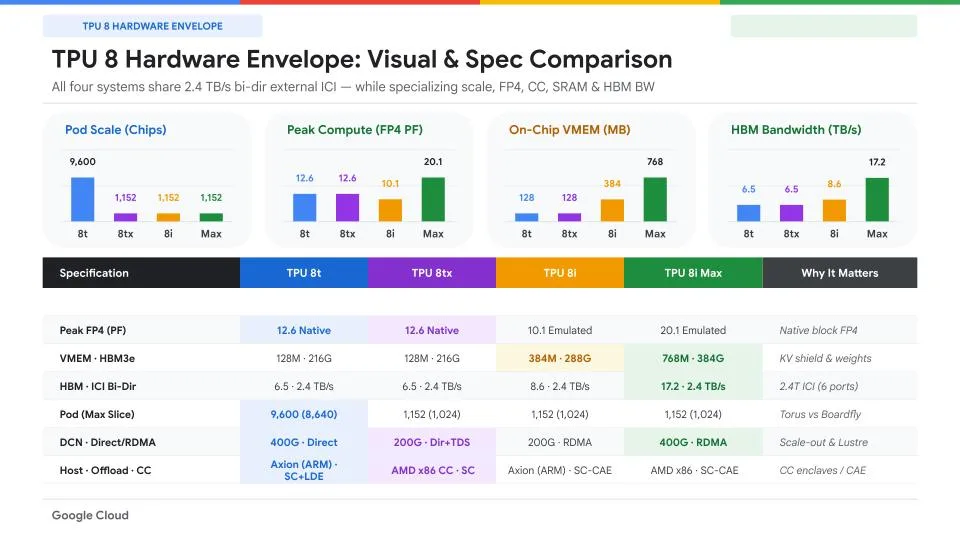
The TPU 8tx targets enterprises and government agencies working with confidential data. Normally, data is encrypted during storage and transmission, but it has to be decrypted in memory once a processor works with it. Google says the TPU 8tx is designed to close that gap, keeping data and model weights protected and isolated even during active use. Nvidia already offers a comparable feature for GPUs through its confidential computing architecture.
The system uses the same low-latency Boardfly network Google developed for real-time inference. Google says the TPU 8tx is supposed to deliver up to twice the latency reduction compared with the TPU 8t. According to Google, enterprises can use a single system to fine-tune models, distill large models into smaller ones, and train AI agents with reinforcement learning, all without moving sensitive data between different clusters.
The TPU 8i Max tackles a different problem: the memory bottleneck. When AI agents work simultaneously across large codebases or hours of video, memory bandwidth becomes the chokepoint. Google addressed this by placing two TPU 8i chips on a single package. The result is double the compute power, double the memory, and double the memory bandwidth in the same rack format, which means significantly more performance per square meter of data center space.
Access and Adoption: Easier TPU Use Outside Google
Beyond hardware, Google is working to make TPUs easier to use. The company has released TorchTPU as open source, so PyTorch code should run on TPUs with minimal changes. Popular inference frameworks like vLLM and SGLang are also supported. Lower adoption barriers matter because the expansion is tied to Google's effort to market TPUs to outside customers rather than use them only internally.
Current Stage: A Four-System Eighth-Generation Platform
Google's latest TPU systems show the company at a new stage in its chip strategy: it now has four TPUv8 variants, four TPU systems shipped within a single year, and nearly 100 external TPU customers. The additions also show how the eighth-generation lineup is being split into workload-specific configurations, with TPU 8tx aimed at confidential AI workloads and TPU 8i Max aimed at memory-hungry applications.
What to watch next is whether this faster modular path helps Google convert its nearly 100 external TPU customers into a broader platform position while inference-focused competitors such as Amazon, Microsoft, OpenAI, and Nvidia continue to build out their own accelerator offers.
Comments
No comments yet. Be the first to comment.