
Persistent personal agents powered by Avatar Intelligence amplify human agency.
Persistent personal AI agents need delegation and oversight; an Agentic Oversight Index balances value, cost, and human control.
Summary of Key Points
- Avatar Intelligence proposes persistent personal AI agents that carry users’ goals, values, and constraints across long-horizon tasks, shifting from one-off assistance to ongoing delegation.
- The framework emphasizes amplifying human agency rather than raw autonomy, reducing routine supervision while keeping users in control of consequential decisions.
- It presents a maturity roadmap for decision delegation, moving from human-directed execution to autonomous operation within bounded domains that agents earn over time.
- The Agentic Oversight Index is introduced to evaluate delivered value against operational costs and human oversight burden, highlighting trust and monitoring effort.
- Key research challenges include identity-continuous personalization, user-situated evolution, and safety mechanisms that combine technical control, accountability, and recourse.
Avatar Intelligence Proposes Personal AI Agent Delegation and Oversight Framework
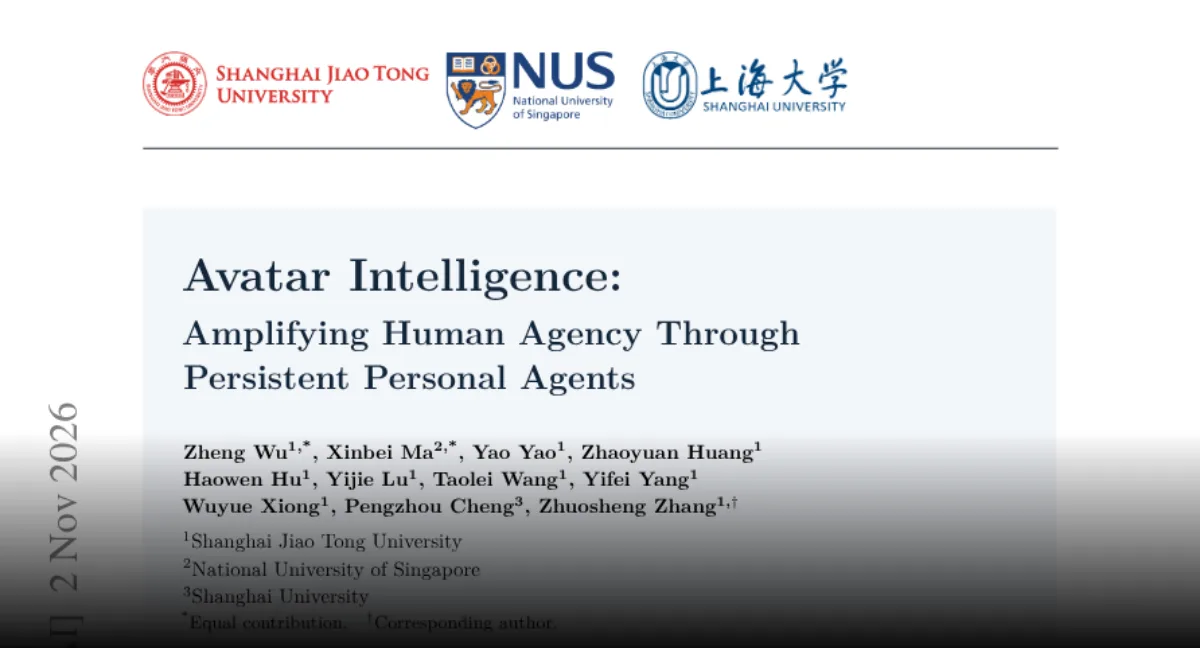
Meta description: Avatar Intelligence proposes persistent personal AI agents, a delegation roadmap, and Agentic Oversight Index to balance value, cost, and oversight.
Tags: Personal AI Agents, Avatar Intelligence, Agentic Oversight Index, Decision Delegation, AI Safety
Featured image: Abstract technology style illustration of a persistent personal AI agent coordinating long-horizon tasks across application windows; no people, logos, or text.
Personal AI agents are increasingly able to handle long-horizon tasks across applications, but the promise of easier automation still runs into a practical limit: users must spend substantial effort specifying goals, resolving ambiguity, and verifying outcomes. The proposal argues that the useful measure of progress is not raw autonomy alone, but whether agents amplify human agency—allowing people to pursue goals with less routine supervision while keeping control over consequential decisions.
Background: The Supervision Bottleneck in Personal AI Agents
For personal agents, the hard part is not simply completing a request in one application. It is carrying a user’s intention across many steps, many interfaces, and changing contexts. The text frames this as a gap between capability and human workload. Long-horizon tasks can span multiple applications, so agents may appear capable while still requiring frequent instructions, clarifications, and checks.
Avatar Intelligence responds to that gap. It describes a paradigm of persistent personal agents that represent users’ goals, values, and constraints through sustained decision delegation across contexts and time. The key shift is from one-off assistance to a continuing relationship: the agent carries the user’s purpose forward as tasks unfold.
Development Process: A Maturity Roadmap for Decision Delegation
The proposal organizes progress as a maturity roadmap rather than a single jump to full autonomy. The starting point is human-directed execution, where the user remains closely involved in task setup and course correction. The later stage is autonomous operation within delegated domains, where the agent can act independently inside areas the user has chosen to hand over.
This sequence matters because delegation is not all or nothing. The roadmap implies that reliable personal agents should earn broader latitude by reducing routine supervision in bounded domains, while the user retains control over decisions that carry significant consequences.
Latest Progress: Measuring Value, Cost, and Oversight
The framework introduced for evaluation is the Agentic Oversight Index (AOI). It is described as a way to judge delivered value against agent-side operational cost and human oversight burden. That pairing is important: an agent may deliver results, but those results can be offset by the effort required to monitor, correct, and trust them.
Three core research challenges are identified: identity-continuous personalization that carries user preferences across tasks; user-situated evolution through Rehearsal Engineering; and safety mechanisms that combine technical control with accountability and recourse. Together, these directions define a research agenda for reliable decision delegation to personal agents across tasks and over time.
What to watch next is how the maturity roadmap is operationalized: whether personalization can remain identity-continuous, whether evolution can stay user-situated, and whether oversight can be measured in a way that reflects both value and burden.
Comments
No comments yet. Be the first to comment.