
CoworkOS Enables Broader Real-World Automation by Scaling Agentic Coworkers
CoworkOS is an open research system for real-world automation via layered agents, shared apps, persistent runtime, and benchmark results.
Key Takeaways
- CoworkOS is presented as an open research system for “agent coworkers,” designed for real-world automation with long-horizon planning, tool use, file editing, and follow-up rather than one-off chatbot responses.
- Its architecture is built on three pillars: a three-layer cowork structure, shared app editing between humans and agents, and a persistent runtime with workspaces, semantic memory, and background jobs.
- The release compares CoworkOS with Codex and DeepSeek Harness across 12 productivity benchmarks and 24 real deliverables, showing an evaluation that covers both synthetic tasks and practical work products.
- It also reports automated post-training results for Qwen3.6-35B-A3B, which improves from 33.19 to 42.95 on 8 benchmarks after 5 training rounds, a gain of +9.76 points.
- With public paper, code, site, and demo links, CoworkOS remains a research release whose main open question is whether its long-horizon automation can keep deliverable quality stable as models improve and designs are tested beyond benchmarks.
Meta description: CoworkOS compares agent coworker results with Codex and DeepSeek Harness across 12 productivity benchmarks and 24 real deliverables, plus Qwen3.6-35B-A3B gains
Tags: CoworkOS, AI agents, productivity benchmarks, Qwen3.6-35B-A3B, automated post-training
Featured image: An abstract technology style scene with layered workspace panels, connected task nodes, and a soft blue gradient, no real people, no company logos, no text.
Background: why a coworker needs more than a chatbot
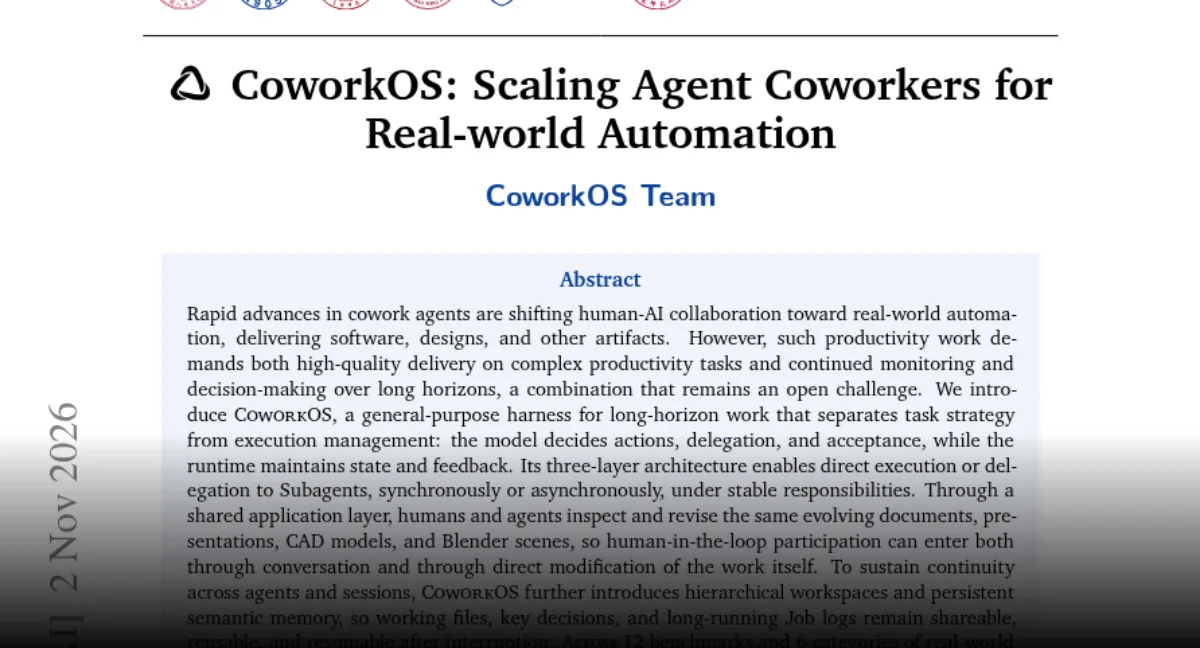
CoworkOS is presented as "Scaling Agent Coworkers for Real-world Automation," a system for agent coworkers rather than a single-response assistant. The project frames its goal as a true "super AI coworker" that handles complex productivity work and long-horizon decision-making.
That framing matters because many agent systems can answer a question or finish a short task, while real office and engineering workflows require planning, tool use, file editing, and follow-up over time. The release links the work to RUC-NLPIR and provides a paper, site, code, and demo, indicating that the project is being shared as an open research artifact rather than a finished commercial product.
Development: three design pillars behind CoworkOS
The architecture is described in three parts. First, a three-layer cowork structure separates planning, scheduling, and execution. In this design, the Main layer plans and accepts work, the Coordinator schedules it, and Subagents execute tasks in synchronous or asynchronous modes.
The split is important because it turns a single agent loop into a coordinated workflow: one component decides what should happen, another allocates resources, and smaller agents perform the work.
Second, CoworkOS emphasizes shared apps. Humans and agents co-edit the same documents, computer-aided design files, and Blender projects through chat or direct edits. This is closer to a collaborative workspace than a chat window, because the agent is placed inside the same artifact that the human is working on.
Third, the project proposes a persistent runtime built from hierarchical workspaces, semantic memory, and background Jobs. The release describes the result as resumable and monitorable. That combination addresses two common problems in agent automation: long tasks that need to survive across sessions, and workflows that require a way to check progress without forcing every step to run in the foreground.
Latest results: 12 benchmarks, 24 deliverables, and a 9.76 point gain
The reported results place CoworkOS in direct comparison with Codex and DeepSeek Harness across 12 productivity benchmarks and 24 real deliverables. The release says the system is competitive in that evaluation set. The benchmark count and deliverable count together show that the evaluation is not limited to a single synthetic test: it covers productivity tasks and real work products.
The release also reports a recursive self-improvement-native training result. After 5 rounds of automated post-training, Qwen3.6-35B-A3B rises from 33.19 to 42.95 on 8 benchmarks, a gain of +9.76. This is the clearest numeric change in the update, and it links the CoworkOS system to measurable improvement in a named model.
The paper is available at http://github.com/RUC-NLPIR/CoworkOS/blob/main/CoworkOS_paper.pdf, the site at https://coworkos-ai.github.io, the code at https://github.com/RUC-NLPIR/CoworkOS, and the demo at https://coworkos-ai.github.io/showcase.html.
Current stage: an open research system to watch
At this stage, CoworkOS is a research release with public paper, site, code, and demo links. The next point to watch is how the three-layer cowork structure, shared app editing, and persistent runtime behave outside the reported benchmark set.
The key question is whether systems built for long-horizon decision-making can keep deliverable quality stable while models gain score through automated post-training, and whether public code and demos make those claims easier to inspect.
Comments
No comments yet. Be the first to comment.