
LiveFoley enables dynamic real-time video-to-audio generation for immersive interactive worlds.
LiveFoley is a decoupled sound engine using a trailing sliding window to cut video-to-audio latency to 156 milliseconds for games and cameras.
Key Takeaways
- LiveFoley is a plug-and-play Video-to-Audio engine built for real-time interactive visual streams rather than offline video files.
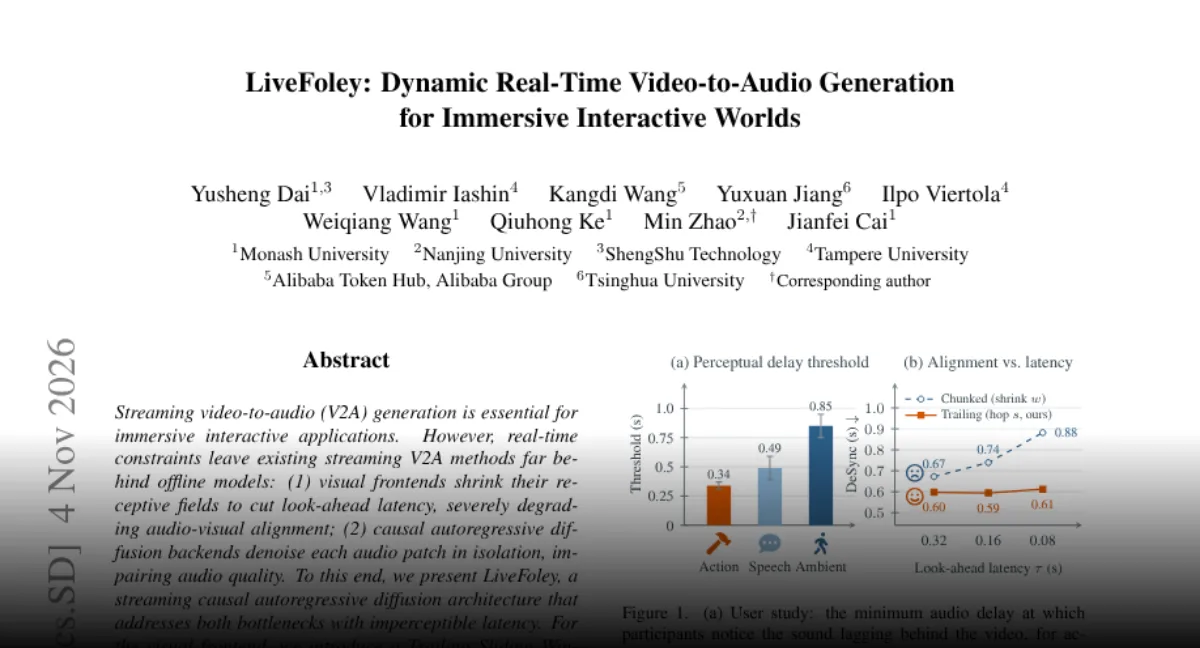
- It uses a Trailing Sliding Window to reach 156 ms full processing latency, staying below the ~250 ms perceptual limit needed for seamless interaction.
- It delivers alignment comparable to offline models while continuously following changing video input.
- It decouples audio from video generation, making it a source-agnostic sound engine that can attach to existing visual pipelines.
- This design enables immediate use in games, AR/VR applications, live cameras, and other immersive interactive worlds.
Headline: LiveFoley Cuts Video-to-Audio Latency to 156 Milliseconds for Interactive Worlds
Meta Description: LiveFoley cuts Video-to-Audio latency to 156 milliseconds with a Trailing Sliding Window, enabling plug-and-play sound for games, cameras, and visual streams.
Tags: LiveFoley, Video-to-Audio, Trailing Sliding Window, real-time audio, interactive worlds
Featured Image: abstract technology image of pixel waves and synchronized audio lines, no real people, no company logos, no text.
LiveFoley is a plug-and-play sound engine for Video-to-Audio generation, the task of creating audio from visual input. The work targets two bottlenecks that have limited real-time interactive audio: strict latency requirements and the tight coupling in recent audio-video models. The goal is not only faster audio, but audio that can follow a changing visual scene as it happens.
The Latency Wall in Interactive Sound Generation
Streaming Video-to-Audio is difficult because interactive environments do not have the same timing behavior as turn-based AI systems. In a system such as GPT-Realtime, a response can arrive after a user action, but an interactive visual world needs continuous, imperceptible response. When a user knocks on a virtual table, the sound must appear at the moment of contact. For interactive use, a sound that arrives after the visual event can break the sense of presence.
The constraint is not only a technical preference; it is tied to perception. The combined video-encoding and audio-synthesis stages have to stay under 250 milliseconds. That limit has left earlier streaming approaches behind offline systems such as MMAudio, which can prioritize alignment rather than immediate playback. The gap between offline quality and real-time usability is where LiveFoley is positioned.
Trailing Sliding Window and 156 Milliseconds
LiveFoley solves the visual frontend bottleneck with a novel Trailing Sliding Window. The full processing path reaches 156 milliseconds. That figure places the system below the 250 millisecond perceptual budget and gives it alignment comparable to offline models while still operating in a streaming setting.
The number is the practical measure of progress here. It suggests that the visual side of Video-to-Audio generation no longer has to sacrifice synchronization to keep latency low. The engine is designed for continuous input, not a single isolated video file, so timing is part of the core function.
Decoupled Audio for External Visual Streams
The second issue concerns architecture. Recent joint video-audio world models often couple sound tightly to their internal video generators, making them unusable for external visual streams. That flexibility matters when the visuals are already being produced by another system.
LiveFoley changes that setup by acting as a decoupled, source-agnostic sound engine. It creates synchronized audio in real time from any incoming pixel stream. Because it does not depend on a paired video model, it can be immediately deployed with 3D game engines, augmented reality and virtual reality applications, and live cameras.
Current Stage of the Work
The current stage shows a step toward truly immersive interactive worlds by separating audio generation from visual generation while keeping latency low. The approach preserves the synchronization expected from offline models, but applies it to streaming visual input. The result is a concrete step beyond tightly paired world models and toward usable audio for live visual streams. For readers following interactive media, the key point is not only the 156 millisecond result, but the broader design choice: a sound engine that can attach to existing visual pipelines instead of requiring a dedicated video model.
Comments
No comments yet. Be the first to comment.