
EvoTeam enables multi-agent collaboration through evolving teams.
EvoTeam improves LLM multi-agent systems by evolving teams, interaction rules, and agent skills from execution experience across four benchmarks.
Key Takeaways
- EvoTeam is a collaboration-centric evolution framework for LLM-based multi-agent systems, improving team organization, interaction rules, and individual agent skills together.
- It shifts optimization from isolated agent tuning to the team context, recognizing that stronger agents do not automatically produce better collaboration.
- The framework maintains a library of reusable teams and uses team-specific interaction rules, allowing collaboration experience to accumulate while skills remain reusable across contexts.
- Experiments across four benchmarks demonstrate its effectiveness, and the available code marks a move in multi-agent research from agent-level tuning to collaboration-level evolution.
EvoTeam Evolves Collaboration in LLM Multi-Agent Systems Through Execution Experience
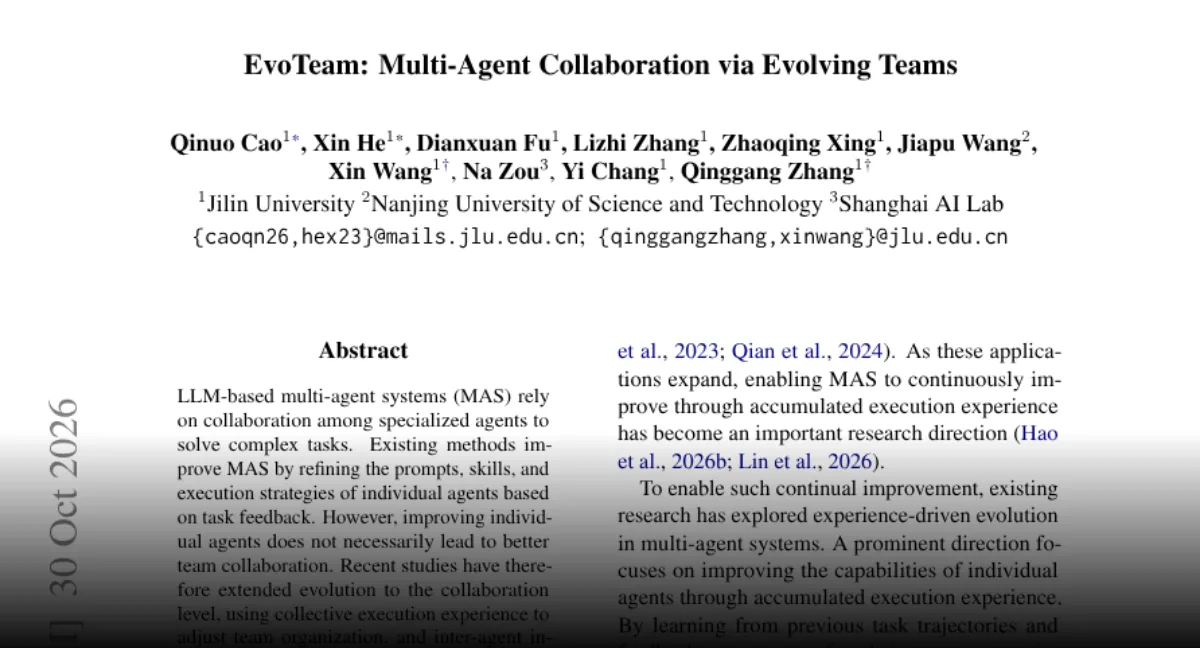
Meta description: EvoTeam advances LLM multi-agent systems by evolving team organization, interaction rules, and agent skills from execution experience across four benchmarks.
Tags: LLM, Multi-Agent Systems, EvoTeam, Collaboration, AI Research
Featured image: abstract technology style with linked nodes and flow arrows, no real people, no company logos, no text.
EvoTeam, a collaboration-centric evolution framework for LLM-based multi-agent systems, jointly evolves team organization, interaction rules, and individual agent skills through execution experience. The framework matters because better individual agents do not guarantee better team collaboration. It shifts improvement from isolated agent tuning to the team context that produces the result.
Background: LLM-based multi-agent systems rely on collaboration among specialized agents to solve complex tasks. In such systems, a task is usually not handled by a single model call. It is divided among agents with different roles, capabilities, or responsibilities. The team must decide who acts first, what information is passed, how feedback is used, and how errors are corrected. These coordination choices can affect task success as much as the quality of any one agent. The challenge grows when tasks are heterogeneous, because a structure that helps one team context may not fit another. When teams are evaluated only as collections of agents, the value of their interaction patterns can be missed.
Development: Existing methods improve these systems by refining the prompts, skills, and execution strategies of individual agents based on task feedback. That direction has produced sharper agents, but it does not necessarily lead to better team collaboration. A stronger agent can still fail when placed in a team structure that does not support its role or when interaction rules do not match the task. Recent studies therefore extended evolution to the collaboration level, using collective execution experience to adjust team organization and inter-agent interactions. The result is a shift in focus from what one agent knows to how the team works together.
Latest progress: EvoTeam addresses a gap in that newer line of work. It proposes a framework that jointly evolves team organization, interaction rules, and individual agent skills through execution experience. The system maintains a library of reusable teams. It can select or create agent teams for tasks and guide collaboration through team-specific interaction rules. This design lets collaboration experience accumulate within compatible team contexts, while individual skills remain reusable across teams. The distinction is important: team context can stay task-appropriate, while useful skills are not locked into a single pattern.
Current stage: Existing approaches still face a practical problem: evolving collaboration across heterogeneous tasks remains challenging, as many constrain team reorganization within a shared structure and reuse interaction rules across incompatible team contexts. EvoTeam treats the team context as the unit that should evolve with the task. Experiments across four benchmarks demonstrate the effectiveness of the framework. The code is available at https://github.com/DEEP-JLU/EvoTeam. The work marks a stage where LLM-based multi-agent research is moving from agent-level tuning to collaboration-level evolution. The next observable signal is how reusable team contexts and team-specific interaction rules behave as tasks, agent roles, and execution feedback become more varied.
Comments
No comments yet. Be the first to comment.