
Microsoft posts its tenth consecutive quarter of record-breaking revenue.
Microsoft posts $92.3 billion, up 19%, its 10th record; net income $36.6 billion, Cloud and AI lead, devices decline, spending hits $45.2 billion.
Key Points Summary
- Microsoft reported quarterly revenue of $92.3 billion, up 19% year over year, marking its 10th consecutive record revenue quarter, with net income of $36.6 billion, up 32%.
- Growth was driven mainly by Microsoft Cloud, which reached $63.9 billion in revenue, up 30% year over year, with Azure contributing $33.2 billion and Microsoft 365 about $28 billion.
- The quarter shows a shift toward cloud and AI-related businesses: Devices and Consumer revenue fell 3% year over year, while Windows OEM and devices revenue dropped 22%.
- AI-linked demand was a major factor, including $10 billion in revenue from OpenAI, while commercial remaining performance obligations rose 73% to $677 billion, reflecting strong contracted future demand.
- Microsoft also set a record for quarterly capital expenditures at $45.2 billion, showing heavy investment to support future cloud and AI commitments.
Microsoft reported quarterly revenue of $92.3 billion on Wednesday, marking a 19% increase over the year-ago quarter and extending its streak of record revenue to 10 consecutive quarters. The result is also profitable revenue, not only a top-line record. The company also reported net income of $36.6 billion, up 32% over the same period under Generally Accepted Accounting Principles. The result is significant because Microsoft’s current record streak is tied to cloud growth, contracted demand from AI labs, and spending to support future commitments.
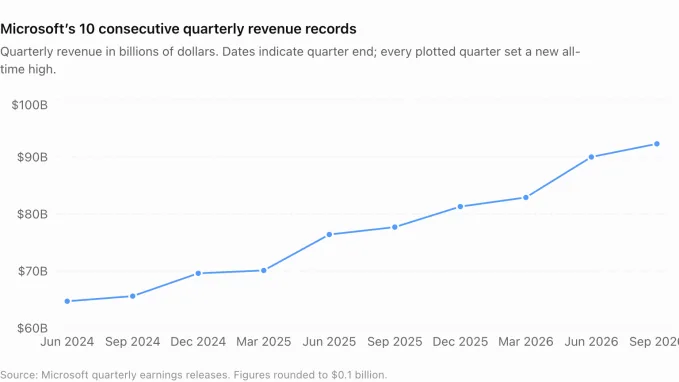
Background: A Ten-Quarter Record Streak
The growth was led by Microsoft Cloud, which reached $63.9 billion in revenue for the quarter, an increase of 30% over the year-ago quarter. That cloud total is not purely AI revenue. Microsoft 365 accounted for nearly $28 billion. Azure brought in the most, at $33.2 billion, and enterprises also run traditional software and SaaS applications on Azure.
The cloud segment therefore includes both long-standing business products and AI-related services. Microsoft 365’s nearly $28 billion and Azure’s $33.2 billion show that traditional enterprise software remains important, even as AI-linked demand draws attention.
Development: Segment Shift And Devices Decline
Microsoft has reorganized its business reporting into two basic segments: Agents and Infra and Devices and Consumer. Devices and Consumer revenue was $15.5 billion, down 3% year over year. Within that segment, Windows original equipment manufacturer and devices revenue fell 22% from the year-ago quarter. The segment change makes the quarter’s composition easier to read: growth is concentrated in cloud and AI-related reporting lines, while devices and consumer revenue is moving lower.
The decline in Windows original equipment manufacturer and devices revenue contrasts with the cloud growth, showing that the record quarter did not depend on hardware or consumer devices. The reporting structure separates Agents and Infra from Devices and Consumer, while Devices and Consumer remains a smaller revenue line.
The AI-linked portion of Microsoft Cloud became clearer through another figure: Microsoft reported $10 billion in revenue from OpenAI. OpenAI has branched out to AWS, Oracle, and others, but still runs many of its services on Microsoft’s cloud. Anthropic runs on Azure as well.
Latest Progress: Contracted Demand And Record Spending
Microsoft said its commercial remaining performance obligation increased 73% to $677 billion. That represents future revenue committed under existing contracts of the AI labs. The $677 billion commercial remaining performance obligation gives a view of contracted future demand, while the $45.2 billion in capital expenditures shows spending to prepare to deliver on those commitments.
Capital expenditures topped $45.2 billion, another all-time quarterly record. The combination of contracted future revenue and record spending suggests the company is balancing current earnings with the cost of serving future demand. The quarter leaves Microsoft in a phase where record revenue and record spending appear together. Cloud growth, AI-lab contracts, and capital investment are now central to its financial reporting, while devices and consumer products remain a smaller, declining part of the revenue picture.
Meta Description: Microsoft reported $92.3 billion revenue, up 19% for its 10th record, as Microsoft Cloud, Azure, and $45.2 billion capital expenditures shaped results.
Tags: Microsoft, Azure, OpenAI, AI, cloud computing
Featured Image: Abstract technology style image showing cloud computing networks and AI data pathways, with no real people, company logos, or text.
Comments
No comments yet. Be the first to comment.