
A foundation model for molecular interactions demonstrates emergent biological capabilities.
Bonbon learns molecular behavior from sequence, predicts interaction features zero-shot, and showed strong blinded assay hit rates.
Key Takeaways
- Bonbon is a biology foundation model accepted as a NeurIPS 2026 Oral, trained only on sequence data without structure, physics, task labels, or supervision, yet develops emergent molecular-interaction capabilities at 1.6 billion parameters.
- In a single inference pass, it predicts mechanism of action, binding site, orthosteric versus allosteric engagement, covalent bonding residues, and active moieties at single-bond resolution, even zero-shot on held-out proteins and molecules.
- It achieves state-of-the-art binding and affinity benchmark performance and runs at 2,500 molecular interactions per second on a single H100, while blinded external assays showed a 61.5% hit rate across nine disease targets versus roughly 0.1% for typical high-throughput screening.
- The results suggest that core rules of molecular biology can be learned from sequence and emerge with scale, potentially collapsing months of sequential drug-discovery experiments into one computational step and enabling chemistry beyond known scaffolds.
Bonbon Emerges at NeurIPS 2026 as a Biology Foundation Model
Meta description: Bonbon, a biology foundation model, emerged at NeurIPS 2026 with zero-shot predictions and a 61.5% hit rate in external blinded contract research assays.
Tags: Bonbon, biology foundation model, NeurIPS 2026, drug discovery, molecular interactions
Featured image: abstract molecular network over a neural representation grid
Bonbon, a vertical biology foundation model accepted to the NeurIPS 2026 main track as an Oral, reports that molecular behavior can be learned from sequence alone. The result matters because most computational drug-discovery tools answer one narrow question at a time, while Bonbon attempts to predict mechanism, binding site, bonding type, and key atoms in a single inference pass.
Background: The prediction gap in molecular biology
Drug discovery often reduces to asking whether a candidate molecule can bind a protein. That question is necessary, but incomplete. A molecule may fit a target and still produce an effect opposite to the one required, engage the wrong location, or depend on a chemical group that creates a problem later in development. Traditional workflows separate these answers into a chain of functional assays, structural analysis, and repeated synthesis of analogs.
Bonbon starts from a different assumption: the hidden relationships governing molecular interactions may be learnable from sequence data. The model was trained on sequences alone, with no structure, no physics, no task-specific labels, and no supervision. Its paper was accepted to the NeurIPS 2026 main track as an Oral, placing it in the top 0.4% of submissions.
Scaling from 42 million to 1.6 billion parameters
The development path followed a pattern familiar in large language models. As Bonbon was scaled from 42 million to 1.6 billion parameters, pretraining loss fell smoothly, while new biological capabilities appeared sharply at the largest scale. The project compares this to large language models learning mathematics without being explicitly trained on it.
At that scale, the model predicts mechanism of action across six classes, including which molecules switch the same target on and which switch it off. It localizes the binding site and distinguishes orthosteric from allosteric engagement, that is, primary versus alternate locations on the same target. It also recognizes covalent binding and pinpoints the residue involved, without being told that covalency is present. In addition, it identifies the active moiety at single-bond resolution, work that usually takes many rounds of making and testing analogs.
All capabilities were evaluated zero-shot on held-out proteins and molecules, meaning the model was not given task-specific training on the test targets.
Benchmarks and blinded contract research assays
The same representation space reaches state-of-the-art performance on widely used binding and affinity benchmarks. It also runs at 2,500 molecular interactions per second on a single H100, about 50,000 times faster than a leading co-folding model.
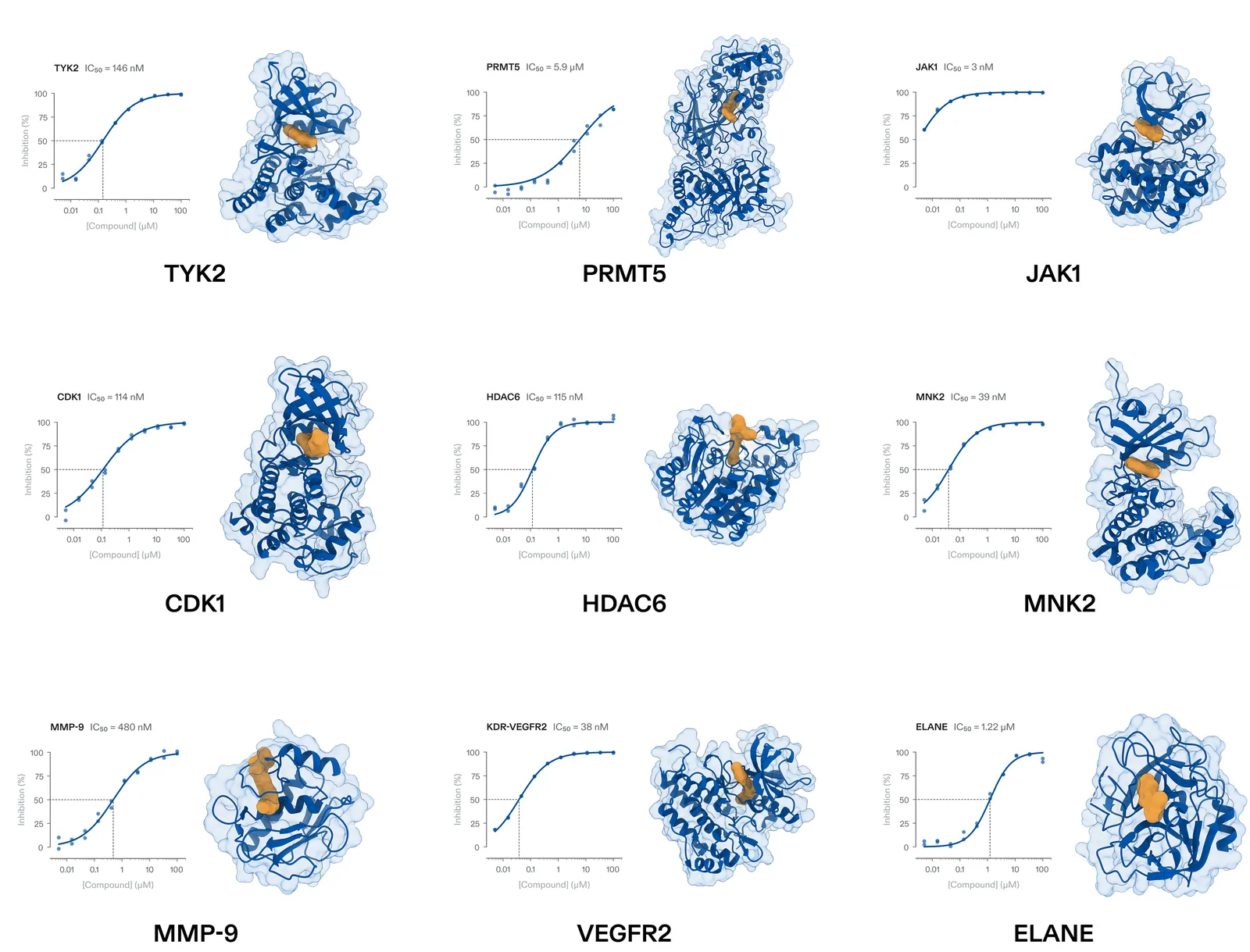
The more practical signal came from blinded dose-response assays at an external contract research organization. De novo molecules ranked by Bonbon achieved a 61.5% hit rate across nine disease targets in seven protein families, compared with the about 0.1% typical of high-throughput screening. Every molecule was less than 60% similar to anything in training.
The examples show why that separation matters. For HDAC6, most known inhibitors rely on hydroxamate chemistry linked to toxicity, but Bonbon found novel non-hydroxamate inhibitors. For MNK2, it found novel inhibitors outside the documented chemical space for this cancer target. For VEGFR2 and ELANE, both absent from training, Bonbon found confirmed inhibitors for each.
Why a single inference pass changes the workflow
Most AI in drug discovery answers one narrow question: does a molecule fit a protein? But a molecule can fit perfectly and still do nothing, or the opposite of what is needed. What it does, where it acts, how it holds, and which atoms drive it are usually answered through a long chain of separate assays and lab iterations.
Bonbon answers these questions together, in a single inference pass, at the scale biology demands. That collapses months of sequential experiments into one step, opens chemistry beyond known scaffolds, and puts the hardest drug programs within reach, including targets with no good starting points.
Current stage and what to watch next
The current stage is an accepted NeurIPS 2026 Oral result showing that sequence-only training can produce emergent molecular prediction capabilities at 1.6 billion parameters. The benchmark and blinded assay numbers suggest the approach can operate beyond narrow protein-fit scoring, while also raising speed to 2,500 molecular interactions per second on a single H100.
More broadly, the work shows that the rules of molecular biology are learnable from sequence alone and emerge with scale. That is the foundation for moving from single interactions to pathways, cells, and understanding biology as a complex system. The next question is whether this sequence-only representation can keep expanding from molecule-level answers to those larger biological systems.
Comments
No comments yet. Be the first to comment.