
OpenAI's Images 2.6 model now allows ChatGPT to convert text prompts and photos into animated GIFs.
OpenAI Images 2.6 lets ChatGPT create editable animated GIFs from prompts or photos, while API models Flare and Sunburst speed image generation.
Key Takeaways
- OpenAI Images 2.6 enables ChatGPT and Codex users to create animated GIFs from text prompts or uploaded photos.
- The update focuses on frame consistency, helping characters or scenes remain recognizable across animated sequences.
- Users can adjust animation speed and edit individual frames after a GIF is generated, making it closer to a lightweight animation tool.
- OpenAI is also offering GPT-Image-2.6 “Flare” and “Sunburst” API models for faster or higher-quality image generation.
- The rollout reflects OpenAI’s broader effort to improve image-generation speed, coherence, and scalability amid more than four billion weekly image generations.
Meta description: OpenAI Images 2.6 lets ChatGPT and Codex users create animated GIFs, adjust frames, and use GPT-Image-2.6 Flare and Sunburst API models for faster generation.
Tags: OpenAI, ChatGPT, Images 2.6, GPT-Image-2.6, animated GIFs
Featured image: Abstract technology style, looping frames around a glowing image node, no real people, no company logos, no text.
Background: Image Models Needed Frame Consistency
OpenAI Images 2.6 is the model behind a new ChatGPT capability that can create animated GIFs, a format used online for short looping visuals. The update matters because earlier image models could generate a single appealing picture, but a moving sequence requires the same character or scene to remain recognizable from one frame to the next. If the subject changes too much between frames, the loop breaks and the result looks unstable.
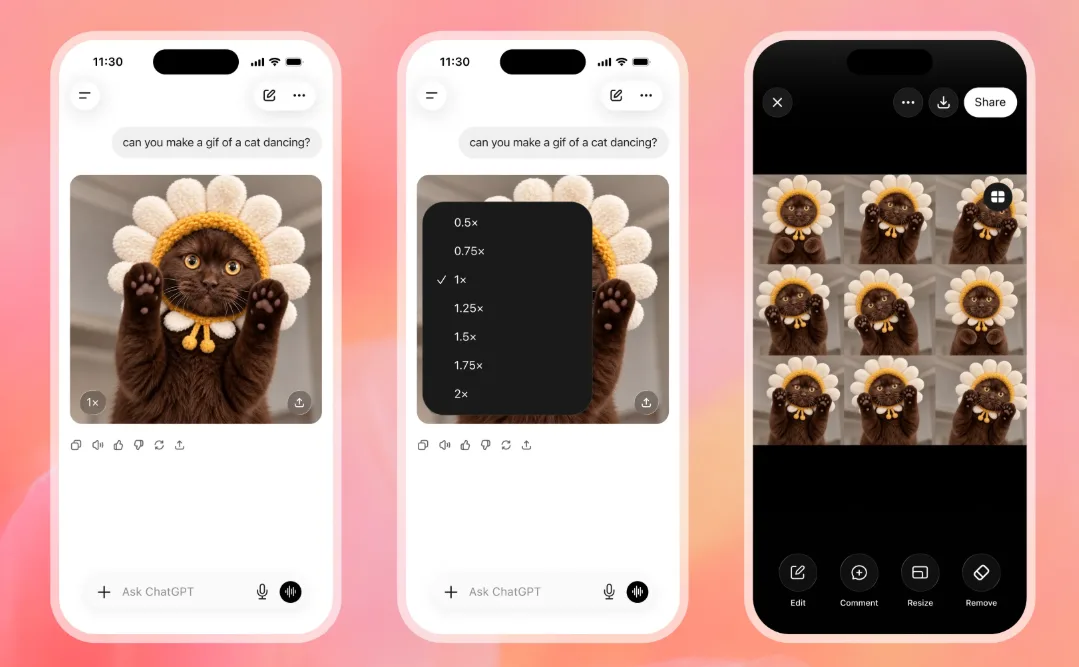
According to The Verge, the feature is based on OpenAI's new Images 2.6 model and is rolling out to all ChatGPT and Codex users on web, desktop, and mobile apps. Users can start from a text prompt or an uploaded photo, then adjust animation speed or edit individual frames after the GIF is produced.
Development: Prompting a GIF and Editing Its Frames
In an example shown by OpenAI, the prompt "Can you make a gif of a cat dancing?" produces several slight variations of a character. The system strings those variations together flipbook-style into a GIF. The key technical point is image consistency across frames. The example suggests Images 2.6 is strong enough to keep the cat recognizable through the sequence, while earlier models would likely have altered its look too much from one frame to the next for the trick to work.
The editing controls give the output a more practical workflow. Instead of treating animation as a fixed result, users can choose a starting image or description, then refine speed and individual frames. That makes the GIF feature closer to a lightweight animation tool than a one-shot image generator.
Latest Progress: Faster Generation and Developer API Models
Beyond GIFs, Images 2.6 is also meant to speed up image generation overall. For developers, OpenAI is releasing API models GPT-Image-2.6 "Flare" and GPT-Image-2.6 "Sunburst". The "Flare" variant is described as efficient, while "Sunburst" is aimed at higher-quality image generation. Both model variants were first introduced with Image 2.5.
OpenAI says users now generate well over four billion images per week via ChatGPT and the API, one billion more than in September. That volume gives the Images 2.6 rollout a broader context: the update is not only a new visual feature for consumer users, but also an expansion of an already large image-generation pipeline that includes developer access through API models.
Current Stage: A Rollout Built on Scale and Consistency
The ChatGPT GIF feature sits at the intersection of consumer use and developer infrastructure. On the user side, it turns text prompts or uploaded photos into short animated sequences with adjustable frames. On the developer side, the GPT-Image-2.6 "Flare" and "Sunburst" models extend the same Images 2.6 direction into the API.
The immediate signal is that OpenAI is pushing image models toward both speed and frame-to-frame coherence, while serving more than four billion weekly images across ChatGPT and the API. The next phase will depend on how developers and users apply these variants beyond simple GIF creation.
Comments
No comments yet. Be the first to comment.