
SeMo3D unifies three-dimensional generation, editing, and completion through selective modeling
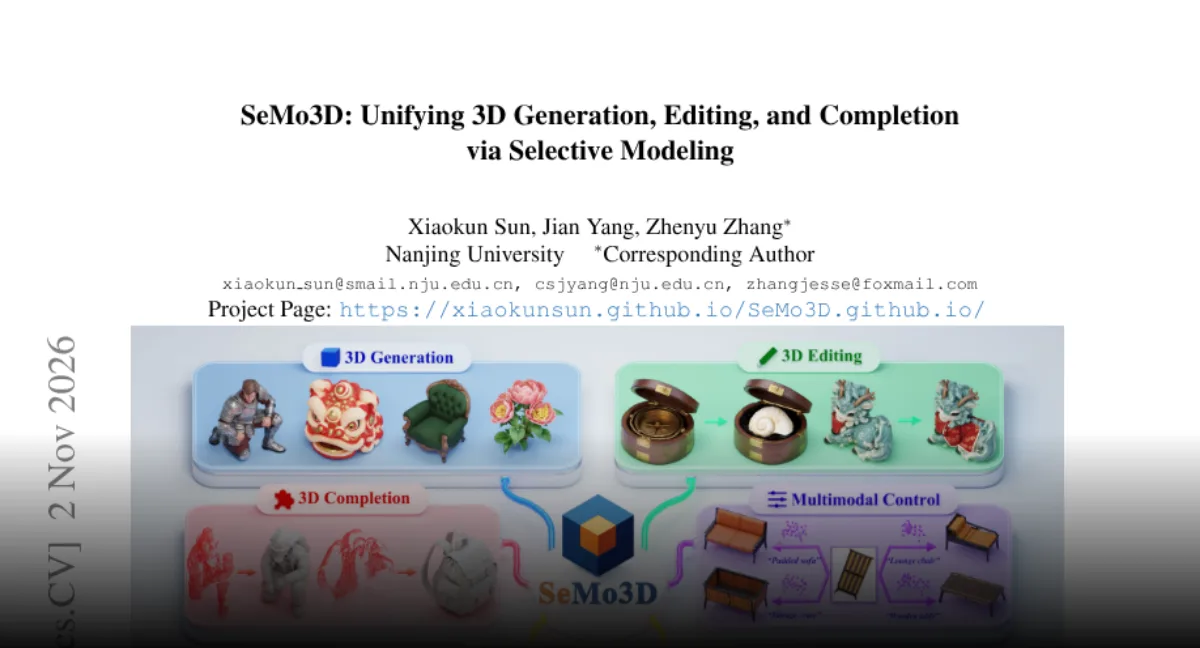
SeMo3D unifies 3D generation, editing, completion via selective modeling, using Omni3DiT to change regions while preserving context.
Key Takeaways
- SeMo3D unifies 3D generation, editing, and completion as one selective modeling task: create a chosen region while preserving the rest of the asset.
- It uses region-selective denoising, adding noise and computing loss only inside randomly selected regions, enabling training without paired editing or completion data.
- The architecture, Omni3DiT, is a multi-condition 3D diffusion transformer that distinguishes regions to create versus retain and fuses image, text, and point guidance.
- SeMo3D surpasses state-of-the-art methods across benchmarks, with strong results in multimodal controllability, editing consistency, and completion accuracy.
- It supports agent-ready workflows by enabling natural-language local 3D changes without switching between separate generation, editing, and completion pipelines.
Meta description: SeMo3D introduces Selective Modeling for 3D assets, unifying generation, editing, and completion while preserving unchanged regions with multimodal control.
Tags: SeMo3D, 3D generation, 3D editing, 3D completion, Omni3DiT
Featured image: abstract 3D mesh, point cloud, and geometric wireframes forming a unified model, no people, no logos, no text.
Background: Why isolated 3D tasks create friction
SeMo3D reframes 3D generation, 3D editing, and 3D completion as one problem: synthesize a selected region while keeping the rest of the asset unchanged. This matters because many existing pipelines treat each task separately and rebuild the whole object under task-specific limits, even if only a small area changes. That approach can create task isolation, alter content that should remain fixed, and require paired data for editing or completion. For a local modification, full regeneration is often unnecessary work and can introduce inconsistencies between the changed part and the parts that should stay the same.
Development process: From one observation to one training recipe
The method starts from a shared pattern. Generation fills a full region, editing changes a target region, and completion fills a missing region; all three preserve the surrounding context. SeMo3D calls this Selective Modeling. Because any 3D asset can be partitioned into a selected region and its context, the approach also enables training without paired editing or completion data. In this formulation, creation and preservation are not separate tasks; they are two parts of the same regional modeling problem. The same asset can supply supervision for all three behaviors simply by choosing different regions.
For training, SeMo3D uses region-selective denoising. The system randomly selects regions of varying sizes on standard 3D assets and adds noise and computes loss only inside those selected regions. This keeps the training signal focused on the region being modeled and lets one system learn all three tasks together. For architecture, SeMo3D uses Omni3DiT, a multi-condition 3D diffusion transformer. Omni3DiT distinguishes regions that should be created from regions that should be retained, and it fuses image, text, and point guidance for fine-grained control. The multi-condition design matters because a selected region may need guidance from more than one input type, while the rest of the asset remains fixed.
Latest progress: Benchmark results and agent-ready workflows
Across three benchmarks, SeMo3D is shown to surpass state-of-the-art methods on all tasks. The outcomes emphasize different strengths: multimodal controllability in generation, and strong consistency and accuracy in editing and completion. Beyond asset creation, the project describes SeMo3D as a unified modeling tool for agents, enabling efficient 3D creation through natural-language interaction. For agents, a single model that understands selected regions can reduce the need to switch between separate generation, editing, and completion pipelines. The project page is available at https://xiaokunsun.github.io/SeMo3D.github.io, and code is available at https://github.com/XiaokunSun/SeMo3D.
What to watch next: A unified route for local 3D changes
The central shift is not merely a new model name, but a common formulation for three tasks that usually require separate constraints and data. SeMo3D suggests that preserving unchanged content can be built into the training objective and architecture, rather than left as a later cleanup step. The next practical test is whether this selective, multi-condition approach can support reliable 3D workflows where users or agents need to change one region without disturbing the rest of a model. The approach points toward local 3D modifications that are easier to train for and easier to control across image, text, and point inputs.
Comments
No comments yet. Be the first to comment.