
Long context is not necessary.
Frequent compaction keeps LLM contexts short and accurate despite long tasks, while later tokens can cost up to 7x more, challenging long context needs.
Key Takeaways
- Frontier open-weight LLMs can make later tokens up to 7x more expensive than earlier tokens as context grows.
- Frequent context compaction maintains short working contexts while preserving task accuracy on long-horizon and long-input tasks.
- In software engineering tasks, models can remain effective even with at most one action per context, challenging the necessity of long contexts.
- Compact semantic state-space models can represent task state instead of carrying all prior actions in long contexts.
Meta description: Frontier open-weight LLMs show later tokens can cost up to 7x more, while frequent compaction keeps short contexts and task accuracy on long tasks.
Tags: LLM, token costs, context compaction, software engineering, long-context models
Featured image: Abstract technology style, no real people, no company logos, no text: a compact context window balancing token cost curves.
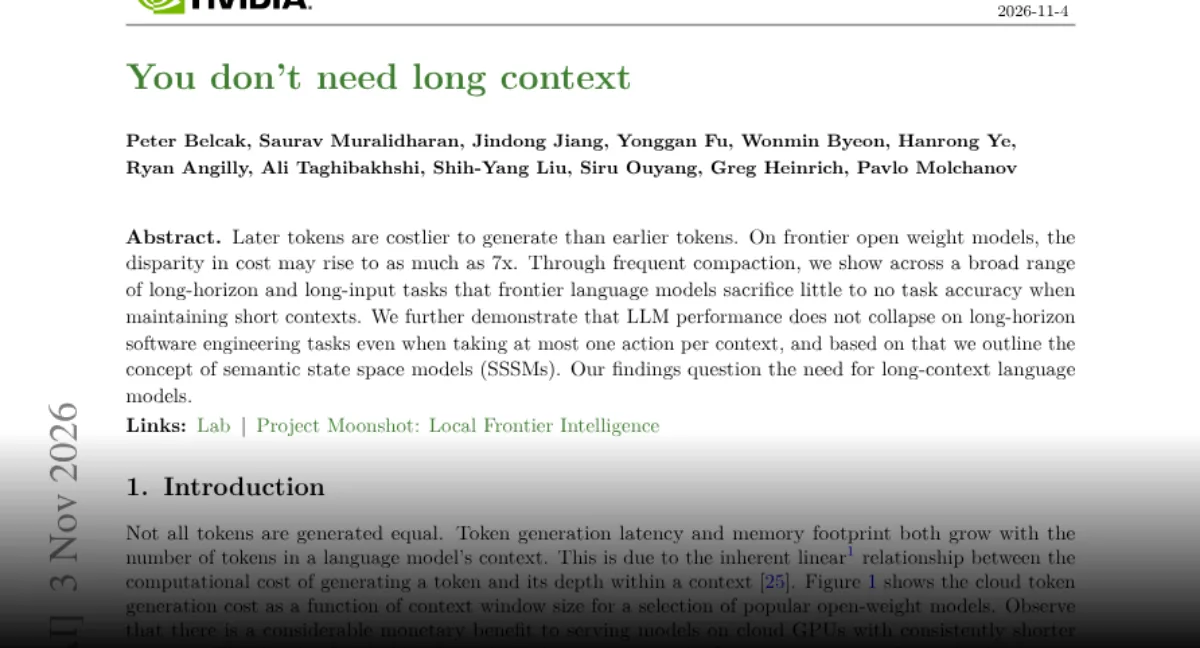
Frontier open weight LLMs generate later tokens at higher cost than earlier tokens, with gaps up to 7x, and frequent compaction can keep short contexts without major accuracy loss.
Background: A Growing Cost Gap Across a Context
Earlier tokens in a sequence are cheaper to produce than later tokens. On frontier open weight models, the cost disparity may rise to as much as 7x. The further a task runs within a single context, the more expensive each new token can become. A long context can contain many earlier tokens, but the later tokens generated after that context show the rising cost pattern.
Development: Frequent Compaction Over Long Tasks
Across a broad range of long-horizon and long-input tasks, frontier language models used frequent compaction—regularly compressing or summarizing earlier information so the model continues from a smaller working history. These models sacrificed little to no task accuracy while maintaining short contexts.
Latest Finding: One Action Per Context and State Models
In long-horizon software engineering tasks, even when the model takes at most one action per context, LLM performance does not collapse. The source outlines semantic state space models as a way to describe task state compactly, rather than relying on a long context to carry every prior action.
Current Stage: Long Contexts Reassessed
The findings question the need for long-context language models. The current stage is not a claim that short contexts always replace long ones, but evidence that short-context operation can preserve accuracy across the tested long-horizon and long-input tasks.
Comments
No comments yet. Be the first to comment.