
An Uncertainty-Guided Progressive Contraction Method Enables Models to Learn More While Training Less in Efficient Reasoning Post-Training
Uncertainty-guided contraction cuts LLM reasoning post-training to 0.22% of budget with 450 times fewer tokens and simpler training pools.
Key Takeaways
- The study introduces uncertainty-guided progressive contraction for LLM reasoning post-training, separating useful optimization paths from redundant reasoning trajectories to reduce training cost.
- It uses two uncertainty signals: learner-specific uncertainty for online optimization and teacher-specific uncertainty for offline trajectory pruning, producing a compact training pool.
- In experiments, the compressed method achieved strong reasoning performance using only 0.22% of the full optimization budget, 450x fewer optimization tokens, and four times fewer reasoning trajectories than standard GRPO.
- The method reduces the reasoning work processed by the optimizer, rather than merely pruning the dataset, and works without complex filtering, distillation, or external knowledge bases.
- The key open question is whether this contraction can remain robust as models, teachers, and reasoning tasks scale up.
Meta description: New research shows uncertainty-guided contraction can cut LLM reasoning post-training to 0.22% of budget and 450x fewer optimization tokens in experiments.
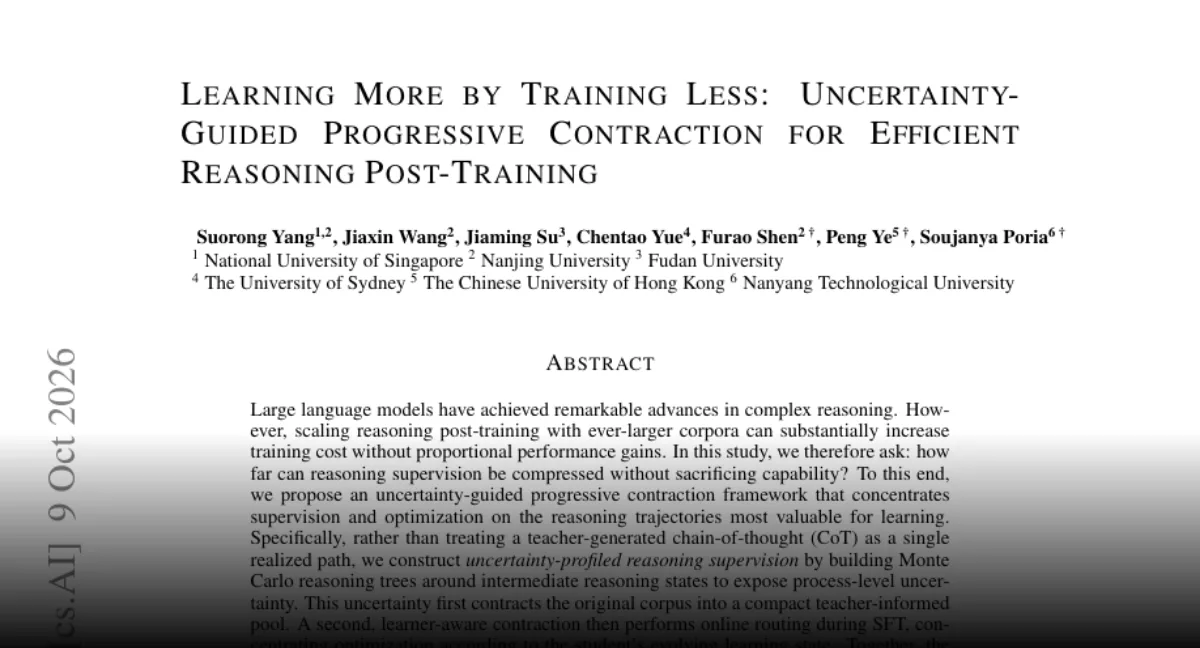
Tags: LLM, reasoning, training efficiency, uncertainty-guided compression, data pruning
Featured image: abstract network of branching reasoning paths narrowing into a compact training graph, no people, logos, or text
Background: Reasoning Gains Meet Cost Limits
LLM reasoning training has become central after large language models made remarkable advances in complex reasoning. The cost problem appears during reasoning post-training, the stage after a base model has learned broad language patterns and is tuned to produce better answers. In that stage, researchers often add larger corpora and more optimization steps. The study says this can substantially increase training cost without proportional performance gains. The question is not whether a model can reason, but how much training work is needed to improve reasoning. This matters because reasoning post-training often relies on generated paths, and those paths can dominate optimization work. The study therefore asks how far reasoning post-training can be compressed while preserving performance.
Development: Building Uncertainty Profiles
The answer comes from uncertainty-guided contraction. The method first derives uncertainty profiles from reasoning trajectories, the intermediate paths a model explores while solving a problem. Instead of treating all generated paths equally, it separates useful optimization work from redundant work.
It works in two stages. The first stage builds learner-specific uncertainty from optimization tokens and training-state signals. This identifies which trajectories should remain in the online optimization loop and which should be removed before they influence the update. The second stage builds teacher-specific uncertainty from offline trajectory pruning. This measures how much each trajectory contributes to learning when the teacher model and student model are considered. The study combines the two signals to produce a compact training pool. The two views connect online training and offline pruning: the learner selects useful paths while the teacher assessment checks what remains after generation.
Latest Progress: Compression Cuts Budget to 0.22%
In experiments across diverse benchmarks, the compressed approach reached strong reasoning performance while using only 0.22% of the full optimization budget. Compared with standard Group Relative Policy Optimization, or GRPO, it used 450x fewer optimization tokens and four times fewer reasoning trajectories.
The result matters because it is not merely data pruning. Pruning usually removes examples from a larger corpus. Here, the study removes or retains the reasoning work that a model must process during optimization. It also requires no complex data filtering, model distillation, or external knowledge bases. That keeps the setup simple for small corpora, black-box teachers, whose internal parameters are not available, and student models of different scales. The study reports data efficiency and cross-scale generalization.
For readers tracking LLM training costs, the contribution is a shift in target: reducing the amount of reasoning work processed by the optimizer, not just the dataset size. The 0.22% figure shows the optimization budget can become a design variable. The 450x fewer optimization tokens and four times fewer reasoning trajectories show where that budget is saved.
Current Stage: A Practical Efficiency Question
The study positions reasoning post-training as an efficiency problem, not only a scale problem. The key numbers show that a small, carefully selected optimization path can preserve strong reasoning performance. The study leaves the next stage open: proving that the compressed path remains robust when the model or teacher scale grows. What to watch next is whether this contraction can scale further while maintaining strong reasoning performance.
Comments
No comments yet. Be the first to comment.