
Thinking Machines' Inkling 2 Small claims the leading position among western open-weight models.
Thinking Machines' Inkling 2 Small leads Western open-weight AI models with strong agentic, vision, and coding scores, though at higher token cost.
Key Takeaways
- Thinking Machines' Inkling 2 Small is a 594B-parameter MoE base model with 17B active parameters, positioned as the leading Western open-weight model for fine-tuning and specialized applications.
- It shows major benchmark gains, especially in agentic workflows and knowledge work, though its lower hallucination rate is partly explained by a reduced response rate.
- The model uses far more tokens and costs more per task than its predecessor, but remains much cheaper than major closed competitors and sits in the low-cost, high-intelligence quadrant.
- It performs strongly in coding, document understanding, visual reasoning, and visual design, although DeepSeek and Kimi still lead some coding benchmarks.
- Weights are currently closed pending external safety testing, with a planned Apache 2.0 release and more model variants to follow.
Thinking Machines, the startup founded by former OpenAI CTO Mira Murati, has released Inkling 2 Small, the second generation of its Inkling model family. The mixture-of-experts model carries 594 billion total parameters with 17 billion active at any given time, and the company positions it as the strongest Western open-weight model to date. The release matters because Inkling models are built as base models for fine-tuning, making them a candidate for specialized applications where teams want to adapt a capable model rather than train from scratch.
Background: A Fine-Tuning-First Model Family
Inkling models are designed from the outset as bases for fine-tuning. That design choice shapes who the model is for: teams building domain-specific applications rather than general chat users. Inkling 2 Small accepts text and images as input and offers an adjustable thinking depth, letting users trade speed for thoroughness. The model is available now through Thinking Machines' Tinker platform, while the weights remain closed pending external safety testing.
Benchmark Gains: Agentic Tasks Improve Most
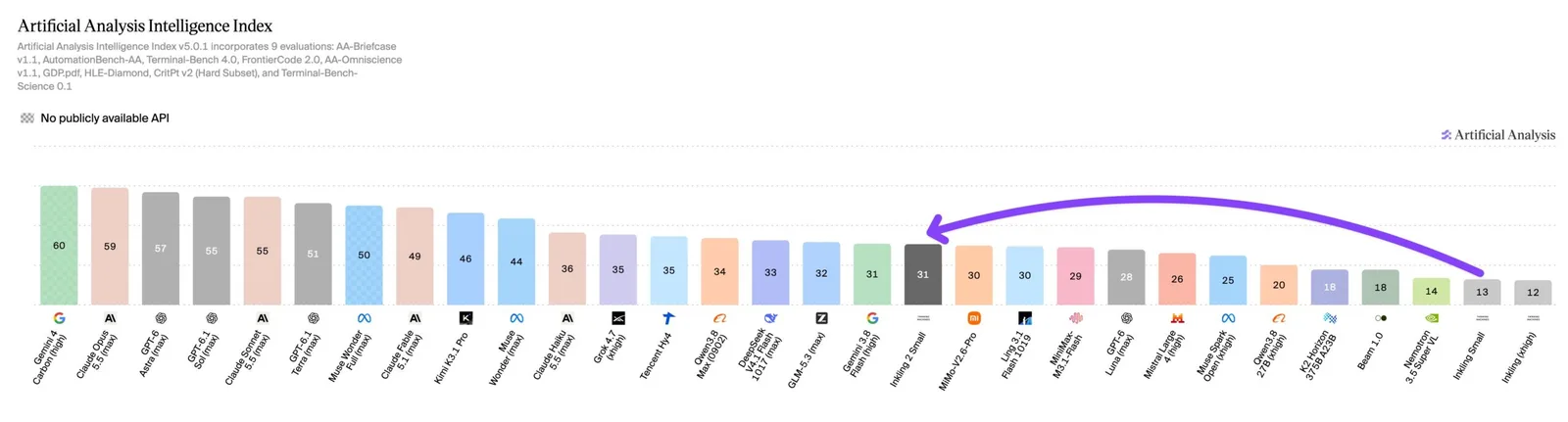
On the Artificial Analysis Intelligence Index, Inkling 2 Small scores 31, an 18-point jump over the predecessor Inkling Small at 13 and roughly level with Google's Gemini 3.8 Flash. The largest improvements appear in agentic tasks, where the model executes multi-step workflows on its own. On AutomationBench-AA the score rises from 5 to 46 percent, and on FrontierCode 2.0 it climbs from 5 to 25 percent. On the knowledge-work benchmark AA-Briefcase, the model reaches 1,527 Elo, 615 points above its predecessor.
The hallucination rate drops from 61 to 27 percent, though Thinking Machines attributes much of that to the model answering fewer questions: the response rate falls from 77 to 53 percent. Readers weighing the hallucination figure should treat the lower response rate as part of the explanation rather than a pure accuracy gain.
Cost Profile: Higher Tokens, Still Cheaper Than Rivals
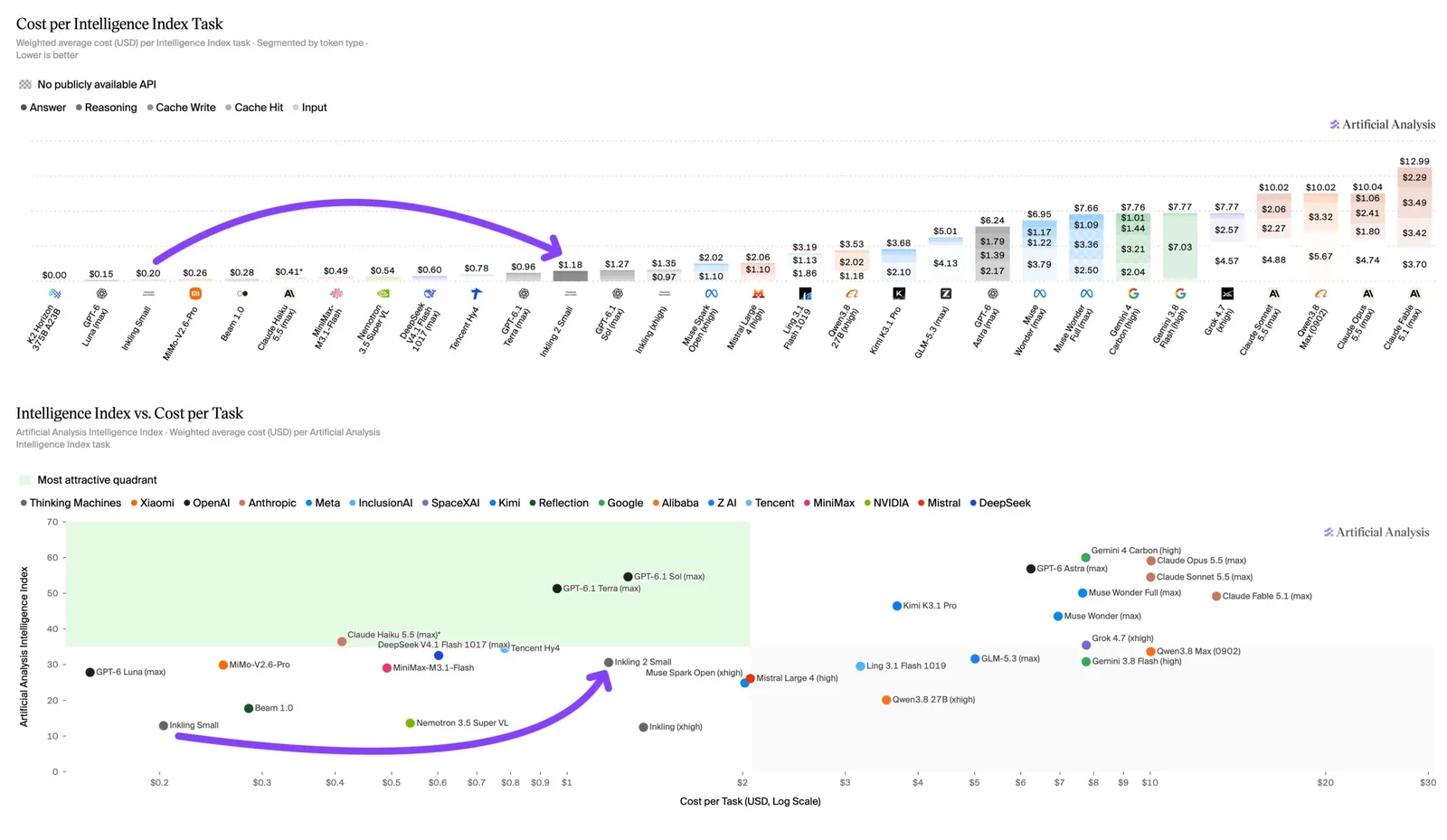
The stronger results come partly at the cost of higher token usage. Inkling 2 Small produces roughly 150,000 output tokens per task on average, about four times as many as its predecessor. At $1.18 per task it costs nearly six times as much as the earlier model, according to Artificial Analysis. That still sits far below Gemini 3.8 Flash at $7.77 per task and Claude Sonnet 5.5 at $10.02, and lands closer to the price range of low-cost Chinese models. On Artificial Analysis' quadrant chart, the model sits in the low-cost, high-intelligence corner.
Coding and Vision: Strong Open-Weight Results, DeepSeek Still Leads Some Tests
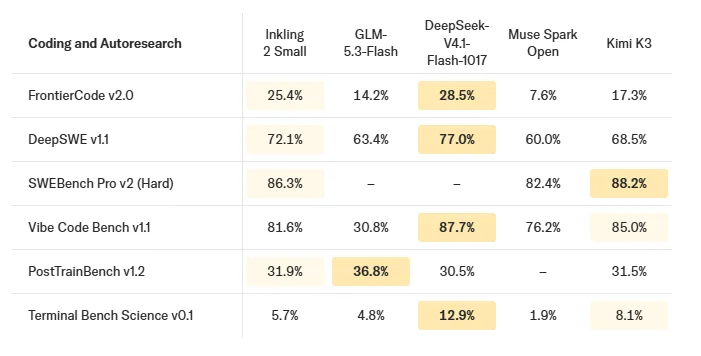
Thinking Machines trained the model with reinforcement learning on hundreds of thousands of long-horizon coding tasks, using an automated evaluation system to check whether code worked and how the model approached each task. On FrontierCode 2.0, Inkling 2 Small reaches 25.4 percent; on DeepSWE, 72.1 percent; and on SWEBench Pro v2 (Hard), 86.3 percent. Deepseek-V4.1-Flash still leads on most of those tests, hitting 28.5 percent on FrontierCode and 77 percent on DeepSWE, while Kimi K3 narrowly tops SWEBench Pro v2 (Hard). The newer Kimi K3.1 Pro is absent from the comparison.
Thinking Machines says the model is strongest in text recognition, infographic interpretation, and visual reasoning. On GDP.pdf, a document benchmark that tests answering questions from complex PDFs, it scores 25.2 percent, the highest among compared models. On MMMU Pro, which tests multimodal understanding of academic tasks involving diagrams and figures, it reaches 81.6 percent. On PerceptionBench, which tests visual perception, it leads with 64.7 percent. For visual creation, it earns a 1,340 Elo rating on DesignArena Website, where users rate AI-generated websites in head-to-head comparisons, the highest among open-weight models. Thinking Machines also reports progress in 3D modeling.
In an unusual demonstration, the team pitted the model against its own researchers in a blind wine tasting; working from a photo alone, Inkling 2 Small correctly identified three wines in 19 out of 20 attempts.
Training Efficiency and Known Weaknesses
The total training run is compact relative to competitors. Across all phases the model processed about 12 trillion tokens, according to Thinking Machines, far fewer than comparable rivals. The reinforcement-learning phase after base training needed only 3 trillion tokens on 2,048 GPUs over nine days.
The company acknowledges shortcomings: the model sometimes communicates inefficiently, does not always pick the best tools for large codebases, lacks audio support, is less optimized for chat, can overreact to health-related topics, and can produce cluttered output.
What to Watch Next: Apache 2.0 Weights and More Variants
Thinking Machines plans to release the weights under an Apache 2.0 license once external safety testing wraps up. That is one of the most permissive open-source licenses and an advantage over more restrictive open-weight licenses such as those from Meta or Mistral. The company says Inkling 2 Small belongs to a family of different sizes and plans to release more variants soon. The immediate question for builders is whether the per-task cost premium over the predecessor is justified by the agentic gains; the next milestone to track is the weight release and how fine-tuned derivatives perform outside Thinking Machines' own evaluations.
Comments
No comments yet. Be the first to comment.