
Adobe is evaluating how effectively AI agents can operate editing tools the way a Photoshop professional would.
EditAgent compares 600 AI image edits with measured verification records, helping judges pick usable results and improving open-source editors.
Key Takeaways
- Adobe EditAgent is an AI image-editing agent that uses a standard language model to choose better edits by comparing candidates with measured evidence, such as close-up crops, change maps, and brightness/color statistics, rather than relying on visual judgment alone.
- Tested on 600 image edits, the study found that the general-purpose editor Flux-2-Klein-9B failed to produce usable results 42.7% of the time, while specialized tools fixed about two-thirds of those failures, especially for tasks like sharpening, rotation, and zooming.
- EditAgent generates multiple edit candidates in parallel from the original image, with a language model comparing them in one pass; professionals preferred parallel candidates over step-by-step refinement in 78.5% of comparisons, and the agent also checks whether later edits undo earlier ones.
- The verification records significantly improved judging: all seven tested language models outperformed fine-tuned judges when given measured evidence, and Qwen3.8-27B selected a usable edit 81.3% of the time, suggesting what a judge sees may matter more than how it was trained.
- EditAgent improved open-source editors, outperformed other AI agents on benchmarks, and generated about 26,000 verified training examples, though it requires roughly ten times more compute than a single editor, with direct relevance to Adobe’s AI agents in Creative Cloud products.
Adobe EditAgent Uses 600 Tests to Pick Best AI Image Edits
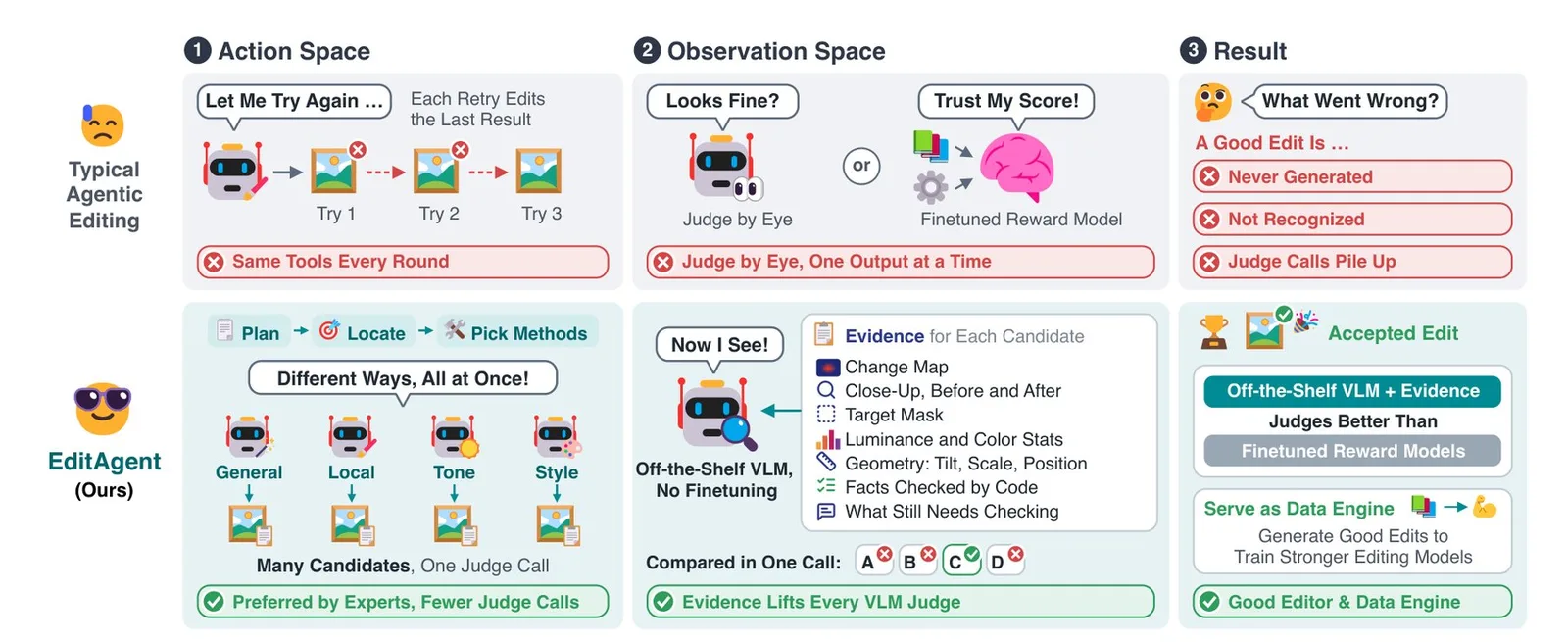
Adobe EditAgent, built by researchers at Adobe Research and UC San Diego, is an AI agent for image editing that has a standard language model compare candidates using measured evidence rather than a purely visual judgment. The approach was tested on 600 image edits, a benchmark in which the general-purpose editor Flux-2-Klein-9B produced no usable result 42.7 percent of the time. For users of image-editing agents, the paper raises a practical question: can a model become a better judge when it sees close-up crops, change maps, and brightness and color statistics?
Background: General-purpose editors miss specialized tasks
Earlier image-editing agents often decompose a request into steps, repeat failed steps with the same tool, and leave another model to assess the result by looking at it. In the new paper, five professionals rated 600 edits without knowing which system made each result. Flux-2-Klein-9B failed to produce a usable result 42.7 percent of the time. Specialized tools solved roughly two-thirds of those failures, especially for sharpening, rotation, and zooming. More retries with the same editor barely helped.
The researchers also compared two improvement paths: step-by-step refinement and parallel candidate generation. Step-by-step refinement builds on an already altered image, which can accumulate small errors. In comparisons where professionals chose a side, they preferred parallel variants generated from the original in 78.5 percent of cases. The agent needed only half as many evaluation passes. EditAgent is built on these two findings.
Development process: Parallel candidates and measured verification
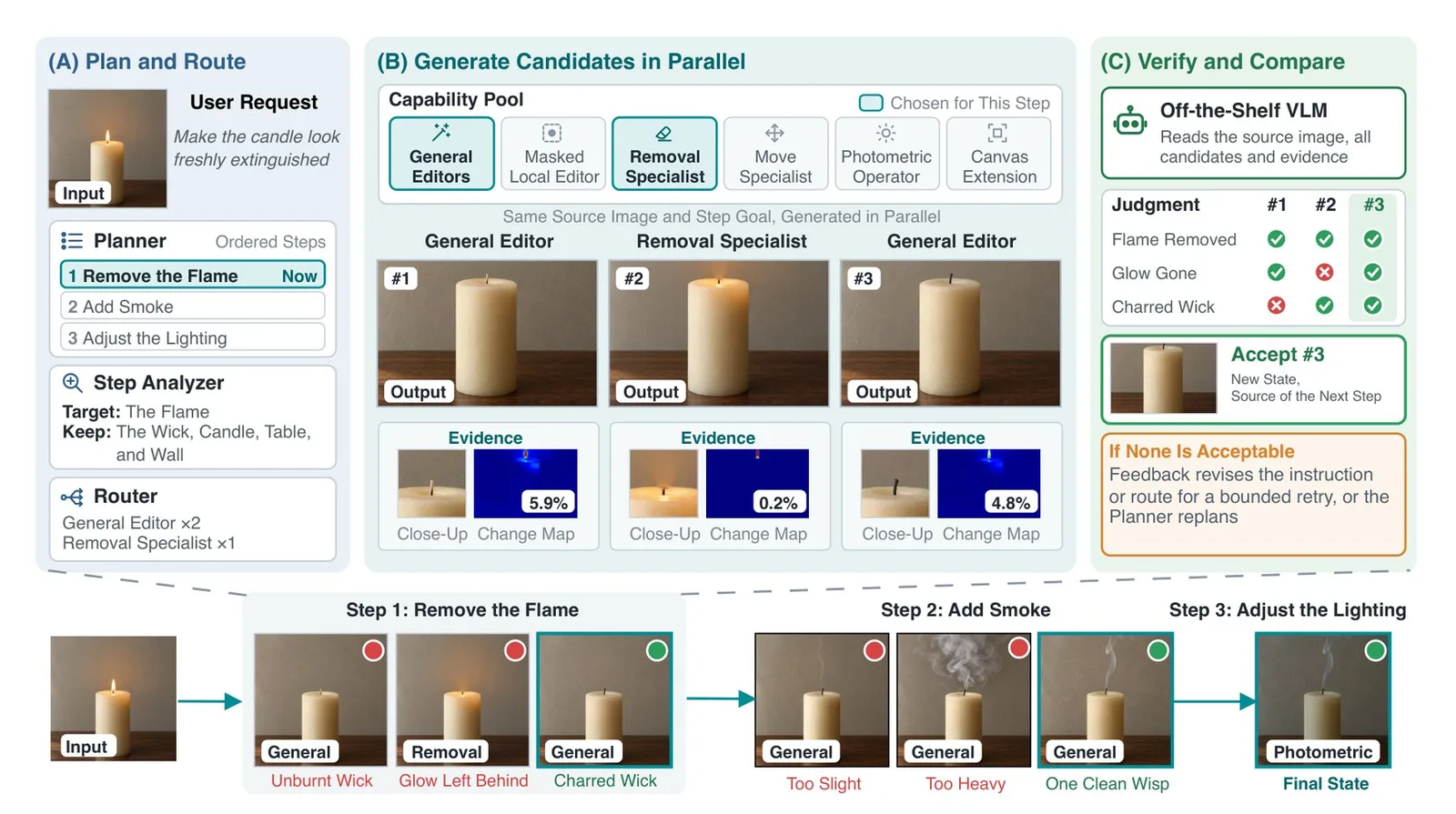
EditAgent turns a request into dependent steps. For every step, EditAgent runs the general-purpose editor side by side with task-matched specialized tools, creating several candidates at once instead of looping through retries. A standard language model then compares all candidates in one pass.
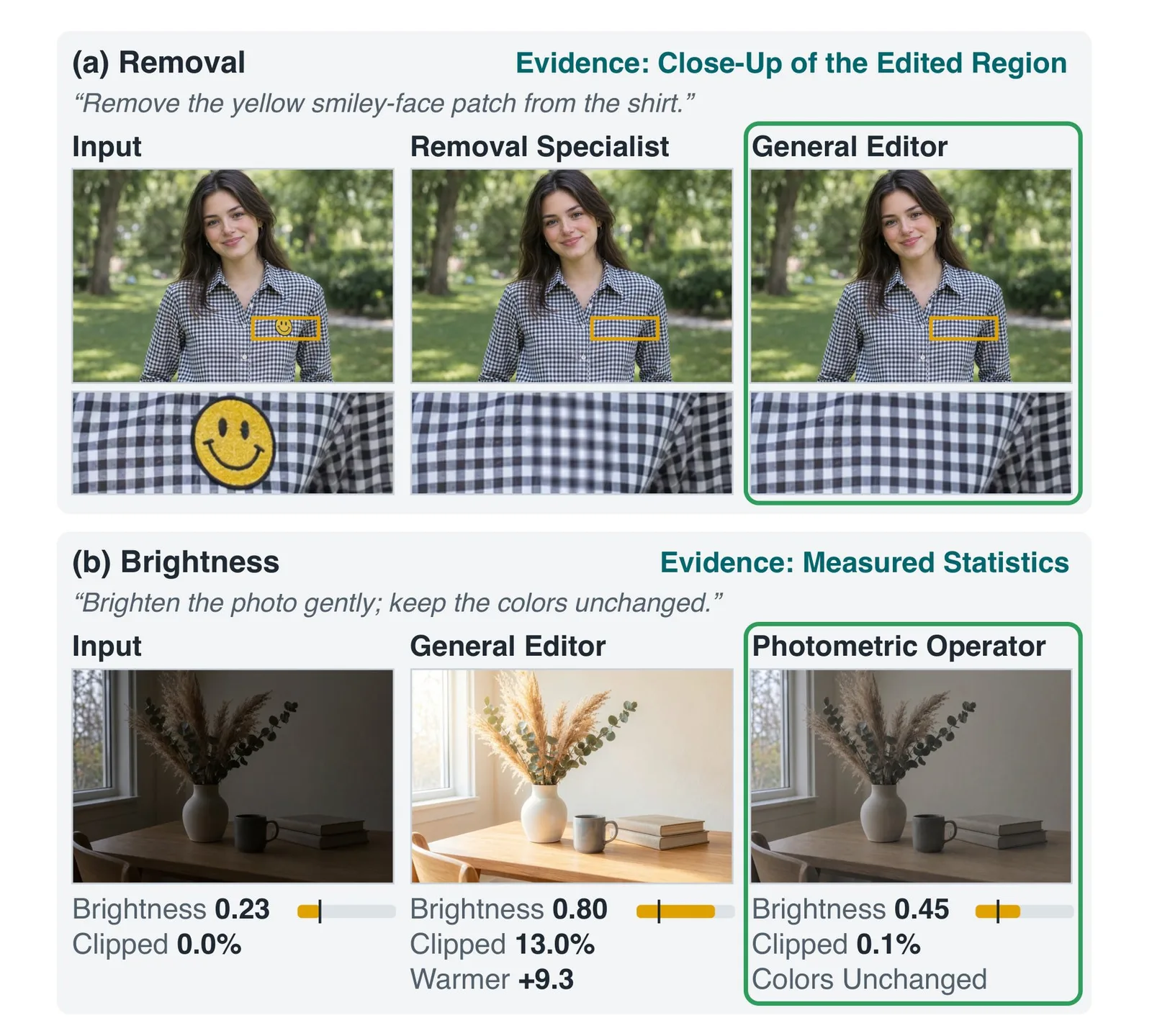
Each candidate is paired with a verification record. The record includes a close-up of the edited area, a change map of altered regions, and measured statistics on brightness and color. In one example, a photo was supposed to be gently brightened. The measured statistics showed that the general-purpose editor overexposed the image and shifted colors warmer, while the specialized tool stayed within spec. The paper says these records reveal errors that a language model can miss when judging only the full image.
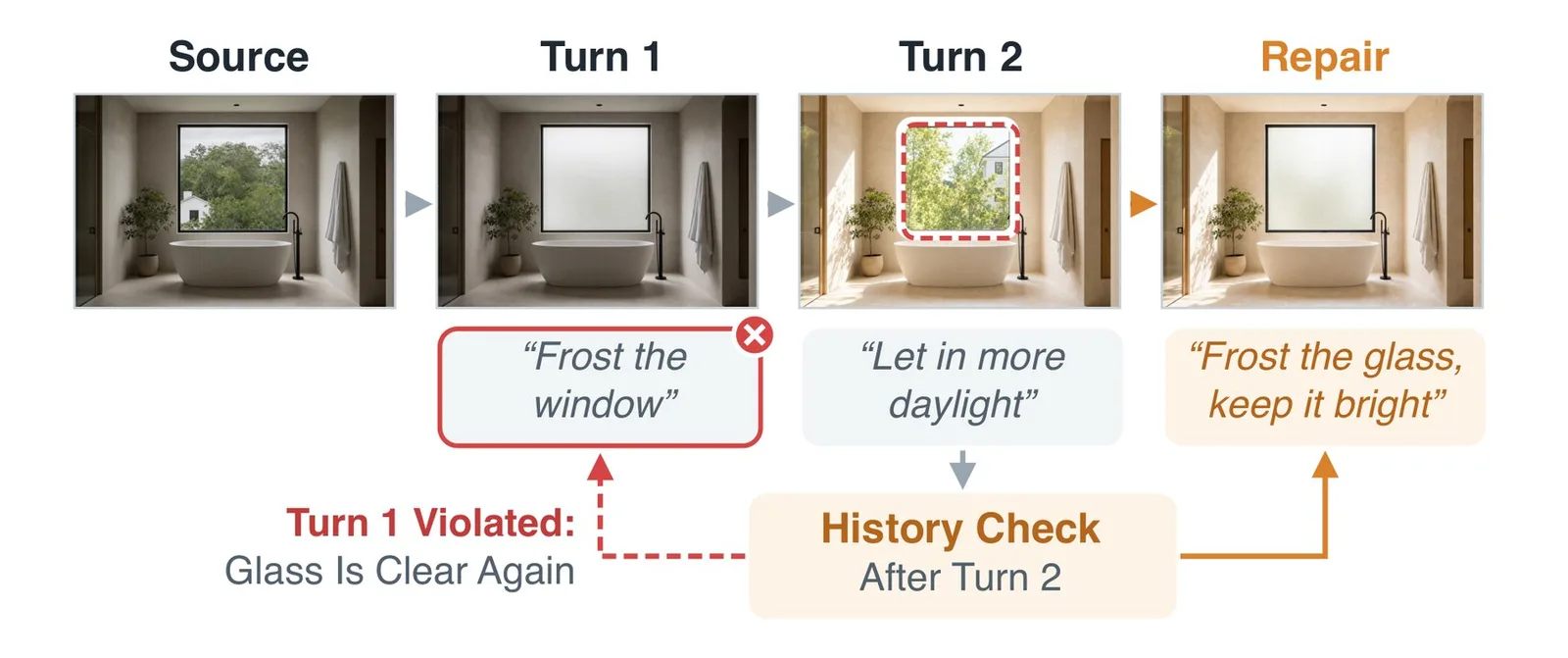
After each round, EditAgent also checks whether later edits accidentally undo earlier ones. In the paper's example, the instruction "let in more daylight" makes a previously frosted window clear again. The agent catches the conflict and fixes it.
Latest progress: Benchmark wins, training data, and product context
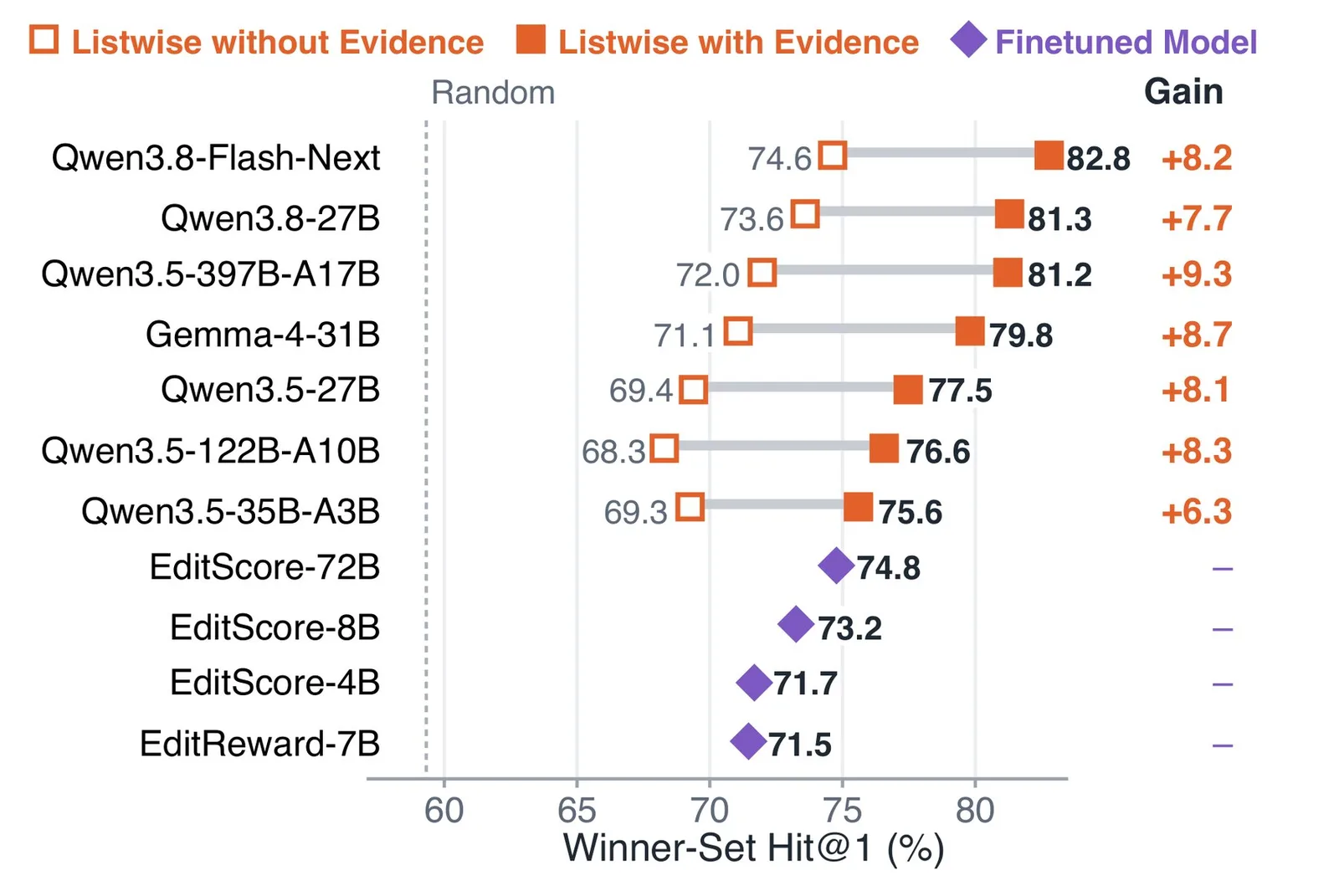
On the 600-edit benchmark, the judge model selected the best candidate from several options. Researchers counted how often its selection was also rated usable by the professionals. Without the verification record, none of the seven language models tested could match the best fine-tuned model. With the record, all seven beat every fine-tuned model, including EditScore-72B, which reached 74.8 percent. Qwen3.8-27B made a usable pick 81.3 percent of the time. The researchers suggest that what a judge model sees can matter more than how it was trained.
EditAgent improved the open-source editors Qwen-Image-Edit-2511 and Flux-2-Klein-9B across three benchmarks and outperformed seven other AI agents. On the EdiVal benchmark, the Qwen variant in its third editing round edged past the commercial models Seedream 4.0 and GPT-Image-1.5. The agent needs about ten times as much compute as a single editor, and its performance depends on which tools are plugged in.
The researchers also used EditAgent as a training-data source. Because the agent keeps only verified results, it produced about 26,000 training examples. Editors fine-tuned on that data performed better across all three benchmarks. Training data generated directly by FLUX made FLUX worse. That tradeoff could make the agent's high compute costs worth it over time.
Adobe added AI agents to Photoshop, Premiere, and other Creative Cloud apps in June, starting as a public beta. Users describe what they want, and the agent handles individual steps. The paper's questions about tool selection and output checking apply directly to Adobe's shipping products. Black Forest Labs has since replaced the general-purpose model tested in the paper: the new Flux 3 Image Klein has 5.6 billion parameters, smaller than Flux 2 Klein, yet it scores higher than all other open models and even the commercial Flux 2 Pro in Black Forest Labs' internal tests.
The paper presents EditAgent as a research system with measurable benchmark gains and a large compute penalty. It shows that verification data can turn standard language models into stronger image-editing judges, while its training-data results point to a possible way to make faster editors better over time.
Meta Description: Adobe EditAgent uses 600 tests and measured verification data to help language models pick better AI image editing results than fine-tuned judges.
Tags: Adobe EditAgent, AI image editing, benchmark 600, verification data, Qwen3.8-27B
Featured image: abstract technology style, layered image-editing candidates and measured data maps, no real people, no company logos, no text.
Comments
No comments yet. Be the first to comment.