
GraphDecisionBench: A Benchmark for Evaluating System One Models on Graph Tasks
GraphDecide benchmarks choice-based System One graph decision models and exposes gaps between adjacency recognition and structural reasoning.
Key Takeaways
- GraphDecisionBench is a model-independent benchmark for evaluating choice-based “System One” graph decision models, comparing Jev with language-model baselines across fourteen interface configurations.
- It combines structural task profiles, graph-text input contrasts, and heuristic-proposal controls to distinguish genuine structural reasoning from surface-level pattern matching.
- Jev’s results show that strong adjacency recognition does not necessarily lead to broader structural correctness, and adding graph-text input does not consistently improve predictions.
- The benchmark highlights that feasible construction alone does not guarantee high solution quality, exposing failure modes rather than producing a single headline score.
- Future value depends on broader adoption of its task contracts and scoring rules, plus follow-up work explaining why adjacency accuracy and structural correctness diverge.
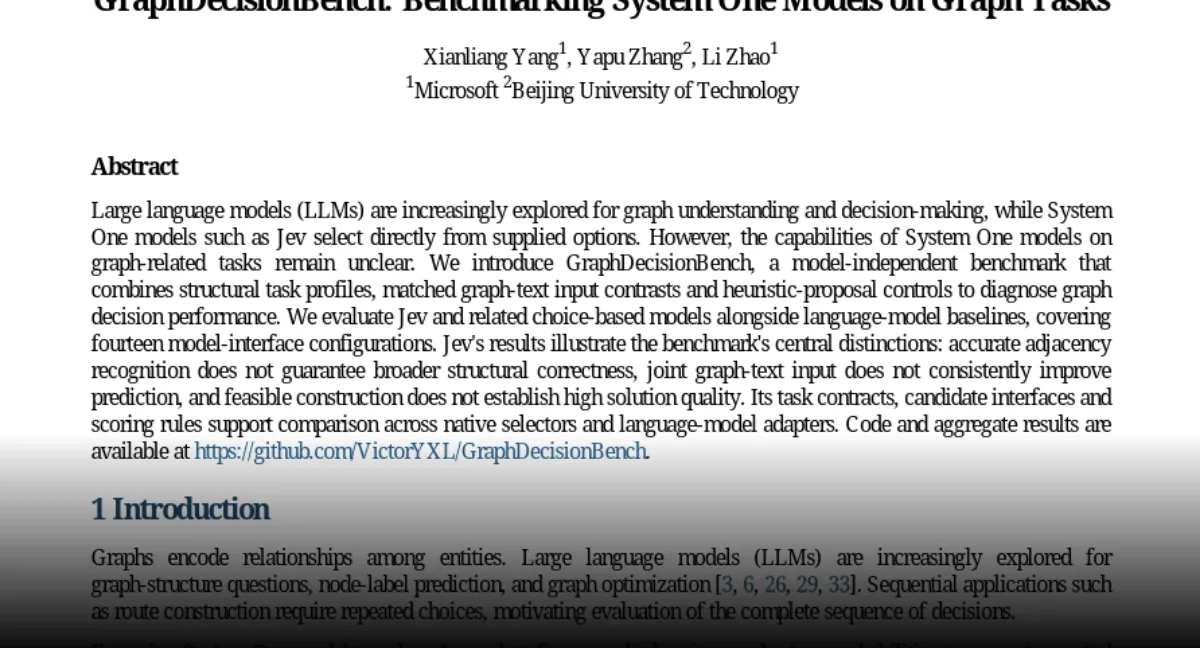
A new benchmark called GraphDecide has been introduced to evaluate how well choice-based "System One" models handle graph-related decision tasks. The work focuses on Jev, a System One model that selects directly from supplied options, and compares it against language-model baselines across fourteen model-interface configurations. The central finding is that strong adjacency recognition does not translate into broader structural correctness, and that adding graph-text input does not reliably improve predictions.
Background: Why Graph Decisions Are Hard to Measure
LLMs are increasingly explored for graph understanding and decision-making. System One models such as Jev take a different route: instead of generating answers, they select directly from provided options. But how capable these selectors are on graph tasks has remained unclear. GraphDecide is designed as a model-independent benchmark to diagnose that gap.
How the Benchmark Works
GraphDecide combines three elements: structural task profiles, matched graph-text input contrasts, and heuristic-proposal controls. This design allows comparison across native selectors and language-model adapters through task contracts, candidate interfaces, and scoring rules. The setup is intended to separate genuine structural reasoning from surface-level pattern matching.
What Jev's Results Show
Jev's performance illustrates the benchmark's central distinctions. First, accurate adjacency recognition does not guarantee broader structural correctness. Second, joint graph-text input does not consistently improve prediction. Third, feasible construction does not establish high solution quality. These three points frame the benchmark's purpose: to expose where decision performance breaks down rather than to produce a single headline score.
What to Watch Next
Code and aggregate results are available at https://github.com/VictorYXL/GraphDecisionBench. The benchmark's value will depend on whether other choice-based models and language-model adapters adopt its task contracts and scoring rules, and whether follow-up work can explain why adjacency accuracy and structural correctness diverge.
Comments
No comments yet. Be the first to comment.