
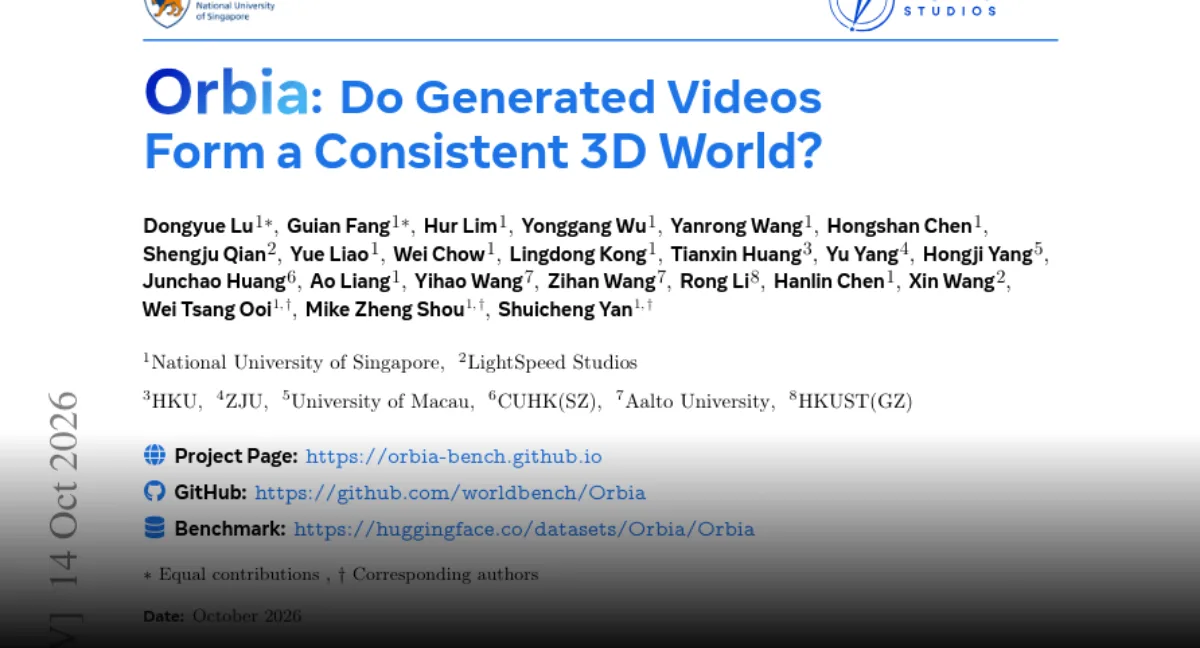
Orbia: Do Generated Videos Create a Coherent Three-Dimensional World?
Orbia benchmarks 3D consistency in interactive video world models via exploration, revisits, preservation, persistence, and self-consistency tests.
Key Points
- Orbia is the first benchmark for systematically evaluating whether interactive video models create coherent three-dimensional worlds.
- Existing evaluations are limited because they test narrow geometric properties or rely on vision-language models rather than comprehensive 3D consistency.
- Orbia measures three dimensions: input preservation, persistence of generated content, and 3D self-consistency across views and time.
- The benchmark includes 720 indoor and outdoor instances, six exploration-and-revisit protocols, and evaluation of 27 text-, action-, and camera-conditioned models.
- Its main contribution is a measurement framework for comparing long-term 3D consistency, not a new video generator.
Video generators are increasingly treated as interactive worlds for exploration and simulation, but a visually convincing frame does not guarantee a coherent 3D scene. Orbia, described as the first benchmark dedicated to systematically and comprehensively evaluating 3D consistency in interactive world models, targets that gap. The work organizes evaluation around controlled exploration and revisit, splitting the problem into three dimensions: input preservation, generated-content persistence, and 3D self-consistency.
Why Existing Evaluation Falls Short
Prior benchmarks assess selected geometric properties or rely on vision-language models to judge memory and consistency. According to the authors, this leaves systematic 3D evaluation underexplored. Orbia is positioned as a response to that shortfall, providing a structured basis for diagnosing 3D inconsistency and for developing more persistent video world models.
How the Three Evaluation Dimensions Work
For input preservation, registered RGB-D references and annotated anchors support measurements of appearance, geometry, and spatial stability.
For generated-content persistence, the benchmark compares revisits to regions absent from the input image against their first generated observations. This tests whether models preserve what they themselves create.
For 3D self-consistency, Orbia examines cross-view depth and feature correspondence, regional scale agreement, and held-out Gaussian rendering. Together these test whether generated views describe the same 3D scene. Minute-long exploration and revisits further test long-term consistency.
Dataset, Protocols, and Models Evaluated
The construction and annotation pipeline combines public datasets, self-captured scenes, and simulation. It yields 720 instances across indoor and outdoor environments, along with six exploration-and-revisit protocols. Evaluation spans 27 text-, action-, and camera-conditioned models through native-interface adapters.
What to Watch Next
Orbia's contribution is a measurement framework rather than a new generator. Its value depends on how widely the 27-model evaluation is reproduced and extended. For now, the benchmark offers a common reference point for comparing how well interactive video models hold a 3D world together over time.
Comments
No comments yet. Be the first to comment.