
AI agents are now able to handle your phone calls.
Grok Bot adds phone calls for paid users while voters back data center limits and Democrats win Congress, increasing scrutiny of agentic AI.
Key Takeaways
- Grok Bot can now make U.S. phone calls for paid users, handling hold times, appointment booking, and bill negotiations, while the user can intervene mid-call if needed.
- SpaceXSI places legal responsibility on the user as the “caller of record,” requiring the bot to disclose that it is a “virtual assistant” and comply with phone laws.
- The launch comes as U.S. midterm voters backed data center limits in 38 of 39 fully counted local measures and gave Democrats control of Congress, putting AI infrastructure under new scrutiny.
- Phone-based AI agents are becoming a key battleground because they automate tedious tasks, but raise questions about disclosure, consent, liability, and compute costs.
SpaceXSI has added phone-call capabilities to Grok Bot, its AI agent platform, letting paid users delegate hold times, appointment booking, and bill negotiation to a bot on U.S. numbers. The rollout lands in the same week that U.S. midterm voters backed data center limits in 38 of 39 fully counted local measures and handed Congress to Democrats, a combination that puts agentic AI and the infrastructure behind it under new scrutiny at the same time.

What Grok Bot's calling feature actually does
Grok Bot can now sit on hold, book appointments, and negotiate bills over the phone using U.S. numbers. When a representative asks something the bot cannot answer, the user receives a message mid-call and types a reply for the bot to pass along, all while following a live transcript of the conversation.
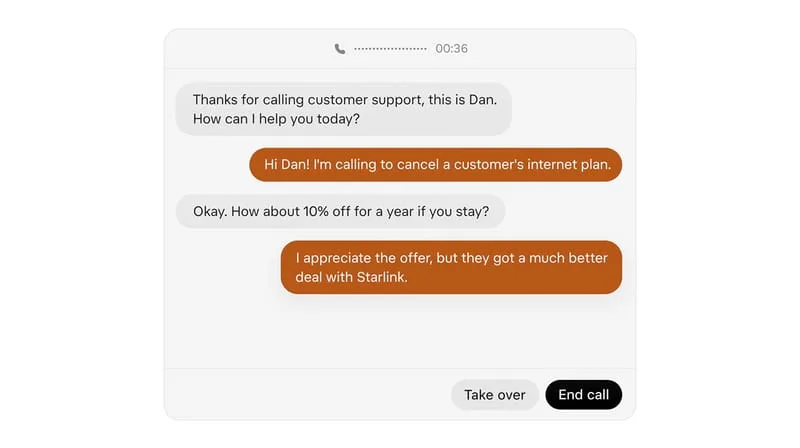
The calls appear to run directly inside the platform through a temporary number. Early examples cited include a Comcast bill negotiation and a pizza order.
SpaceXSI's terms place responsibility squarely on the user: the account holder is designated the "caller of record" and is "solely responsible" for calls and for compliance with phone laws. Bots disclose that they are a "virtual assistant" during calls. The feature is available to paid users, and Elon Musk responded to complaints about usage limits by describing the platform's cost as "unsustainably high relative to revenue."

Why phone calls are the next agent battleground
AI labs have spent the past two years pitching agents as a way to remove tedious life tasks from people's plates, and phone calls sit near the top of most lists. SpaceXSI says Grok Voice already answers 20,000 Starlink calls a day, giving the company a direct measure of how much phone traffic can be automated.
The direction of travel points toward bots talking to other bots — the phone equivalent of an agentic internet — which raises practical questions about disclosure, consent, and who bears liability when an agent misrepresents something on a recorded line. SpaceXSI's answer so far is to make the human the caller of record and require the bot to identify itself as a virtual assistant.

Voters draw a line on data centers
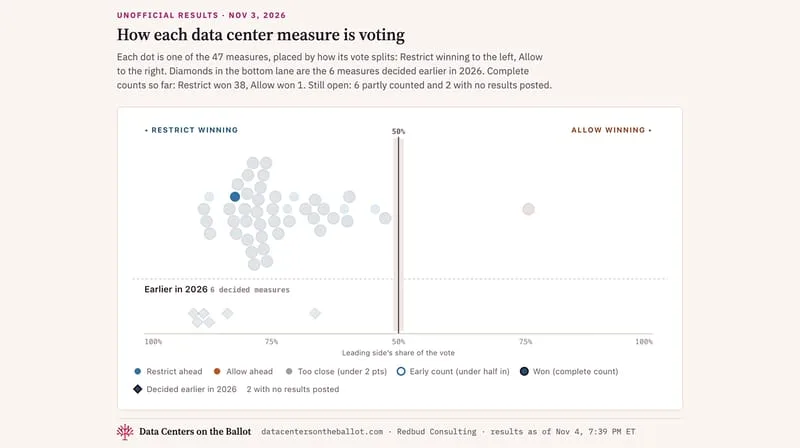
The same week, U.S. midterm voters backed limits on data centers almost everywhere those measures appeared on local ballots. According to election trackers, data center opponents took 38 of 39 fully counted local measures, with only Harwood, N.D., voting the other way.
In NBC's exit poll, 76% of voters said they would oppose a data center going up in their own community, and 57% said they expect AI to hurt society more than help. Goldman Sachs reportedly sees 45% of planned U.S. data center capacity at risk of temporary freezes, though it expects the political heat to cool over time.

Democrats, who will now run the hearings on AI regulation, won control of Congress. Elon Musk, the biggest midterm donor at $446M backing Republicans, posted after the results that data centers in space look "pretty appealing right now."

What to watch next
For readers, the two stories connect at the point of cost and permission. Agentic features like Grok Bot's calling capability depend on compute that is now politically contested at the local level, and the terms users accept — caller of record, sole responsibility, virtual assistant disclosure — are being written before any regulator has weighed in.

The near-term signals worth tracking: whether other agent platforms follow SpaceXSI into phone calls with similar liability language, how the 45% of planned U.S. data center capacity flagged by Goldman Sachs actually fares through local permitting, and what the new Congress chooses to examine first when AI oversight hearings begin.
Meta description: SpaceXSI's Grok Bot now makes phone calls for paid users, while U.S. midterm voters backed data center limits in 38 of 39 local measures and gave Democrats Congress.
Tags: Grok Bot, SpaceXSI, AI agents, data centers, U.S. midterms
Featured image: Abstract technology illustration of a phone handset formed from circuit lines against a dark blue gradient, no people, no logos, no text.
Comments
No comments yet. Be the first to comment.