
What are the ultimate limits of computing?
AI data-center spending is surging as scaling laws stall, but fundamental physics still allows progress if computing moves toward deeper limits.
Key Takeaways
- Core scaling laws such as Moore’s Law, Dennard’s Law, Kryder’s Law, and Keck’s Law are slowing or breaking, meaning chip performance gains from transistor shrinkage are no longer arriving as easily as before.
- The data-center buildout now buys computing power largely by brute force—adding more chips, memory, cooling, and electricity—rather than by making each chip fundamentally better.
- AI training compute has grown far faster than Moore’s Law since 2010, but most of that growth comes from scaling systems, not from continued transistor miniaturization.
- Today’s computers are still far from the true physical limits of computation, including Landauer’s energy-erasure limit, Lloyd’s ultimate-laptop bound, and Bekenstein’s information-capacity limit.
- The remaining room for improvement is enormous in principle, but reaching it requires both advanced engineering and deeper fundamental science, not just faster chip shrinking.
Meta description: Six hyperscalers will spend over $700 billion on data centers this year as Moore's Law, Dennard's Law and Kryder's Law stall. Physics shows how much room remains.
Tags: Moore's Law, data centers, computing limits, Landauer limit, AI compute
In December 1959, Richard Feynman told an American Physical Society meeting at Caltech that there was "plenty of room at the bottom"—that no physical law blocked us from writing the Encyclopædia Britannica on a pinhead or arranging matter atom by atom. For decades, the chip industry descended into that space almost for free. That descent has now stalled, and the clearest evidence is the data-center buildout: six of the largest hyperscalers are on track to spend more than $700 billion this year on computing infrastructure, roughly twice the record they set in 2025, pouring concrete, copper and silicon into new sites faster than the electrical grid can supply them. That spending buys performance by brute force. The other kind of progress—the kind that made chips better—is quietly running out.
The scaling laws are bending
The trend lines of the 20th-century information age are bending or breaking. Moore's Law, which plots transistor density on silicon, has slowed. Dennard's Law—power consumption per patch of chip staying flat as transistors shrink—has ended. Koomey's Law, tracking computation per joule, has begun to flag. Kryder's Law, on magnetic storage density, has slowed to a crawl. Keck's Law, charting the information a single optical fiber can carry, is flattening.
These are observations about engineered systems, not fundamental physics. The true physical limits—set by quantum mechanics, general relativity and information theory—lie far below anything in a data center today. The scaling laws chart the descent behind us; the physical limits chart the room that remains. Work toward them pays twice: once in technology, once in fundamental science.
From Feynman's prizes to the first transistor
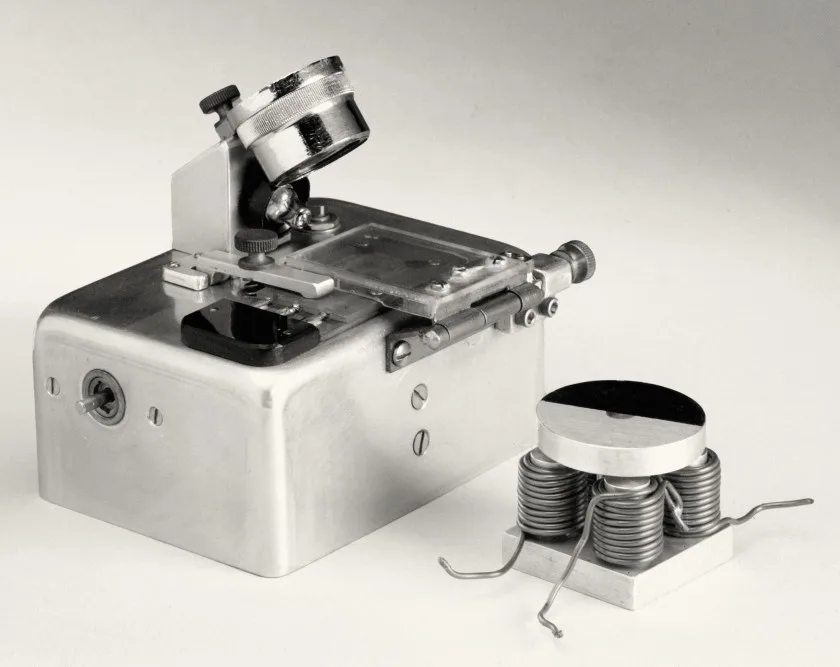
Feynman offered two $1,000 prizes from his own pocket. The first, for a working electric motor smaller than a 0.4-millimeter cube, went about a year later to William McLellan, a Caltech-trained engineer who hand-assembled a quarter-milligram machine the size of a grain of sand using a toothpick and a watchmaker's lathe under a microscope. It proved the point without requiring new technology—just steady hands.
The second prize, for shrinking a page of text 25,000 times in each direction, stood unclaimed for a quarter century. Tom Newman, a Stanford graduate student, won it in 1985 using an electron-beam lithography machine, an ancestor of today's chipmaking pattern tools, to transcribe the opening page of A Tale of Two Cities at the required scale.
The descent was already underway. In July 1958, Jack Kilby, newly hired at Texas Instruments with no vacation yet to take, worked nearly alone in the lab; by September he had wired a transistor, a capacitor and three resistors from a single sliver of germanium, proving an entire circuit could be carved from one block of semiconductor. Gordon Moore, in a 1965 trade-magazine article, drew a line through the doubling trend and extended it—and Moore's Law was born. Moore never claimed transistors could shrink forever; he observed that a cost-minimizing number of components per chip (50 in 1965) was doubling steadily. Too few wastes the chip; too many collapses yields.
Dennard scaling supplied a further gift for four decades: each shrink brought faster switching and proportionally less power. Around 2004 the gift ran out. Chips could no longer shed the heat of running every transistor flat out; clock speeds stalled past three gigahertz, and Intel canceled its promised four-gigahertz processor. The industry pivoted to multiple cores, and progress changed texture. Today it is bought mostly by scaling systems—more chips, more memory, more power and cooling—rather than by shrinking transistors. Training compute for AI has doubled roughly every six months since 2010, far faster than Moore's Law allows, but little of that comes from shrinking. Each new generation arrives more slowly and pays back less.
How far the descent has already gone
In nearly eight decades since the first transistor, density has grown 10 orders of magnitude—a factor of 10 billion—with more than 100 million transistors per square millimeter (100 billion or more per chip). Computational speed has grown 12 orders of magnitude, a factor of a trillion. Energy per operation has fallen 17 orders of magnitude, from about 100 joules for an early vacuum-tube machine to a femtojoule—one-quadrillionth of a joule—for a single logic-gate switch.
The floor lies lower still. Around the turn of the millennium, MIT physicist Seth Lloyd asked how much computing physics could ever wring from a kilogram of matter packed into a liter—about the mass of a laptop. In his 2000 Nature paper "Ultimate physical limits to computation," he called the imaginary machine the ultimate laptop. Its speed is governed by energy: a kilogram holds about 9 × 10^16 joules under E = mc², roughly what the entire United States draws from its grid every two days. Spent entirely on computation, that yields about 5 × 10^50 operations per second, some 35 orders of magnitude faster than a leading chip today. The catch: concentrating that rest energy into computation would turn the machine into a plasma of about a billion degrees, closer to the early universe than to a laptop.
Closer is the energy-waste limit. In 1961, IBM physicist Rolf Landauer showed that erasing a single bit must release at least about 2.9 × 10^-21 joules at room temperature. A chip today spends several hundred thousand times that on every switch. Memory obeys a limit reaching to gravity: in 1981, Jacob Bekenstein, working out black-hole thermodynamics, found that information inside any bounded region is capped by its size and energy—about 10^42 bits for a region the size of Lloyd's ultimate laptop, some 10^36 per cubic millimeter, nearly 30 orders of magnitude beyond today's storage. Communication has its own ceiling: in 1973, Soviet mathematician Alexander Holevo determined the ultimate limit on information a stream of quanta can convey. A single one-watt channel at the Holevo limit could deliver on the order of 10^17 bits per second; today's optical interconnects deliver about one-millionth of that for the same power, a gap narrowing quickly inside data centers as each generation moves more bits on less power.
What the limits mean
Four limits mark the true bottom, derived from three fundamental theories: quantum mechanics sets computing speed, general relativity caps memory, and information theory limits both communication rate and the minimum energy of an irreversible step. No road map exists to reach them, and they hold whether or not anyone tries. Measured against them, the descent has barely begun—the largest gap, in computing speed, spans 35 orders of magnitude between today's technology and the physical ceiling.
For readers, the practical takeaway is that the $700 billion buildout and the stalled scaling laws are two faces of the same story: performance now comes from systems and spending rather than from physics giving ground for free. Watch whether interconnect efficiency inside data centers keeps closing the Holevo gap, and whether chipmakers find ways to approach Landauer's floor—both would signal the next phase of the descent has begun.
Comments
No comments yet. Be the first to comment.