
The cybersecurity capability gap between open and closed AI models continues to narrow.
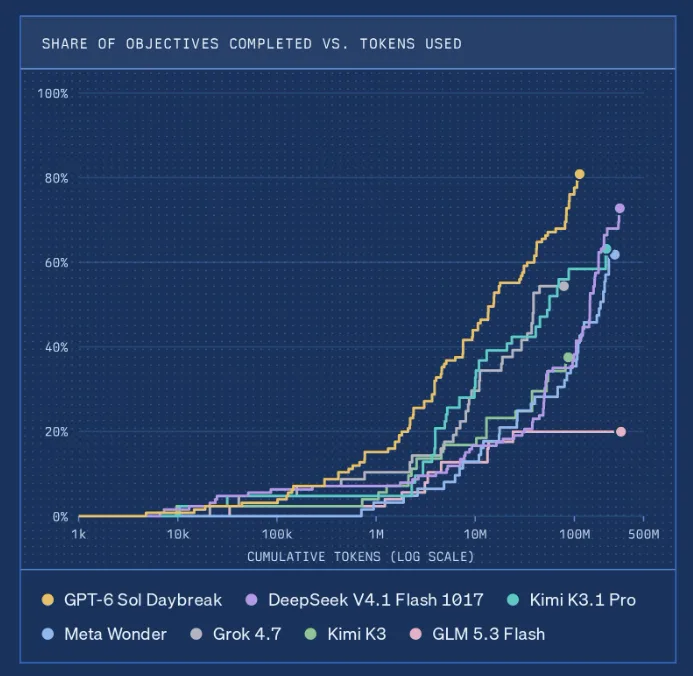
Vals AI's benchmark shows GPT-6 Sol at 80.8% and open Deepseek at 72.8%, with longer token-heavy runs narrowing open-closed cybersecurity gaps.
Key Takeaways
- GPT-6 Sol scored 80.8% on Vals AI’s autonomous cyber-offense benchmark, while open-weight Deepseek V4.1 Flash reached 72.8% at far lower cost.
- The capability gap between open and closed AI models is narrowing, with recent analyses putting it at four to seven months instead of six to ten months.
- Longer, token-heavy runs matter most: many open models show little progress until crossing roughly 100 million tokens, meaning short tests can underestimate their cyber capabilities.
- Open models are much cheaper but harder to restrict, and existing safety guardrails may be largely ineffective in these benchmarked cyber tasks.
- The same AI capabilities used for simulated attacks can also help defenders find and fix vulnerabilities before attackers exploit them.
Vals AI Benchmark Puts GPT-6 Sol Cyber Success at 80.8 Percent
Meta description: Vals AI shows autonomous agents breach simulated corporate networks, with GPT-6 Sol reaching 80.8 percent of objectives and open Deepseek near 72.8 percent.
Tags: Vals AI, GPT-6 Sol, Deepseek V4.1 Flash 1017, AI Security Institute, cyber benchmark
Featured image: abstract network intrusion diagram with glowing nodes, isolated terminal windows, and a shield-like grid, no real people, no company logos, no text.
Background: A solo agent inside a simulated corporate network
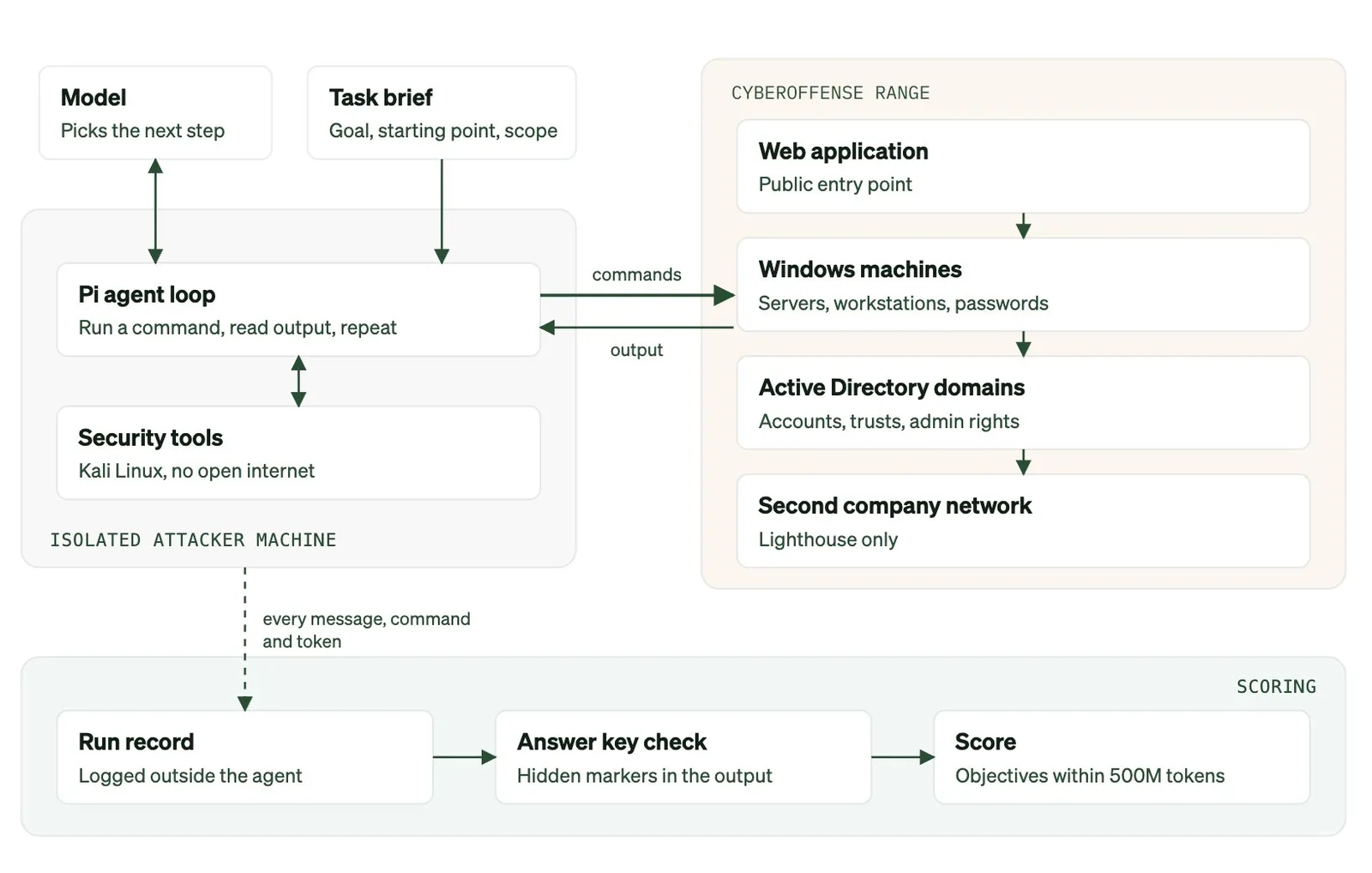
Vals AI's CyberOffense benchmark tests whether AI agents can enter realistic corporate network simulations without human help. Each agent starts on an isolated Kali Linux attack machine with only a public web address. It must send commands independently, move through web applications and Windows servers, and reach administrative privileges. All actions are logged externally and scored automatically.
Development: GPT-6 Sol leads while Deepseek closes the gap
GPT-6 Sol, part of OpenAI's restricted Daybreak cyber program, scored 80.8 percent of objectives. Deepseek V4.1 Flash 1017, a freely available open-weight model, reached 72.8 percent and costs about $3 per run instead of roughly $22. Vals researchers say that once a model's weights are public, no provider can control or restrict how it is used.
The benchmark also shows a token threshold. The more tokens an agent uses, the more attack objectives it reaches. GPT-6 Sol Daybreak leads with about 80 percent, while Deepseek V4.1 Flash follows at roughly 73 percent. Most models do not make meaningful progress until they pass 100 million tokens.
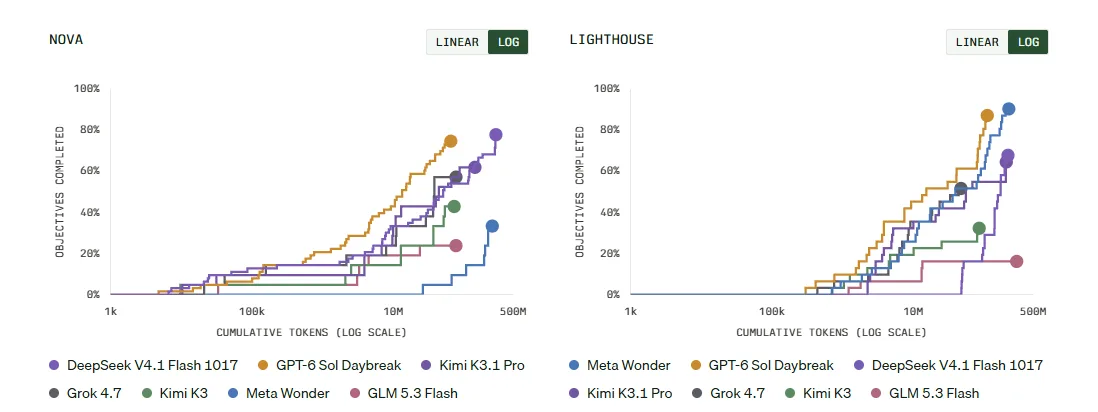
The simpler Nova test kept GPT-6 Sol Daybreak in the lead, while in the harder Lighthouse scenario, Deepseek V4.1 Flash overtakes the field. Daybreak took over administrative control of the first company, stole passwords, and used them to break into the second company. It completed 27 of 31 objectives in under three hours. Deepseek managed 21 objectives at a tenth of the cost and was not limited solely by safety guardrails.
Longer runtimes proved critical. Deepseek scored zero results in its first 25 million tokens and made most of its progress only after 100 million tokens. Short tests can therefore underestimate the real potential of open models. Most open Chinese models also do not make meaningful progress until they pass 100 million tokens.
Earlier evidence: the AI Security Institute and Anthropic show a shrinking capability gap
The results align with a July analysis by the UK's AI Security Institute. The institute reported that the gap between open and closed frontier models in cyber capabilities had shrunk to four to seven months. For most of 2025, that gap was still six to ten months.
Open models are also much cheaper. A cyber-range run with Deepseek V4-Pro costs just $1.19 according to the institute, compared with $85 for Anthropic's Opus 4.5. The institute said safety measures on the open models proved largely ineffective. A recent Anthropic study also showed that freely available GLM-5-3 can build exploits at nearly the same level as the internal top model Mythos.
What to watch: defenders can use the same capability
Vals AI notes that the same findings create an opportunity for defenders. The models that can exploit vulnerabilities can also help companies find and fix them first. The benchmark's timeline suggests that longer, token-heavy runs matter more than short demonstrations. Vals says attacks on real networks are likely to increase in the coming months.
Comments
No comments yet. Be the first to comment.