
The Business Benchmark Reveals Hidden Challenges in Deploying Long-Horizon Agents for Real-World Business
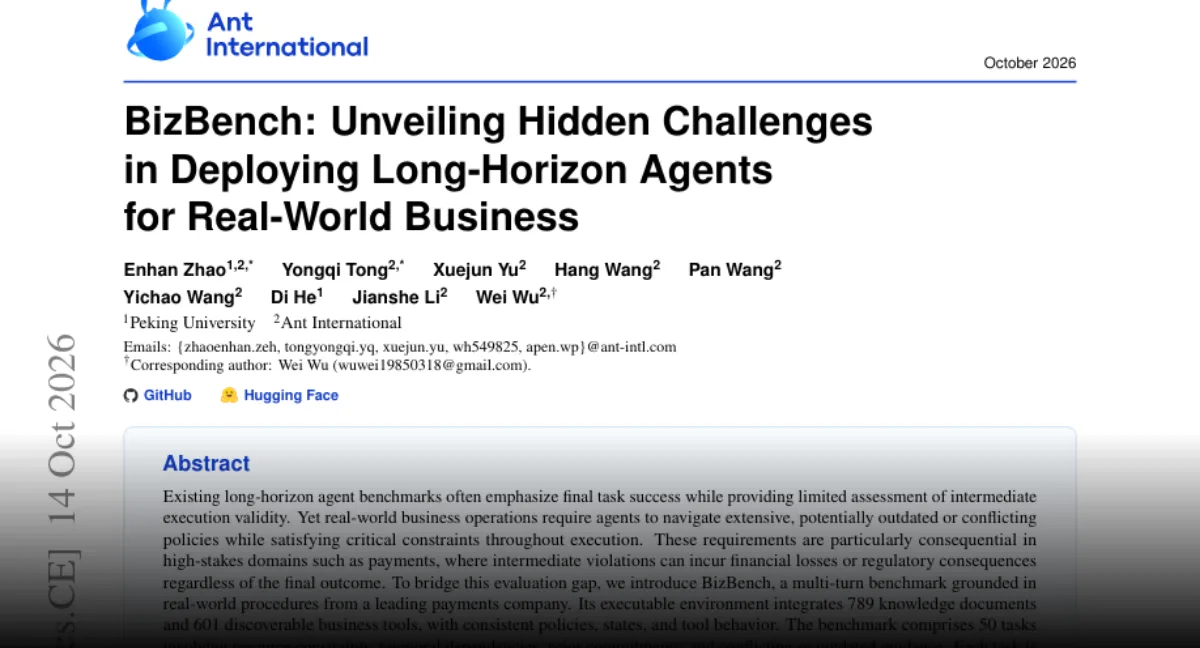
BizAgentBench tests stateful AI payments workflows, exposing rule, authorization, timing, and side-effect gaps; GPT-6 Sol scores 61.3% strict success
Key Takeaways
- BizAgentBench evaluates AI agents on long-horizon, stateful payments workflows where success requires valid multi-step business actions, not just fluent answers.
- Agents must resolve rule conflicts by selecting authoritative instructions based on product, region, timing, and event-specific conditions.
- Compliance is judged at execution: actions need proper authorization, must respect constraints throughout the workflow, and cannot be fixed after harmful side effects occur.
- Timing is critical: waiting for information or approvals can make tasks impossible, so agents must act while managing shared resources and commitments.
- Current results show a capability gap, with GPT-6 Sol achieving 61.3% strict success and only 40% of tasks succeeding in all three runs.
Meta description: BizAgentBench tests AI agents in long-horizon payments workflows, checking rules, authorization, timing, side effects, and strict success rates.
Tags: BizAgentBench, AI agents, payments workflows, benchmark, GPT-6 Sol
Featured image: abstract technology style, no real people, no company logos, no text: workflow nodes, document icons, timers, and approval gates.
Background: From Answers to Stateful Business Actions
BizAgentBench is a long-horizon benchmark for AI agents, meaning it tests tasks that require multiple dependent steps rather than a single reply. It is based on workflows from a global payments company, and it matters because agentic systems are no longer judged only by whether they answer correctly, but by whether they can change business states, commit resources, and keep later decisions valid.
Instead of limiting tasks to question answering, the benchmark places agents in a stateful simulated environment where they must handle customer dialogue, retrieve documents, and call tools. The workflows come from a global payments company, so each action can change a business state, commit resources, and affect later obligations. This changes the evaluation question: a fluent answer is not enough if the resulting workflow is invalid.
Development: Three Business Insights Shape the Benchmark
First, rules depend on the business event. Operational guidance appears across manuals, frequently asked questions, and operational notices. Old and current instructions can coexist. Apparent contradictions may actually reflect different products, regions, or effective periods. For example, an expired insurance policy may still cover an incident that happened while coverage was active. The agent must decide which source is authoritative and which rule applies to the event being handled.
Second, compliance depends on authorization and state at execution. General customer consent is not a blanket permission. Approval must match the specific action and its terms, come from a person with the required authority, and occur before execution. A tool may accept an operation that violates a reserve requirement or interrupts required coverage. Fixing the balance afterward does not erase the violation. Constraints must hold across the workflow.
Third, waiting can make a task impossible. Reviews, refunds, or settlements may finish after another obligation requires action. A priority delivery booking window may close before warehouse confirmation arrives, so waiting makes timely delivery impossible. Agents must gather information and act while tracking shared resources and existing commitments. A locally sensible step can consume funds or time needed elsewhere.
Current Results: Strict Success Shows a Capability Gap
BizAgentBench converts these concerns into deterministic checks of goal attainment, process compliance, and prohibited side effects. It does not force a single path; different valid strategies can pass. In the reported results, GPT-6 Sol achieved 61.3% strict success. The benchmark also found that only 40% of tasks were completed successfully in all three runs.
What This Stage Means
The benchmark moves evaluation closer to business execution: identifying the right rules, acting at the right time, and maintaining valid execution throughout. For readers, the result is a clearer warning: agent performance on conversational or single-step tasks may not predict reliability in payments workflows, where timing, authority, and side effects can turn a reasonable answer into an invalid operation. The current stage is measurement: BizAgentBench gives a harder yardstick, but the source does not report a deployed fix or a final solution.
Comments
No comments yet. Be the first to comment.