
Meta debuts Spaces, a new method for collaborating with your Muse agent
Meta adds Spaces to Muse agents, organizing AI chats into topic-based project experiences with app connections and voice video features.
Key Takeaways
- Meta launched Spaces for Muse agents, letting users create topic-specific AI workspaces that separate projects into dedicated sidebar conversations.
- Each Space focuses on a concrete goal, such as vacation planning, recipes, gift tracking, wedding planning, or DIY projects, turning chat ideas into trackers, planners, or project boards.
- Spaces can connect with third-party apps and update automatically in the background, acting more like living project dashboards than passive chat logs.
- The feature follows recent Muse updates like Muse Voice, showing Meta’s push to make its AI agents more immersive, organized, and useful for everyday tasks.
Meta description: Meta has launched Spaces for Muse agents, allowing users to create topic-based custom experiences, connect apps, and collaborate with AI helpers in a sidebar.
Tags: Meta Muse Spaces, AI agents, Muse Voice, custom experiences, Mark Zuckerberg
Featured image: abstract technology style digital workspace with glowing panels, no people, logos, or text
Meta Muse Spaces is the latest addition to the company’s Muse agents, introducing topic-based custom experiences that let users separate different goals into dedicated conversations. The move follows the recent rollout of Muse agents, which Meta has described as agentic helpers presented with cuddly avatars. Spaces now gives those agents a more organized surface, placing each project in the sidebar of the interface where users interact with Muse.
Background: From Muse Agents to Custom Experiences
The Muse agents arrived as a new generation of personal AI helpers. Their presentation leaned heavily into approachable avatars, and the concept received a relatively warm reception in the months after launch. Meta has now built on that foundation with Spaces, which the company calls custom experiences. In practice, a Space functions as a breakout conversation centered on a particular topic. When a user opens one, Muse works toward a specific goal in that context instead of mixing every task into one continuous chat.
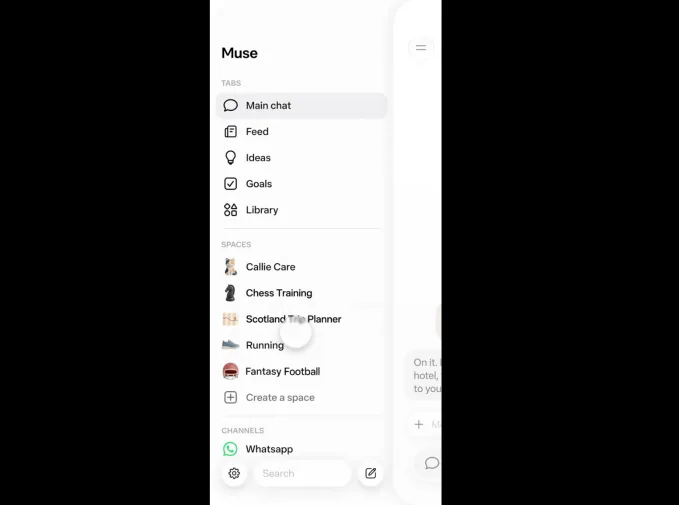
The examples Meta gives are practical rather than abstract. A user planning a vacation can create a Space for that project and return to it whenever needed. Someone collecting recipes for an upcoming family event can do the same. Meta also points to a holiday gift tracker, a wedding planner, and a space for DIY projects. The company’s framing is simple: describe an idea in chat, and Muse builds a tracker, planner, or project board around it.
Development: How Spaces Work Inside the Muse Interface
Spaces live in the sidebar, making them visible as separate tabs or containers for ongoing work. Clicking a Space brings up its conversation, where the agent focuses on the selected goal. This structure turns Muse from a single assistant into a set of project-specific helpers, each attached to a different task.
Meta says Spaces can also connect with third-party apps and information. The idea is that connected apps keep a Space updated in the background, so new concert dates, price changes, or savings progress appear without the user needing to ask. That positions Spaces less as passive chat logs and more as living dashboards for individual projects.
Mark Zuckerberg, Meta’s founder and CEO, highlighted the feature on X on Friday. He said he had been playing around with spaces in Muse, adding that users can tell Muse what they need and the agent builds it. Among the examples he shared were a BBQ game, an event tracker, and a home control dashboard. He also said he was excited to see what users build.
Recent Momentum: Muse Voice and User Growth
Spaces is not the only recent addition to the Muse experience. It is the second new Muse feature Meta has introduced over the last week. On Thursday, the company announced Muse Voice, which allows users to video chat with their agent and give commands verbally. Together, Spaces and Muse Voice show Meta expanding the interaction layer around its agents, moving beyond text-only assistance toward a more immersive and organized workflow.
The timing also follows earlier traction for the agents. During its earnings call in October, Zuckerberg said the agents had 10 million users in the U.S. and Canada less than two months after they debuted. That number gave Meta a visible base on which to build more structured features like Spaces.
The broader competitive context includes other cartoonish AI agent experiences, such as OpenAI’s dots and SpaceXAI’s Grokbot. Meta’s approach with Spaces is to keep the agents useful by tying them to concrete projects and connected information. For now, the current stage is one of rapid iteration: Muse agents already have a user base, Spaces adds structure, and Muse Voice adds another way to interact, while the company tests how far these helpers can move from novelty into everyday organization.
Comments
No comments yet. Be the first to comment.