
A former OpenAI researcher said he found fingerprints of Nvidia Blackwell hidden inside six Chinese AI models
A report links six Chinese AI models, including DeepSeek and Moonshot AI, to Nvidia Blackwell traces, but not legal proof.
Key Takeaways
- An analysis by former OpenAI researcher Will DePue claims six Chinese AI models released since April 2026 show statistical weight-initialization traces matching Nvidia Blackwell GPUs, described as the first public technical evidence of such access.
- The method relies on GPU core counts during PyTorch initialization: Hopper chips show a 132-core pattern, while Blackwell variants show 148 or 152 cores; DePue says a faint pattern can survive training in unused weight slots.
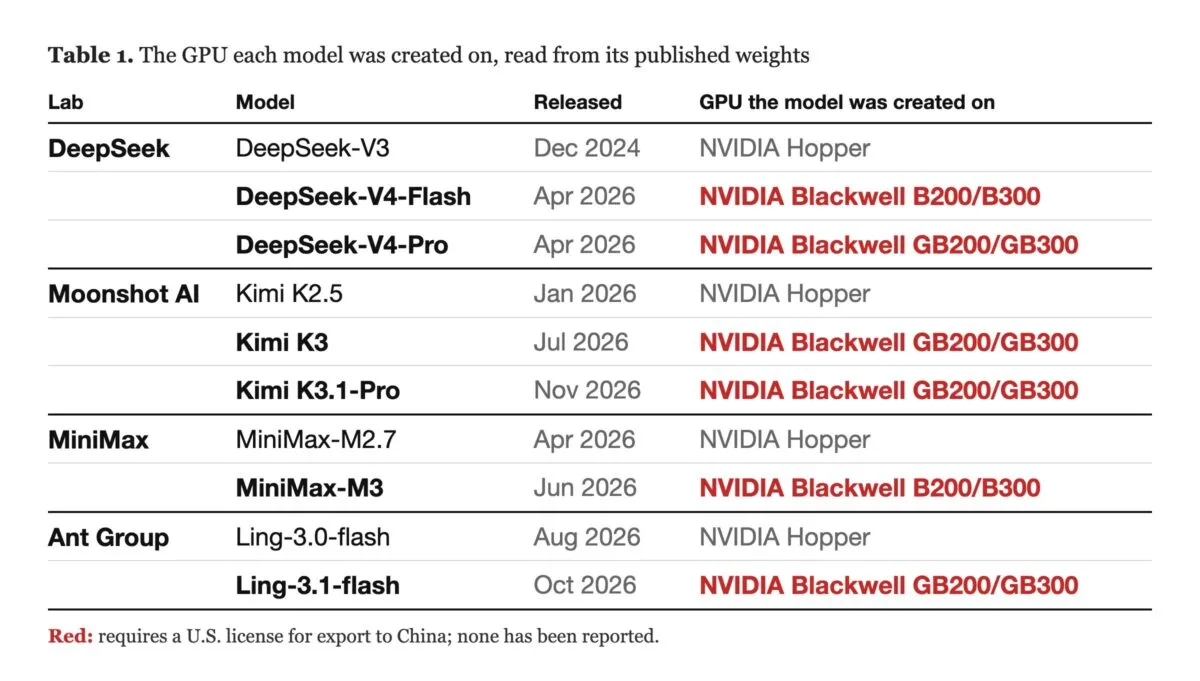
- The report links DeepSeek-V4-Flash and MiniMax-M3 to 148-core B200/B300 patterns, and DeepSeek-V4-Pro, Kimi K3, Kimi K3.1-Pro and Ant Group's Ling-3.1-flash to 152-core GB200/GB300 patterns, while earlier models such as DeepSeek-V3 and Kimi K2.5 show Hopper traces.
- It estimates the five examined training runs used about 12,000 Blackwell GPUs, roughly equivalent to 30,000 H100 chips, with Kimi K3 alone estimated at 4,500 Blackwell processors for about 70 days and cluster costs of $200 million to $300 million each.
- The findings indicate access to Nvidia’s top hardware but do not prove GPU location, ownership, smuggling, or US export-law violations; AMD MI300X is noted as a possible technical alternative but reportedly ruled out for DeepSeek-V4-Flash by rounding differences.
Title: Will DePue Analysis Finds Chinese AI Models Show Nvidia Blackwell Traces
Meta description: A new analysis says six Chinese AI models since April 2026 show Nvidia Blackwell weight-initialization traces, but does not prove export-law violations.
Tags: Nvidia Blackwell, DeepSeek, Moonshot AI, AI hardware evidence, US export law
Featured image: Abstract blue GPU circuit patterns and scattered numerical weights forming a statistical fingerprint.
Source analysis image credit: Will DePue / Unemployment Labs.
Background: Suspicions Around DeepSeek and Moonshot AI
Will DePue’s report points to six Chinese models released since April 2026 as bearing a distinct Nvidia Blackwell signature, which he says is the first technical evidence of that access. For DeepSeek and Moonshot AI, US officials and news outlets had already suspected Blackwell use, yet no proof had been published. Writing on X, DePue said senior researchers at OpenAI and Anthropic had independently checked and confirmed the results. The same analysis places earlier models, including DeepSeek-V3 and Kimi K2.5, with traces of Nvidia’s older Hopper generation.
Development: Weight Initialization as a Hardware Fingerprint
The analysis starts from published language models. A language model is built from billions of numerical values called weights. PyTorch is the standard software framework. Before training, it fills empty slots with random numbers generated from a starting value called a seed. To spread a massive amount of data quickly, the GPU divides the filling task among its compute cores. Different chips have different core counts, so the initial fill produces a characteristic pattern, the report says.
DePue says Hopper chips such as the H100 and H800 contain 132 compute cores. Blackwell chips use exactly 148 or 152 cores, depending on whether the model is B200/B300 or GB200/GB300. Millions of training updates later, unused word or symbol slots can still hold their starting random values. DePue says a faint statistical echo of the initial distribution survives even in heavily trained regions.
He reports working backward from the pattern to reproduce DeepSeek-V4-Flash and Kimi K3 exactly on real Blackwell chips. The verification code is on GitHub.
Scale: Estimated GPU Counts, Costs, and Control Tests
DePue’s mapping assigns DeepSeek-V4-Flash and MiniMax-M3 to B200 or B300 chips, the 148-core Blackwell pattern. The 152-core pattern appears in DeepSeek-V4-Pro, Kimi K3, Kimi K3.1-Pro, and Ant Group's Ling-3.1-flash, matching Nvidia's liquid-cooled GB200 or GB300 flagship rack systems. DePue says statistical chance can be excluded, and the method identified all 24 known-hardware control models, including Meta's Llama 3.1 on H100.
The report estimates five examined training runs used about 12,000 Blackwell GPUs in total, equal to the computing power of roughly 30,000 older H100 chips. Kimi K3 alone is estimated to have needed 4,500 Blackwell processors for about 70 days, while DeepSeek-V4-Pro needed about 3,000 Blackwell processors. With each unit priced around $70,000, the report puts each cluster at $200 million to $300 million and the five systems together more than half a billion dollars.
Dylan Patel, chief analyst at SemiAnalysis, reached a related view. In a Sequoia Capital interview, Patel said DeepSeek-V3's architecture remained specifically tailored to Hopper chips, while DeepSeek-V4's architecture was designed for Blackwell GPUs and Huawei's Ascend chips. DePue's report says other Chinese lab models, including Alibaba's Qwen3.8 and models from Zhipu, Tencent, Xiaomi, and StepFun, still show Hopper signatures only, while Meituan's LongCat-2.0 points to Huawei hardware.
Current Stage: Access Evidence, Not Legal Proof
The fingerprint does not establish a legal violation. Strictly, it identifies only the hardware that initialized the weights, although DePue says training probably ran on the same systems. The only alternate technical possibility is an AMD MI300X, also restricted, artificially throttled to create the same pattern. DePue says tiny rounding differences between chips ruled out AMD for DeepSeek-V4-Flash.
The data does not show GPU locations or ownership. Since Chinese companies can rent computing capacity at data centers outside China, the report says the evidence shows access to Nvidia's top hardware but does not, by itself, prove physical smuggling or a US export-law violation. At present, the analysis provides a technical fingerprint of Blackwell initialization while leaving ownership, physical location, and export-law compliance unresolved.
Comments
No comments yet. Be the first to comment.