
The creator of the bitter lesson has a bitter lesson for people enthusiastic about LLM scaling
Sutton says AI scaling needs new methods, while researchers debate the bitter lesson and 45 labs seek gaps; OpenAI and Anthropic defend LLM scaling.
Key Takeaways
- Richard Sutton argues that raw compute and LLM scaling alone are not enough for intelligence, and that AI needs new methods such as agents, world models, and continuous learning.
- Researchers like Jerry Tworek and Jayden Teoh say the “bitter lesson” is often misread: scaling outcomes are uneven, and promising non-scaling ideas should not be dismissed too quickly.
- The disagreement has fueled new AI labs, including Core Automation and Sutton’s Oak Lab, which are pursuing learning methods beyond today’s transformer-based recipe.
- OpenAI’s Sam Altman and Anthropic’s Dario Amodei defend continued LLM scaling, saying the evidence still supports it and critics may slow progress.
- The AI field is now at a fork: dominant scaling approaches versus a push for new algorithms, world models, and continuous learning to extend intelligence.
Meta description
Richard Sutton says AI scaling needs new methods, while OpenAI and Anthropic leaders defend LLM progress and 45 new labs explore gaps in AI research.
Tags: AI scaling, Richard Sutton, OpenAI, LLM research

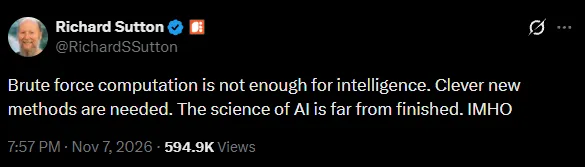
After Turing Award winner Richard Sutton said raw compute alone isn't enough for intelligence, the AI scaling debate moved from quiet disagreement to public argument. Sutton argued that AI science needs clever new methods and is far from finished, and his recent post on X drew wide discussion in the AI community, suggesting he touched a live nerve.
Background: The Bitter Lesson and Its Limits
Sutton's 2019 essay "The Bitter Lesson" became a reference point for a broad claim: over time, general methods that scale with compute tend to defeat elaborate human-engineered designs. The important ideas, in that framing, are the ones that can expand with compute rather than lean on human assumptions.
Although that essay is often quoted in favor of scaling, Sutton has warned that scaling LLMs alone has limits. In earlier statements, he called synthetic data a "big mistake" because the real world is infinitely complex and any simulation of it is only "microscopic." He also said human expertise can become a bottleneck that prevents true scaling.
Instead, Sutton has pushed agents with world models that continuously learn from their own experience. His case is that the world is massively more complex than internet text, and today's language models don't keep learning after training. The missing capability, he says, is continuous learning without destroying old knowledge.
Development: Sutton's Recent Warning and Researcher Pushback
Jerry Tworek, an AI researcher who like many others left OpenAI, one of the major AI companies, to explore new AI approaches, framed Sutton's warning as a correction rather than a rejection of the bitter lesson. The lesson still holds, Tworek writes, but more compute in model training makes the algorithm matter more.
Scaling outcomes are uneven, Tworek argues: some algorithms scale, others hit dead ends, and many dimensions of scaling remain completely unexplored. The temporary success of transformer scaling, combined with a misreading of the bitter lesson, "has reward-hacked the brains of a whole generation of scientists."
Jayden Teoh, another AI researcher, says the bitter lesson can also hold back academic research, with promising ideas dismissed for straying too far from its spirit. Teoh places responsibility on a misreading of the original message, not on Sutton.
Teoh adds that ideas later judged not to follow the bitter lesson were often replaced by cleaner, more general approaches, but that did not make them wrong; they often enabled progress at the time. He wants researchers to stop dismissing such work as soon as it appears. "An idea doesn’t necessarily have to survive scaling forever to be an important contribution to AI progress," Teoh writes.
Latest Progress: New Labs and Industry Executives Take Sides
The gap between Sutton's push for new learning methods and Tworek's critique of blind transformer scaling has become visible in startup formation. The latest Frontier Radar #5 tracked 45 new AI labs betting on exactly these gaps.
Tworek runs Core Automation, one of those labs, searching for learning algorithms beyond pretraining and reinforcement learning. Sutton's Oak Lab belongs to the same pattern: these founders believe in much more capable AI, but doubt today's recipe alone will get there.
Some prominent industry leaders see things differently. OpenAI CEO Sam Altman considers LLM scaling far from exhausted and accuses LLM critics of slowing down an entire generation of researchers by being too sure about what scaling can't do.
His evidence includes an OpenAI model that recently disproved a mathematical conjecture mathematicians had long failed to crack. Altman says world models can be useful, for instance in robotics, but argues the data clearly favor further LLM scaling.
Anthropic CEO Dario Amodei makes a similar case, calling scaling progress "a rainbow with no end." Amodei and Altman lead the two AI companies whose entire technical approach rests on this bet, and they are obviously biased in its favor.
Current Stage of the Debate
The debate now sits at a fork. LLM scaling remains dominant at major AI companies, while Sutton, Tworek, Teoh, and 45 new AI labs are pressing for methods that go beyond today's recipe. The central question is whether new learning algorithms, world models, and continuous learning can extend intelligence in ways that raw compute alone cannot.
Comments
No comments yet. Be the first to comment.