
Trustworthy Recursive Self-Improvement in the Era of Large Models Involves Foundations, Risks, Evaluation, and Open Challenges
Survey defines recursive self-improvement in AI, covering update risks, trustworthiness themes, oversight validity, and open evaluation challenges.
Key Takeaways
- Recursive self-improvement means large-model AI systems use experience and feedback to make persistent changes not only to outputs, models, prompts, memories, tools, and workflows, but also to the mechanisms that govern future updates.
- Self-modification alone does not guarantee trustworthy improvement, because gains may be misleading, capabilities or safety constraints may regress, sensitive or compromised artifacts may persist, and changes to update processes may invalidate prior verification.
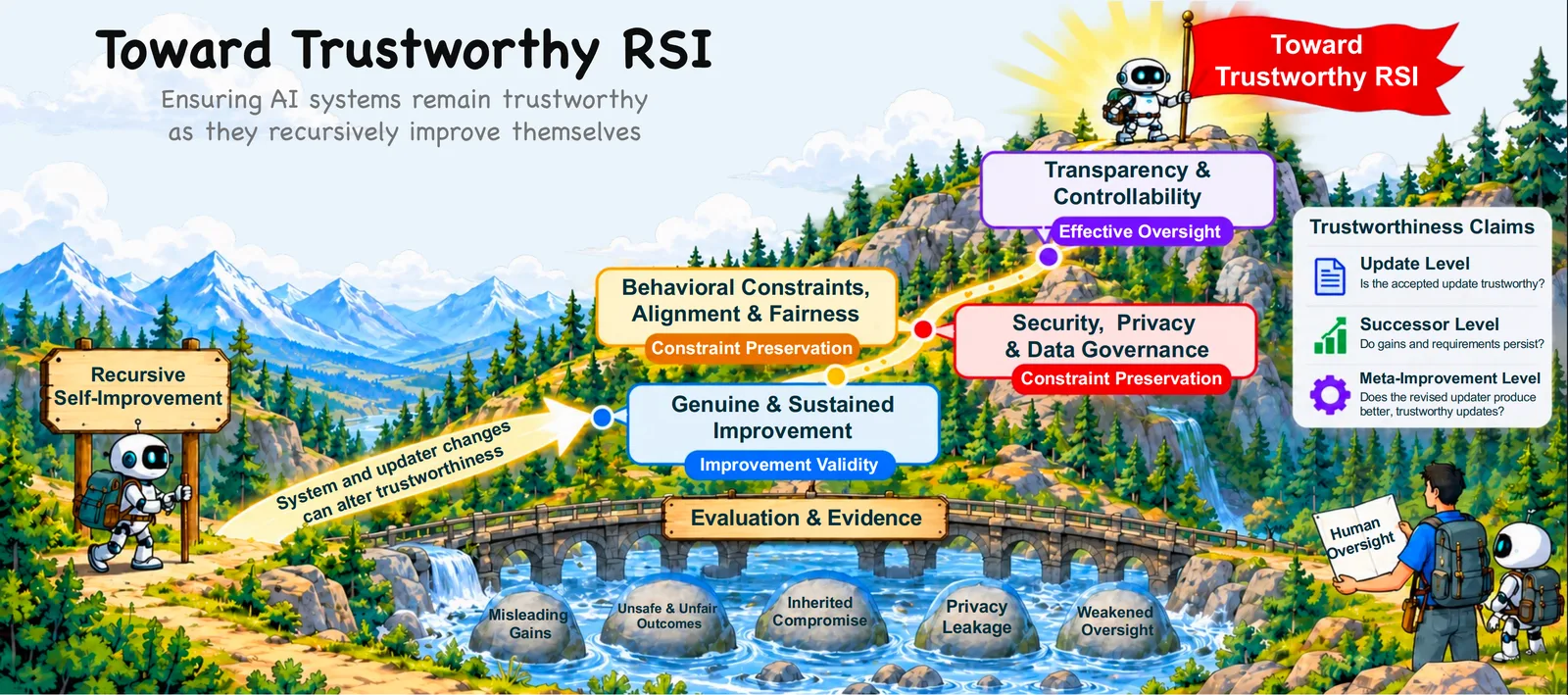
- The survey organizes trustworthy recursive self-improvement around four themes: sustained improvement, alignment and fairness, security and privacy, and transparency and controllability.
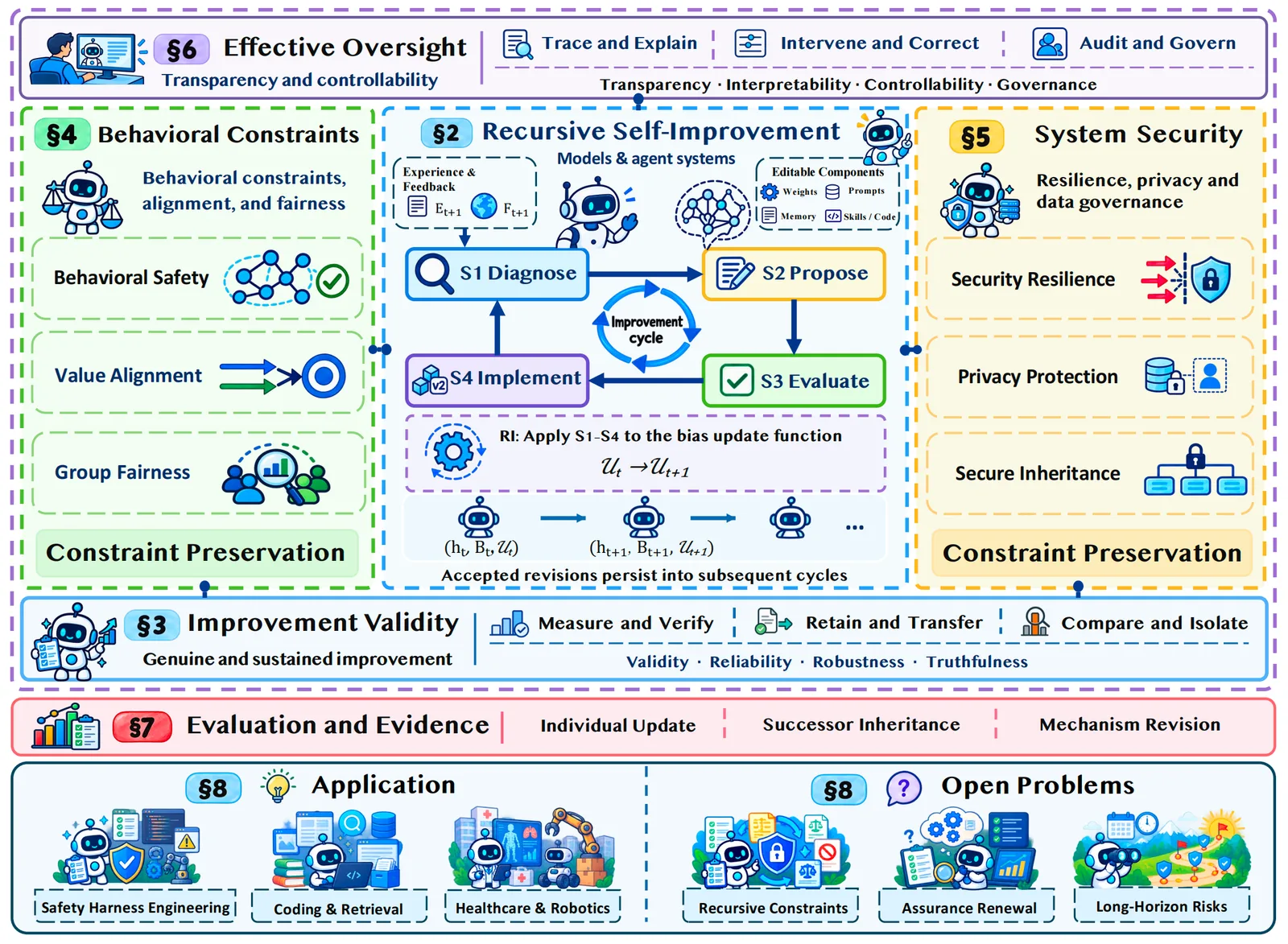
- It analyzes the update cycle—diagnosis, proposal generation, proposal evaluation, and implementation—and its recursive reach, where these stages themselves may later be revised.
- Current research focuses on mapping trust requirements, risks, safeguards, and evaluation gaps, especially the need for independent, longitudinal assessment and effective human oversight.
Meta description: A survey defines recursive self-improvement and maps trustworthy AI update risks across models, prompts, memories, tools, workflows, and oversight.
Tags: Recursive Self-Improvement, AI Trustworthiness, Model Updates, Oversight, Safety Evaluation
Featured image: Abstract technology illustration of recursive update loops, no people, logos, or text.
A survey frames recursive self-improvement as the process by which large-model AI systems use experience and feedback to make persistent changes to models, prompts, memories, tools, workflows, inductive biases, and the mechanisms that govern future updates. This matters because self-modification alone does not guarantee trustworthy improvement: reported gains may reflect flawed evaluations, previously acquired capabilities may deteriorate, compliance with behavioral constraints may weaken, compromised artifacts or sensitive information may persist in successor systems, and changes to improvement mechanisms may invalidate earlier verification results and make human oversight less effective.
Background: Experience-Driven Updates in Large-Model AI
AI systems built around large models increasingly use experience and feedback to make persistent changes to models, prompts, memories, tools, and workflows. Those changes are not limited to a single parameter update. They can alter the instructions the system sees, the information it retains, the external tools it calls, and the sequence of steps it follows.
The survey treats recursive self-improvement as an extension of this pattern. It moves beyond changing outputs or stored information and includes changes to inductive biases and to the mechanisms that govern future updates. Those mechanisms can themselves be revised and reused across improvement cycles.
Development: Why Self-Modification Does Not Equal Trustworthy Improvement
Yet self-modification alone does not guarantee trustworthy improvement. Reported gains may reflect flawed evaluations, previously acquired capabilities may deteriorate, and compliance with behavioral constraints may weaken. Compromised artifacts or sensitive information may also persist in successor systems.
Changes to improvement mechanisms may invalidate earlier verification results and make human oversight less effective. If the process that produced a safer version is later rewritten, evidence collected under the earlier process may no longer describe the system that runs next.
Latest Progress: Survey Framework for Trustworthy Recursive Self-Improvement
A survey presents an operational definition and process framework for recursive self-improvement. It organizes the requirements for trustworthy recursive self-improvement into four interconnected themes: genuine and sustained improvement; behavioral constraints, alignment, and fairness; system security and privacy; and transparency and controllability.
The survey examines these themes from three perspectives: Improvement Validity, Constraint Preservation, and Effective Oversight. This structure separates whether improvement is real, whether safety and fairness properties survive, and whether people can still monitor and control the system.
Mapping the Update Cycle and Its Recursive Reach
The analysis covers improvement diagnosis, proposal generation, proposal evaluation, and update implementation (S1--S4), including the recursive application of these stages to improvement mechanisms (RI). This means each stage can be studied both as a normal update step and as a target that future updates may change.
The survey reviews risks, safeguards, and evaluation evidence for individual updates, effects inherited by successor systems, and revisions to improvement mechanisms. It also distinguishes direct recursive self-improvement findings from evidence in related systems.
Current Stage: Evaluation Settings and Open Research Problems
Finally, the survey examines evaluation settings, identifies requirements for independent and longitudinal assessment, and discusses applications and open research problems. The current stage is therefore a mapping of trust requirements, update stages, and evaluation gaps, rather than a record of completed deployment outcomes.
Comments
No comments yet. Be the first to comment.