
Terminal agents recursively improve themselves by rewriting themselves and refining their policies
Terminal-RSI recursively rewrites trajectories and refines policies, making verifier feedback actionable for terminal agents on benchmarks.
Key Takeaways
- Terminal-RSI is a five-stage, recursive refinement method built from Qwen3.8-27B that alternates verified trajectory rewriting and policy refinement to turn verifier feedback into actionable training signals.
- The approach combines Recursive Self-Rewrite with Recursive Policy-Refine, using critic inheritance, a warm-up critic model, recursive critic handoff, and stage-specific learning rates.
- Its reward design preserves partial progress while targeting full resolution through Turn-Boundary Skip-Observation GAE, Family Dense Reward, and Success-Prioritized Reward.
- Benchmark results are uneven across Terminal-Bench versions, ranging from 19.84% on 4.0 to 86.52% on 2.1, showing version-specific behavior rather than one aggregate score.
- On LHTB, the method improves process reward, strict completion, and doubles SWR100 success from 3.00% to 6.00%, indicating better verified task resolution.
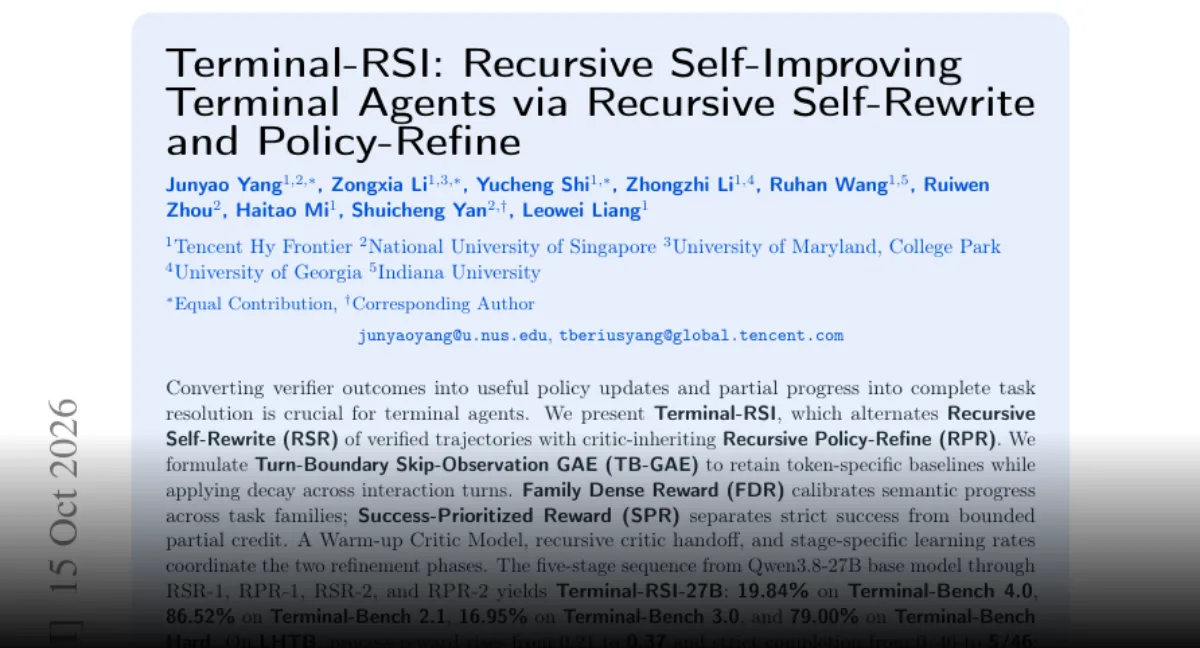
Terminal-RSI is a five-stage refinement sequence built from the Qwen3.8-27B base model, and it focuses on a practical problem for terminal agents: making verifier feedback actionable in policy updates while moving partial task progress toward full resolution. The approach alternates verified trajectory rewriting with policy refinement, then evaluates the resulting Terminal-RSI-27B model on Terminal-Bench variants and LHTB, where SWR100 success rises from 3.00% to 6.00%. The method alternates Recursive Self-Rewrite and Recursive Policy-Refine rather than relying on a single update cycle.
Background: Verifier Feedback Needs a Learning Path
Terminal agents can receive outcomes that say whether a task has passed, but those outcomes do not automatically become useful training signals. A task may end without strict completion even when several steps are correct, and a policy update that treats only final passes as valuable can discard the repairs that make later success possible. Terminal-RSI is built around that missing path from outcome to update. For terminal agents, the practical gap is not only solving a task once, but making each verified outcome reusable in a policy update.
Development: Recursive Rewriting and Critic Inheritance
The sequence starts from Qwen3.8-27B and moves through five stages: RSR-1, RPR-1, RSR-2, and RPR-2, producing Terminal-RSI-27B. Recursive Self-Rewrite handles verified trajectories, while Recursive Policy-Refine uses inherited critic information to adjust the policy. A Warm-up Critic Model, recursive critic handoff, and stage-specific learning rates coordinate the two phases.
Reward design shapes how progress is measured. Turn-Boundary Skip-Observation GAE keeps token-level baselines and applies decay across interaction turns. Family Dense Reward calibrates semantic progress across task families. Success-Prioritized Reward separates strict success from bounded partial credit. Together, these signals preserve useful local behavior while pushing the agent toward verified completion.
Latest Progress: Terminal-Bench and LHTB Gains
The reported Terminal-RSI-27B scores are 19.84% on Terminal-Bench 4.0, 86.52% on Terminal-Bench 2.1, 16.95% on Terminal-Bench 3.0, and 79.00% on Terminal-Bench Hard. The spread across versions shows that the sequence produces uneven benchmark movement rather than a single uniform improvement: the highest reported score is 86.52% on Terminal-Bench 2.1, while Terminal-Bench 4.0 reaches 19.84%. The benchmark scores therefore show the model’s behavior across different Terminal-Bench versions, not a single aggregate terminal-agent score.
The LHTB results track completion more directly. Process reward rises from 0.21 to 0.37, and strict completion improves from 0/46 to 5/46. SWR100 success doubles from 3.00% to 6.00%. These figures describe a shift from partial progress to verified task resolution on the evaluated set.
Current Stage: Consolidated Behaviors and Measured Completion
Each retained stage acts as a consolidation step. Verified trajectory rewriting and critic-inheriting policy refinement are coupled recursively, while the reward components keep semantic progress and strict success distinct. The result is Terminal-RSI-27B, measured on Terminal-Bench and LHTB, with the reported evidence showing stronger process reward, more strict completions, and doubled SWR100 success.
SEO Elements
Meta description: Terminal-RSI builds Qwen3.8-27B through five stages, raising Terminal-Bench scores and doubling SWR100 success to 6.00% on LHTB benchmark tasks.
Tags: Terminal-RSI, Qwen3.8-27B, Terminal-Bench, LHTB, SWR100
Featured image: abstract terminal grid with recursive arrows and reward curves, no real people, no company logos, no text.
Comments
No comments yet. Be the first to comment.