
Cross-layer latent vector quantization aggressively compresses per-layer embeddings.
OPTIC compresses Gemma 4 embeddings 100x with shared cross-layer codes, retaining 97.8% performance and reducing GPU memory.
Key Takeaways
- OPTIC compresses Gemma 4 per-layer embeddings by about 100× using one shared quantized token code across layers, instead of encoding each token-layer vector separately.
- The compressed embeddings retain 97.8% of BF16 E4B performance across seven benchmarks, far above product quantization’s 66.3% retention.
- Gemma 4’s per-layer embeddings account for 35.2% of E4B parameters, making them a major target for reducing deployment memory while preserving embedding capacity.
- Serving BF16 E4B directly from compact codes reduces GPU memory by 29.7%, with at most 0.40% wall-time increase on an RTX 4090 and compatibility with backbone weight quantization.
Title: OPTIC compresses Gemma 4 per-layer embeddings 100× while retaining 97.8% performance
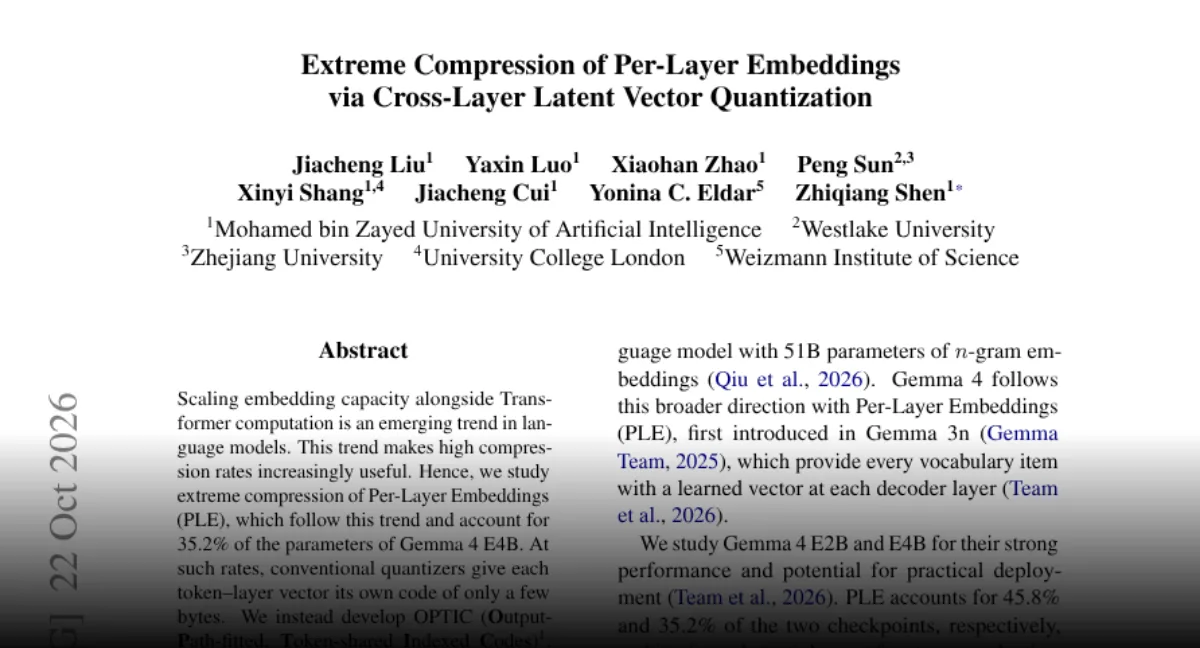
Meta description: OPTIC compresses Gemma 4 per-layer embeddings 100x, keeping 97.8% of BF16 E4B performance and cutting GPU memory by 29.7% while serving on an RTX 4090.
Tags: Gemma 4, OPTIC, embedding compression, BF16 E4B, RTX 4090

A new Gemma 4 embedding compression method, OPTIC, replaces separate per-layer codes with one shared token code and reports 97.8% retention of BF16 E4B performance at about 100× compression. The result matters because embedding capacity is being used to improve language models, while deployment memory remains limited. It answers a practical question for scaling: can the model keep embedding capacity without exceeding memory limits?
Background: Larger embeddings meet limited deployment memory
The timeline begins with recent work showing that increasing embedding capacity can improve language models. That makes embedding tables a useful scaling direction. The study examines Gemma 4, where per-layer embeddings account for 35.2% of E4B parameters. Once such a large share of parameters sits in embedding tables, extreme compression becomes important: the goal is to keep the benefits of larger embeddings while fitting models into limited deployment memory.
The study’s target is not just any embedding table, but Gemma 4’s per-layer embeddings. In E4B, these account for 35.2% of parameters, so compression decisions at this layer directly shape the model’s memory footprint.
Development: OPTIC shares one quantized code across layers
Before OPTIC, a straightforward path is to encode each token-layer vector independently. That gives each vector a tiny code, but it misses the opportunity to share storage across layers. OPTIC changes the unit of compression. It gives each token one quantized code shared across all layers. Layer-specific affine decoders then reconstruct the different per-layer embeddings from that shared code.
The method also fits the representation to its effect after the gate and output projection, so the compression objective reflects how the model actually uses the embeddings. The shared code also makes the compression objective more practical: the representation is judged by the embeddings’ downstream role, not only by vector reconstruction.
Latest progress: 100× compression keeps 97.8% of BF16 E4B performance
At about 100× compression, only about five bytes remain for each token-layer vector. Under that setting, OPTIC retains 97.8% of BF16 E4B performance across seven benchmarks, compared with 66.3% for product quantization. The comparison puts the result in context: sharing storage across layers changes the quality-memory trade-off.
The serving path gives another signal: serving BF16 E4B directly from the compact codes reduces GPU memory by 29.7%. On an RTX 4090 with the same 1 GiB key-value cache, the wall-time increase is at most 0.40%. The method also works alongside backbone weight quantization.
Current stage: Paper, code and 100× per-layer embedding artifact
The released package includes the paper, code and method walkthrough, and a 100× PLE artifact. This places the work at the stage of a shared compressed embedding path for Gemma 4. The defining numbers are now visible: 35.2% parameter share, 100× compression, 97.8% retained performance, 29.7% GPU memory reduction, and at most 0.40% wall-time increase.
Comments
No comments yet. Be the first to comment.