
A Continual Learning Assessment Benchmarks Long-Horizon Recursive Self-Improvement and Experiential Learning in LLM Agents
Continual Learning Exam tests 120 tasks and 600 levels, revealing weak long-horizon self-improvement and experience-driven learning in LLM agents.
Key Takeaways
- The Continual Learning Exam (CLE) is a large-scale benchmark designed to test whether LLM agents can learn from experience and improve over time, not just solve isolated tasks.
- CLE includes 120 real-world professional tasks, 600 progressive levels, 89 occupations, and 12 domains, using stateful environments and human-authored evaluation criteria to measure long-horizon learning.
- Its “Task Ladder” structure requires agents to complete earlier levels before accessing harder ones, testing memory, skill transfer, and the ability to reuse prior experience.
- Frontier results reveal a substantial learning gap: Claude Code + Opus 5 completed only 47.7% of levels and 23.3% of full Task Ladders, showing that consistent long-term improvement remains difficult.
- The benchmark frames Agent Continual Learning, Memory, Skill Learning, and Recursive Self-Improvement (RSI) as key open challenges and provides a common framework for future agent evaluation.
Meta Description: Continual Learning Exam tests LLM agents through 600 levels, and Claude Code + Opus 5 reaches only 47.7 percent level completion rate in the benchmark.
Tags: LLM agents, Continual Learning Exam, Recursive Self-Improvement, Agent Benchmarks, Claude Code
Featured Image: Abstract technology style, layered task ladder and agent memory network, no real people, no company logos, no text.
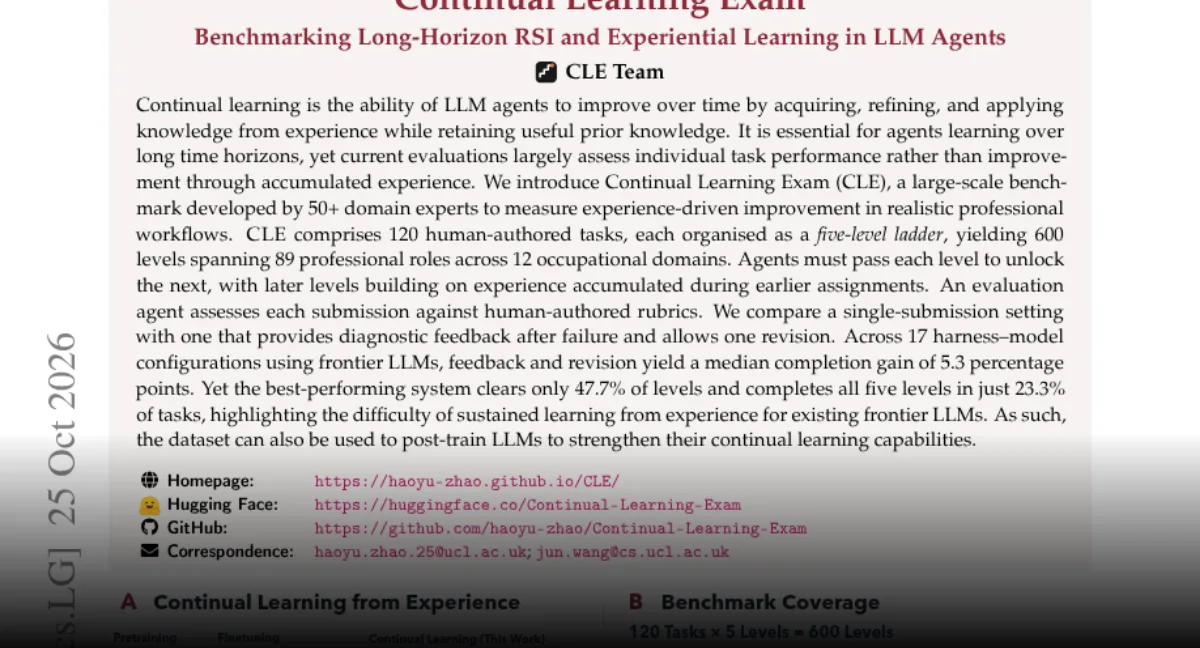
The Continual Learning Exam is a large-scale benchmark introduced to test whether LLM agents can learn from experience rather than only solve isolated tasks. It covers 120 real-world professional tasks and 600 progressive levels across 89 occupations in 12 domains. The reported results show a difficult starting point: even the strongest tested system, Claude Code + Opus 5, completes 47.7% of levels and 23.3% of full Task Ladders.
From Single-Task Competence to Long-Horizon Learning
Most existing agent benchmarks focus on whether agents can solve individual tasks. The announcement frames the central question differently: can LLM agents truly learn from experience and continuously improve over time? The benchmark’s premise is that real-world intelligence requires more than task completion. An agent should learn from past successes and failures, accumulate experience, and transfer acquired knowledge, strategies, and skills to future challenges.
This matters because a system that solves many separate tasks may still fail if it cannot remember what worked, avoid repeated mistakes, or adapt its approach to a related but harder task. CLE addresses that uncertainty by designing tasks as a progression rather than a loose collection of one-off challenges. The benchmark is built to evaluate long-horizon continual learning and experience-driven self-improvement in LLM agents.
Building a Professional Test Environment
The benchmark was developed with 50+ domain experts. It covers 120 real-world professional tasks, 600 progressive levels, 89 occupations, and 12 domains. The environment includes approximately 24,000 real-world files, 19 stateful applications, and 16,000+ human-authored evaluation criteria.
The scale and realism are central to the benchmark’s purpose. Real-world files and professional tasks create contexts where answers may depend on prior steps, while stateful applications make the environment respond to actions over time. Stateful applications are software environments whose data changes as an agent acts, so earlier decisions can affect later steps. Human-authored criteria add another layer: performance is judged against professional expectations, not only automatic correctness.
CLE organizes work into game-like Task Ladders. Agents must complete each level to unlock the next one. Later levels require them to reuse and build upon knowledge, strategies, and skills acquired through earlier experience. That structure is what turns the benchmark from a simple task list into a test of persistent learning.
Frontier Results Show a Learning Gap
The evaluation covered 17 frontier agent configurations. The strongest reported system was Claude Code + Opus 5. It reached a 47.7% level completion rate and a 23.3% full Task Ladder completion rate.
The results reveal a substantial gap between solving individual tasks and achieving genuine long-term continual learning. The 47.7% level completion rate shows that individual levels remain challenging even for a strong configuration. The 23.3% full Task Ladder rate shows that the harder requirement is consistency across a sequence. Together, the numbers suggest that short-term task solving and long-term learning are different problems. A system may perform well on a single challenge while still failing to carry useful experience forward through a longer professional workflow.
Current Stage: A Benchmark for Memory and Skill Transfer
The project presents CLE as a realistic and verifiable benchmark for research on Agent Continual Learning, Memory, Skill Learning, and Recursive Self-Improvement, abbreviated RSI. RSI refers to systems that improve their capabilities through repeated cycles of learning and modification. The announcement welcomes feedback, discussions, and collaborations from the community.
For readers, the announcement is less about a single score and more about a new way to compare agent systems. It creates a common setting for measuring memory, skill transfer, and experience-driven improvement. Because the benchmark spans many occupations and domains, it can reveal whether an agent learns narrowly or carries useful strategies across professional work.
The current stage is best understood as a measurement framework and early evidence that long-horizon learning remains unsolved. Future progress can be tracked by whether newer agent systems raise level completion and full Task Ladder completion while using earlier experience in later tasks.
Comments
No comments yet. Be the first to comment.