
DominoBench Evaluates Multi-Step Physical Reasoning from Static Images
DominoBench tests 30 vision-language models on 854 static chain-reaction images; accuracy rises when models explicitly calculate steps.
Key Takeaways
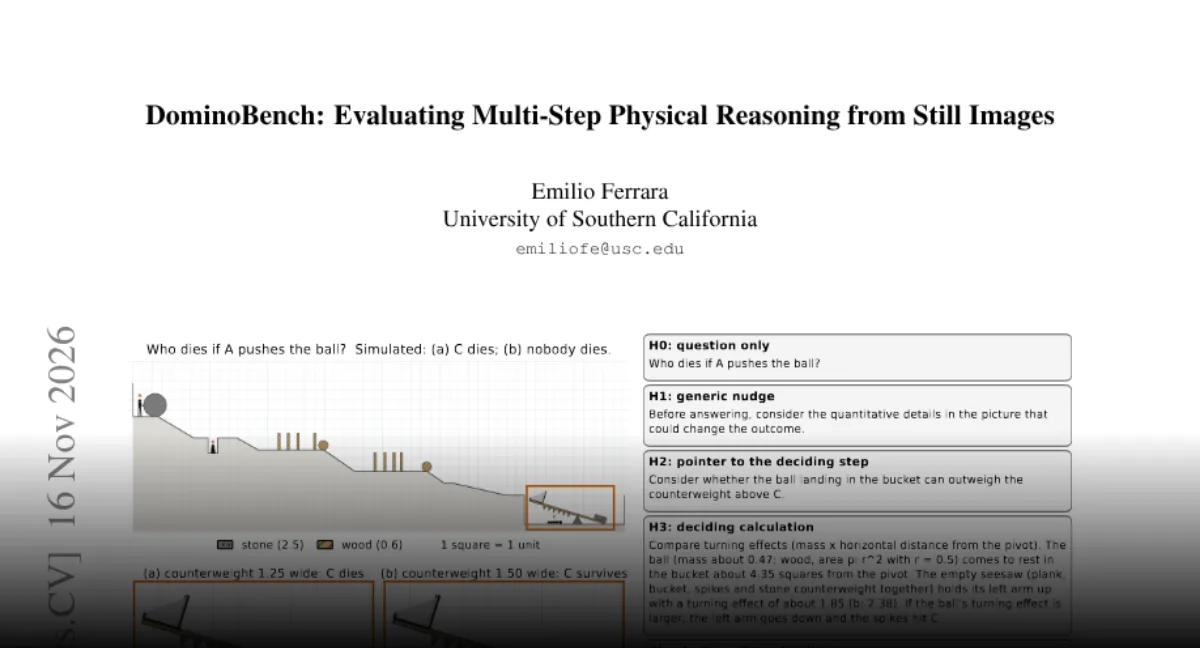
- DominoBench evaluates whether vision-language models can perform multi-step physical reasoning from static images of simulated domino chain reactions.
- It uses 854 minimal-pair scenes where moving one quantity by one grid step changes one person’s fate, separating visual recognition from causal tracking.
- Among 30 tested models, unaided reasoning was limited: best accuracy was at most 75%, and only 40% got both minimal-pair variants correct.
- Writing out the calculation steps significantly improved performance to 80–92%, while simply pointing at the decisive step helped little.
- GPT-6 models were strongest without support, whereas GPT-5.6-Sol improved most from explicit calculation and ranked first overall, suggesting different internal reasoning mechanisms.
Meta description: DominoBench tests 30 vision-language models on 854 chain-reaction scenes, revealing weak accuracy without calculation and strong gains when steps are written.
Tags: DominoBench, vision-language models, chain-reaction reasoning, GPT-6, GPT-5.6-Sol
Featured image: abstract technology style, domino grid and calculation trace, no real people, no company logos, no text.
Background: A Small Visual Change That Changes One Fate
DominoBench tests whether vision-language models can look at a still image of a simulated chain reaction, follow the sequence, and identify who gets hit. It contains 854 simulator-labelled minimal-pair scenes; moving one quantity one grid step flips one person's fate. This separates image recognition from causal tracking: models may see people and grid positions but fail when the decisive step changes.
Development: Testing 30 Models With a Hint Ladder
The evaluation covered 30 models, starting with no guidance. Best unaided accuracy for the person whose fate flips was at most 75%; both twins of a minimal pair were correct at most 40%. Pointing at the deciding step helped little. Writing out the calculation raised the same models to 80–92%.
Latest Findings: Two Families Move in Different Directions
GPT-6 models were most accurate unaided but barely gained from calculation. GPT-5.6-Sol started lower but benefited strongly and ended first. This suggests the bottleneck is not only visual perception: some models infer the chain directly, while others need the reasoning process externalized to apply it to the image. Dataset and materials are available at https://huggingface.co/datasets/emilioferrara/DominoBench, with open images, simulator trajectories, the hint ladder, the generator, and evaluation code.
Current Stage: Open Benchmarks, Unresolved Mechanisms
DominoBench sits at a useful stage: a clear task, controlled dataset, 30 tested models, and public materials. Chain-reaction vision reasoning remains unreliable without support, and calculation is far more useful than pointing. The open resources let researchers test their models and identify failure mechanisms. The benchmark measures the gap between seeing a sequence and calculating its consequence.
Comments
No comments yet. Be the first to comment.