
Revisiting Constrained Decoding Reveals Whether It Helps or Harms LLM Performance
Constrained decoding need not harm LLM reasoning; effects depend on constraint type. Validity improves reliability, reasoning paths can help or hurt.
Key Takeaways
- Constrained decoding does not inherently harm LLM reasoning; its impact depends on the type of constraint applied.
- The study distinguishes three constraint types: format constraints, validity constraints, and reasoning constraints, each affecting a different part of the answer space.
- Apparent performance drops are largely caused by non-equivalent prompting and output formats, not by decoder-level masking itself.
- Validity constraints improve reliability and extractability by removing invalid or malformed outputs.
- Reasoning constraints can improve accuracy, but only when the restricted reasoning path is better than the unrestricted one.
Constrained decoding does not inherently harm LLM reasoning; three constraint types across four model families and eleven models shape reliability and accuracy.
Tags: constrained decoding, LLM reasoning, validity constraints, reasoning constraints, benchmark testing

Background: The assumption about constrained decoding
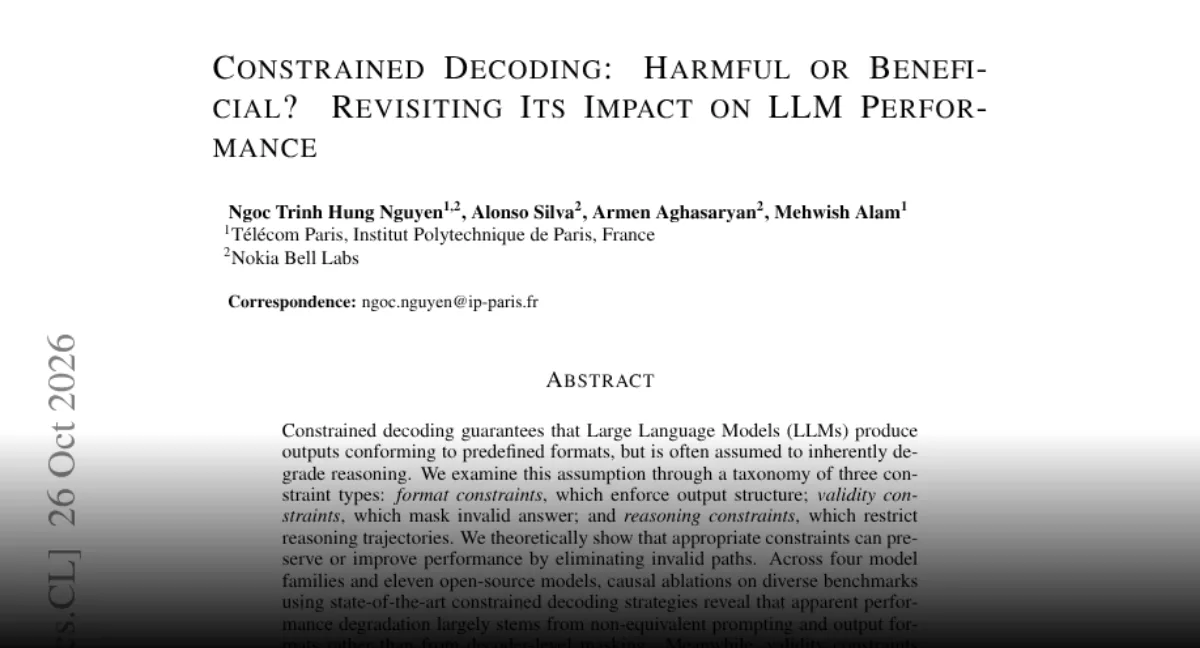
Constrained decoding guarantees that Large Language Models (LLMs) produce outputs that follow predefined formats. That guarantee is useful when an application needs machine-readable text, but a common assumption holds that it harms reasoning. The source treats that assumption as a testable claim. It organizes the issue into three constraint types: format constraints, which enforce output structure; validity constraints, which mask invalid answers; and reasoning constraints, which restrict reasoning trajectories. The distinction matters because each type removes a different part of the possible answer space. This framing helps explain why one decoding method can hurt one benchmark and help another.
Development: Theory and causal testing across models
The work first separates the theoretical role of masking from the practical role of prompt and output changes. It shows that constraints can preserve or improve performance when they remove invalid paths rather than useful ones. Then it examines the claim through causal ablations on diverse benchmarks. Causal ablations are tests that change one factor at a time to isolate the effect of masking. The tests cover four model families and eleven open-source models and use state-of-the-art constrained decoding strategies. The key result is that apparent performance loss is largely traced to non-equivalent prompting and output formats, not to decoder-level masking itself.
This is important for readers because a benchmark score can fall for different reasons. The model may be prevented from exploring valid reasoning paths, or the evaluation may compare differently formatted prompts and outputs. The source argues that the second explanation accounts for much of the observed degradation. In other words, the measured drop may come from changing the test setup, not from the decoder blocking reasoning.
Latest progress: Constraint type changes the outcome
The findings distinguish the effects of validity and reasoning constraints. Validity constraints improve reliability and extractability because they eliminate invalid answers. In practice, that means outputs are less likely to contain unusable or malformed results. That makes downstream parsing more dependable. Reasoning constraints can improve reasoning and accuracy when they enforce beneficial trajectories. They do not automatically help; they help only when the restricted path is better than the unrestricted path.
The overall conclusion is that constrained decoding is not a single good or bad technique. Its impact depends on the type of constraint and the output space it removes. Code is available.
What to watch next
The current evidence points to a more precise way to judge constrained decoding: identify which constraint type is present, check whether prompting and output formats match, and look at the paths removed from the answer space. The next question is how these three constraint types interact in more complex applications, especially where strict formats and reasoning trajectories are combined. The source places the field at a stage where constrained decoding is being reclassified from a blanket risk into a set of tools with different effects.
Comments
No comments yet. Be the first to comment.