
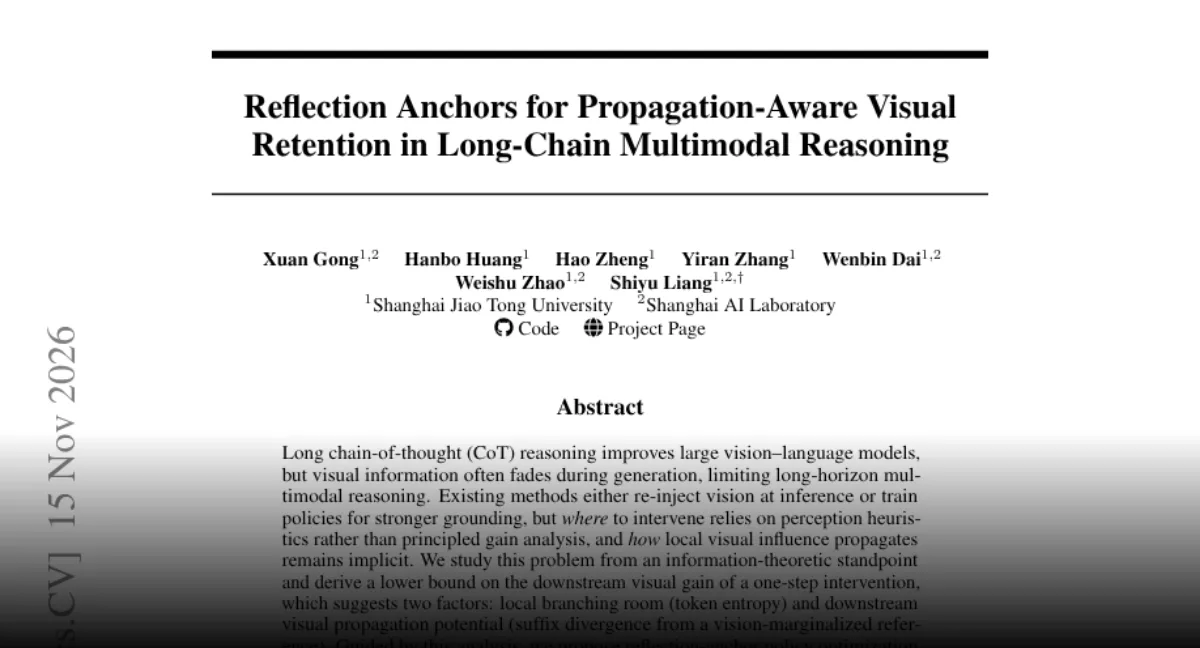
Reflection Anchors Enable Propagation-Aware Visual Retention in Long-Chain Multimodal Reasoning
The method uses reflection anchors and a chain-masked objective to keep visual evidence in multimodal reasoning, improving Qwen3-VL-2B-Instruct.
Key Takeaways
- RAPO addresses visual evidence decay in long-chain multimodal reasoning, where models increasingly rely on generated text instead of the original image.
- The method identifies high-entropy reasoning positions as sparse reflection anchors and trains with a chain-masked KL objective to preserve downstream visual influence.
- RAPO avoids visual re-injection during decoding and uses standard inference, with motivation rooted in information-theoretic visual propagation.
- On Qwen3-VL-2B-Instruct, RAPO improves the six-benchmark average from 40.79 with GRPO to 43.01 using mean@8 accuracy.
Title: RAPO Paper Shows Reflection Anchors Improve Visual Retention in Long Chain Reasoning
Meta Description: RAPO is a NeurIPS 2026 paper that uses reflection anchors to keep visual evidence in long-chain multimodal reasoning, improving Qwen3-VL-2B-Instruct.
Tags: RAPO, Multimodal Reasoning, Visual Retention, NeurIPS 2026, Qwen3-VL-2B-Instruct
Featured Image: Abstract diagram of visual evidence and text reasoning paths connected by anchor nodes, no people, no logos, no text.
Background: Visual Evidence Fades in Long Reasoning Chains
RAPO, or Reflection-Anchor Policy Optimization, is the subject of a NeurIPS 2026 paper titled Reflection Anchors for Propagation-Aware Visual Retention in Long-Chain Multimodal Reasoning. The work addresses a sequence problem in multimodal models: as reasoning chains grow longer, the model can gradually lose its dependence on visual evidence and rely more on generated text. This matters because long-chain answers may drift from the image while appearing fluent.
Development: Reflection Anchors Keep Visual Influence in the Loop
The method identifies high-entropy reasoning positions as sparse reflection anchors. It then trains the policy to preserve visual influence in downstream reasoning through a chain-masked KL objective. KL, or Kullback-Leibler divergence, is used here as the training signal. The motivation is information-theoretic, focusing on local branching and downstream visual propagation. Instead of adding visual re-injection or anchor selection during decoding, RAPO uses standard inference.
Latest Progress: Benchmarks, Paper, and Project Pages
On Qwen3-VL-2B-Instruct, the paper reports that RAPO improves the six-benchmark average from 40.79 with GRPO to 43.01 using mean@8 accuracy. The main resources are the paper at https://arxiv.org/abs/2605.09614, the project page at https://coder-gx.github.io/RAPO/, and the GitHub repository at https://github.com/coder-gx/RAPO. These pages show the method's place in the current NeurIPS 2026 output and offer entry points for follow-up discussion and implementation details.
Comments
No comments yet. Be the first to comment.