
LoopFill introduces pipelined multi-token speculative decoding for looped transformers.
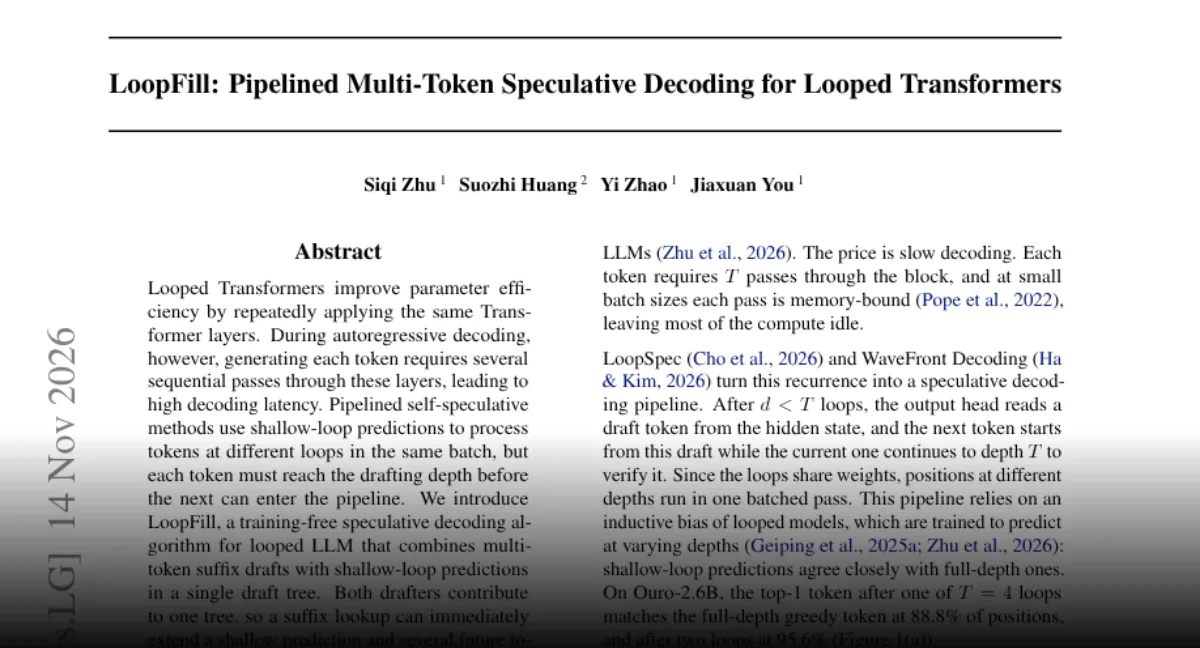
LoopFill is a training-free speculative decoding method for looped LLMs, where reused Transformer layers cause high token-by-token latency. It merges multi-token suffix drafts with shallow-loop predictions into one draft tree, letting several future tokens enter the pipeline together. Full-depth verification preserves the original autoregressive distribution. Across seven benchmarks, it reports 5.85x average speedup on Ouro-2.6B and 5.13x on Huginn-3.5B, outperforming LoopAhead by 40% and 25% respectively.
Key Takeaways
- LoopFill is a training-free speculative decoding method for looped LLMs, designed to reduce the high decoding latency caused by repeatedly applying the same Transformer layers.
- It improves on prior pipelined self-speculative approaches by combining multi-token suffix drafts and shallow-loop predictions into a single draft tree, allowing multiple future tokens to enter the pipeline together.
- This shared drafting structure helps overcome the “depth-gated” bottleneck where earlier methods required tokens to reach a certain loop depth before later tokens could be processed.
- LoopFill preserves model correctness by keeping full-depth verification, ensuring the final output still matches the original autoregressive distribution.
- Across seven benchmarks, it reports average speedups of 5.85× on Ouro-2.6B and 5.13× on Huginn-3.5B, outperforming the strongest baseline, LoopAhead, by 40% and 25%, respectively.
Meta description: LoopFill combines suffix drafts and shallow-loop predictions for looped LLM decoding, reporting 5.85× speedup on Ouro-2.6B and 5.13× on Huginn-3.5B.
Tags: LoopFill, Speculative Decoding, Looped Transformers, LLM Inference, Ouro-2.6B
Featured image: abstract neural-network diagram with looping arrows and token pipelines, cool blue gradient, no people, no logos, no text.
LoopFill is a training-free speculative decoding algorithm for looped LLM models, and it matters because it targets the high decoding latency created when the same Transformer layers are reused during autoregressive generation. The method combines multi-token suffix drafts with shallow-loop predictions in one draft tree, reporting 5.85× average speedup on Ouro-2.6B and 5.13× on Huginn-3.5B.
Background: Looped Layers Trade Parameter Efficiency for Latency
Looped Transformers improve parameter efficiency by repeatedly applying the same Transformer layers. The architecture reuses the same computational block rather than relying on a long sequence of unique layers.
That reuse creates a bottleneck during autoregressive decoding. Each new token is produced by passing the sequence through the repeated layers in order, so generating one token requires several sequential passes. The result is high decoding latency, especially in token-by-token generation.
The issue matters for looped LLM models because the same mechanism that saves parameters also makes each token wait through more internal loop steps. A model can be efficient in its layer count, yet still slow to emit the next token.
Development: Pipelined Drafting Was Limited by Depth
Pipelined self-speculative methods addressed this latency by using shallow-loop predictions. These methods process tokens at different loop depths within the same batch, allowing some work to happen before a token has completed the full loop path.
The constraint was in how tokens entered the pipeline. Each token had to reach the drafting depth before the next token could enter. That gate kept the batch from filling quickly. One token waited for its depth, and later tokens remained queued behind it.
Latest: LoopFill Builds One Draft Tree from Two Sources
LoopFill changes the drafting stage by combining multi-token suffix drafts and shallow-loop predictions in a single draft tree. Both drafters contribute to the same tree, so a suffix lookup can immediately extend a shallow prediction. That allows several future tokens to enter the pipeline together instead of waiting for a single token to reach the drafting depth.
The method is training-free for looped LLM models, meaning it does not require additional training. Its shared block computes the highest-scoring draft candidates at different loop depths in one batch. Full-depth verification then preserves the model's autoregressive output distribution.
This matters because speculative decoding can be fast only if the verified output still matches the original distribution. LoopFill keeps the full-depth verification step while reorganizing how drafts are generated and batched.
Current Stage: Seven-Benchmark Speedups Lead LoopAhead
Across seven benchmarks, LoopFill's average speedup over greedy autoregressive decoding is 5.85× on Ouro-2.6B and 5.13× on Huginn-3.5B. The speedups exceed those of LoopAhead, the strongest baseline, by 40% on Ouro-2.6B and 25% on Huginn-3.5B.
At this stage, the evidence shows that merging suffix drafts with shallow-loop predictions can reduce the depth-gated pipeline wait in looped LLM decoding. The next watchpoint is how this single draft-tree mechanism performs outside the seven-benchmark comparisons and against the strongest existing baseline.
Comments
No comments yet. Be the first to comment.