
MovieRoll: A Systematic Framework for Producing Long-Form Videos
MovieRoll links streaming fine-tuning, distillation, and inference to extend video generation to 60 seconds, improving quality and memory efficiency.
Key Takeaways
- MovieRoll is a base-to-distilled framework for streaming video generation, connecting streaming fine-tuning, long-rollout distillation, and long-horizon inference to address quality and memory challenges.
- The base stage uses WinTF for longer-sequence training and HieraKV for hierarchical KV-cache compression, reportedly reducing cache memory by up to 78% while improving generation quality.
- The distillation stage applies CuLT-DMD to convert the base model into an efficient few-step generator by averaging local gradients across long self-rollouts.
- During inference, KV recomputation and AnnealCFG help extend generation beyond training lengths, with MovieRoll-Base competitive at 30s and MovieRoll-Distilled achieving top scores up to 60s on HeliosBench.

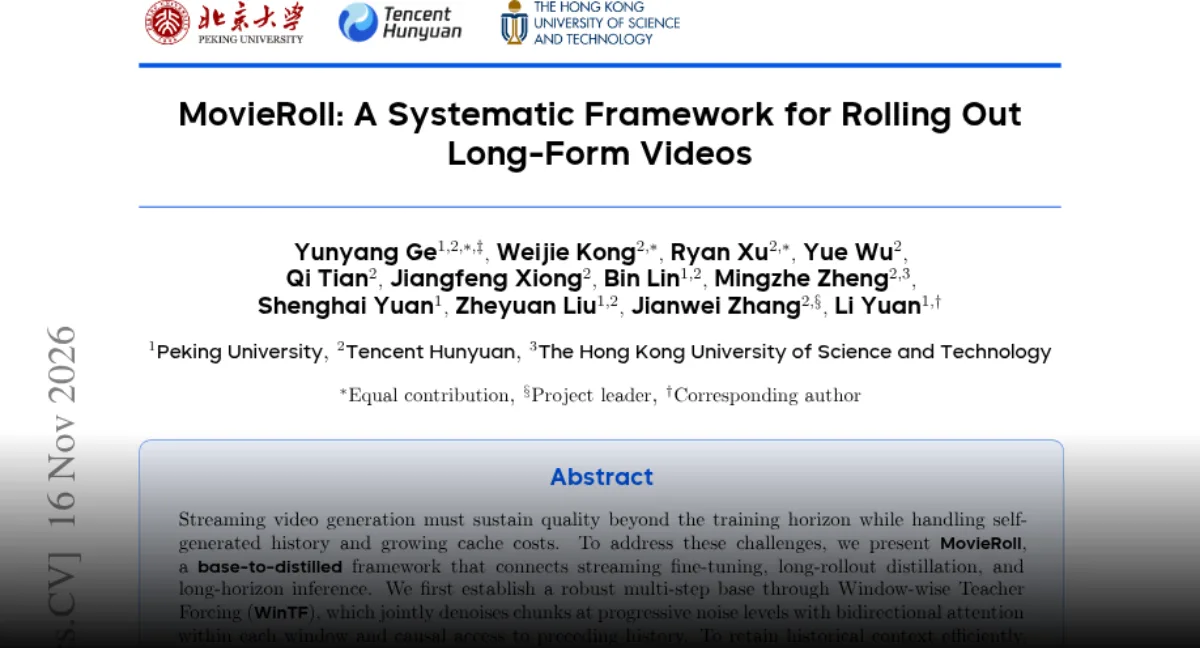
Meta description: MovieRoll combines WinTF, HieraKV, CuLT-DMD, FBCA attention, and PS-VAE decoding to extend streaming video generation, with HeliosBench scores at 30s and 60s.
Tags: MovieRoll, streaming video generation, HieraKV, CuLT-DMD, HeliosBench
MovieRoll is a base-to-distilled framework for streaming video generation that links streaming fine-tuning, long-rollout distillation, and long-horizon inference. The reported HeliosBench results place it at two useful points: MovieRoll-Base remains competitive at 30s after training on videos of up to 15s, while MovieRoll-Distilled achieves the highest total scores among compared methods across single- and multi-event evaluations up to 60s.
Background: quality and memory beyond the clip
Streaming video generation has to keep quality after the duration used during training, while the system also manages content it has generated itself. As the output grows, the memory needed to carry that history becomes a second pressure point. MovieRoll is presented as a response to those linked constraints.
Base stage: WinTF and HieraKV
The framework begins with Window-wise Teacher Forcing, or WinTF. It jointly denoises chunks at progressive noise levels. Inside each window, attention works bidirectionally; when looking backward, it uses causal access to preceding history. That creates a base model able to work with longer sequences rather than only isolated clips.
To keep that history affordable, hierarchical key-value cache compression, called HieraKV, uses layer-wise attention patterns. Shallow layers retain full history, while deeper layers keep sink and recent history. According to the reported figures, this reduces cache memory by up to 78% while improving generation quality.
Distillation stage: CuLT-DMD and streaming support
On top of the base, MovieRoll applies cumulative long tuning with distribution matching distillation, or CuLT-DMD. During each long self-rollout, parameters stay fixed. Local gradients are averaged before an update. The update therefore brings together supervision across temporal positions while keeping only one local computation graph. This makes long-rollout training efficient for a few-step generator.
FBCA attention and PS-VAE decoding support the framework from the engineering side, helping efficient training and streaming output.
Inference stage: recomputation and AnnealCFG
For generation beyond the training horizon, key-value recomputation, or KV recomputation, bounds context for both models. Guidance annealing, or AnnealCFG, reduces guidance toward the clean endpoint to stabilize MovieRoll-Base.
The resulting evaluation is split between the base and distilled variants. MovieRoll-Base remains competitive at 30s after training on videos of up to 15s. MovieRoll-Distilled achieves the highest total scores among compared methods across single- and multi-event evaluations up to 60s, combining sustained naturalness with active motion.
Current stage: a connected pipeline
MovieRoll is positioned as a connected pipeline rather than a single model. WinTF and HieraKV build a memory-efficient base; CuLT-DMD converts that base into a distilled few-step generator; recomputation and AnnealCFG support inference beyond the clip lengths used in training. The evidence currently centers on HeliosBench scores at 30s and 60s, with cache reduction reported at up to 78%.
Comments
No comments yet. Be the first to comment.