
Large-scale LLM serving adapts to agents on evolving infrastructure.
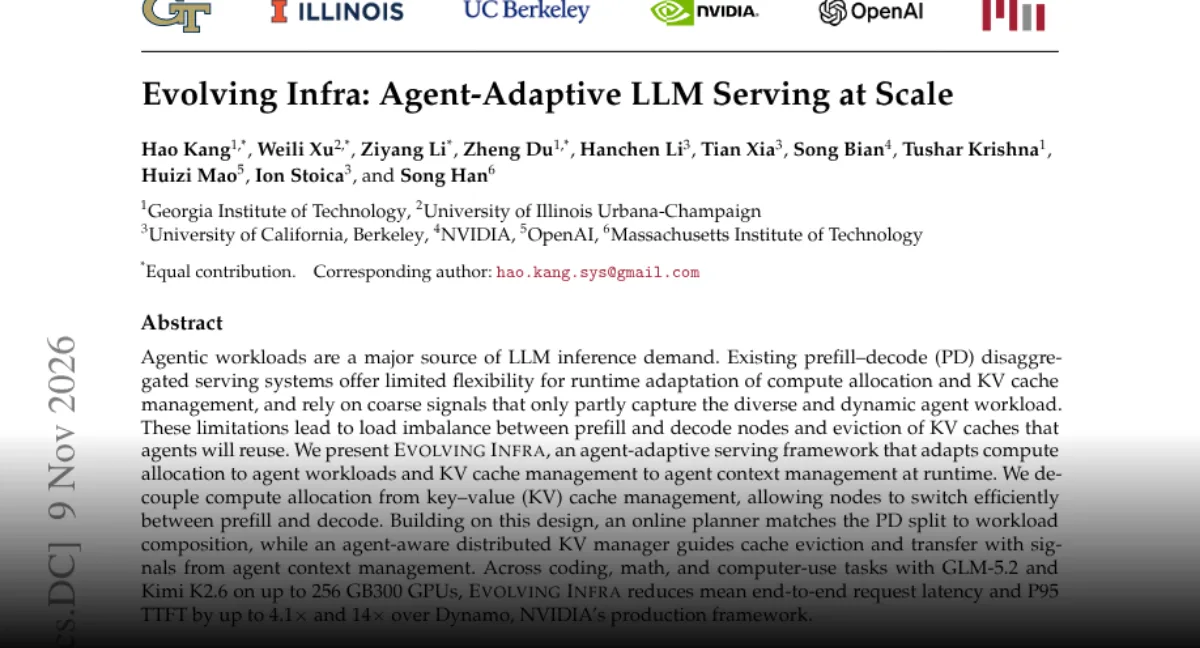
Evolving Infra adapts LLM serving by separating compute and key-value cache, improving agentic latency and tail delays versus Dynamo on GB300 GPUs.
Key Takeaways
- Evolving Infra is an agent-adaptive LLM serving framework that addresses limitations in prefill-decode disaggregated serving by decoupling compute allocation from KV cache management and adapting both at runtime.
- Agentic workloads expose serving weaknesses because existing systems rely on coarse signals, leading to imbalanced prefill/decode load and premature eviction of reusable KV cache state.
- The framework uses an online planner to match prefill-decode compute allocation to workload composition and an agent-aware distributed KV manager to guide cache eviction and transfer based on likely agent context needs.
- Benchmarks on up to 256 GB300 GPUs with GLM-5.2 and Kimi K2.6 report reductions versus Dynamo: up to 4.1x lower mean end-to-end request latency and up to 14x lower P95 time-to-first-token.
- The results suggest that agent-aware runtime control can improve average throughput and tail latency, but broader consistency across model families, task mixes, cache sizes, and deployment scales remains to be evaluated.
Meta description: Evolving Infra adapts GPU serving for agentic LLM workloads by decoupling compute and KV cache, cutting latency and TTFT versus Dynamo on GB300 GPUs.
Tags: Agentic AI, LLM inference, GPU serving, KV cache, Dynamo
Featured image: Abstract technology style image showing connected GPU nodes and cache pathways, no real people, no company logos, no text.
Evolving Infra is an agent-adaptive serving framework for large language model inference, aimed at the share of demand created by agentic workloads. It targets a gap in prefill-decode, PD, disaggregated serving by separating compute allocation from key-value cache management and adapting both at runtime.
Background: Agentic Workloads Expose Serving Limits
Agentic workloads are a major source of LLM inference demand. PD disaggregated systems split prompt processing, called prefill, from token generation, called decode. The key-value cache stores intermediate state from earlier tokens so the model can continue generation without recomputing that state. Existing serving systems offer limited flexibility for runtime adaptation of compute allocation and KV cache management. They rely on coarse signals that only partly capture the diverse and dynamic agent workload.
That reuse is central because agent systems can return to earlier context. These limitations lead to two problems. Load can become imbalanced between prefill and decode nodes. KV caches that agents will reuse can be evicted. For a serving system, that means GPU capacity may sit in the wrong stage while reusable context is discarded too early.
Development: Separating Compute and KV Cache Control
Evolving Infra changes the control model by decoupling compute allocation from KV cache management. This allows nodes to switch efficiently between prefill and decode. The framework keeps the two concerns separate instead of treating node role and cache placement as one fixed decision. This decoupling is what makes runtime switching practical.
It uses two coordinated mechanisms. An online planner matches the PD split to workload composition. An agent-aware distributed KV manager guides cache eviction and transfer with signals from agent context management. The planner tracks how much compute belongs to prefill and decode as the workload changes. The KV manager decides what cache state to keep, move, or remove based on what the agent is likely to need.
Current Stage: Benchmark Results and What to Watch
The reported evaluation covers coding, math, and computer-use tasks with GLM-5.2 and Kimi K2.6 on up to 256 GB300 GPUs. Against Dynamo, NVIDIA's production framework, Evolving Infra reduces mean end-to-end request latency by up to 4.1x and P95 TTFT by up to 14x. The reported scale, up to 256 GB300 GPUs, is part of the benchmark context.
Those metrics matter for agent serving. Mean end-to-end request latency reflects the average wait for a complete request. P95 TTFT reflects a tail latency measure for time to first token that can affect interactive loops. Large reductions in both suggest that runtime adaptation can improve average throughput and reduce slow responses in the tested settings. The comparison is against Dynamo, NVIDIA's production framework.
The current stage shows that agent-aware control can change serving performance beyond static PD resource allocation. The next question is how consistently these gains appear across model families, task mixes, cache sizes, and deployment scales.
Comments
No comments yet. Be the first to comment.