
MIRA: An Agent that Refines Musical Intent to Align Text-to-Music Generation with User Goals
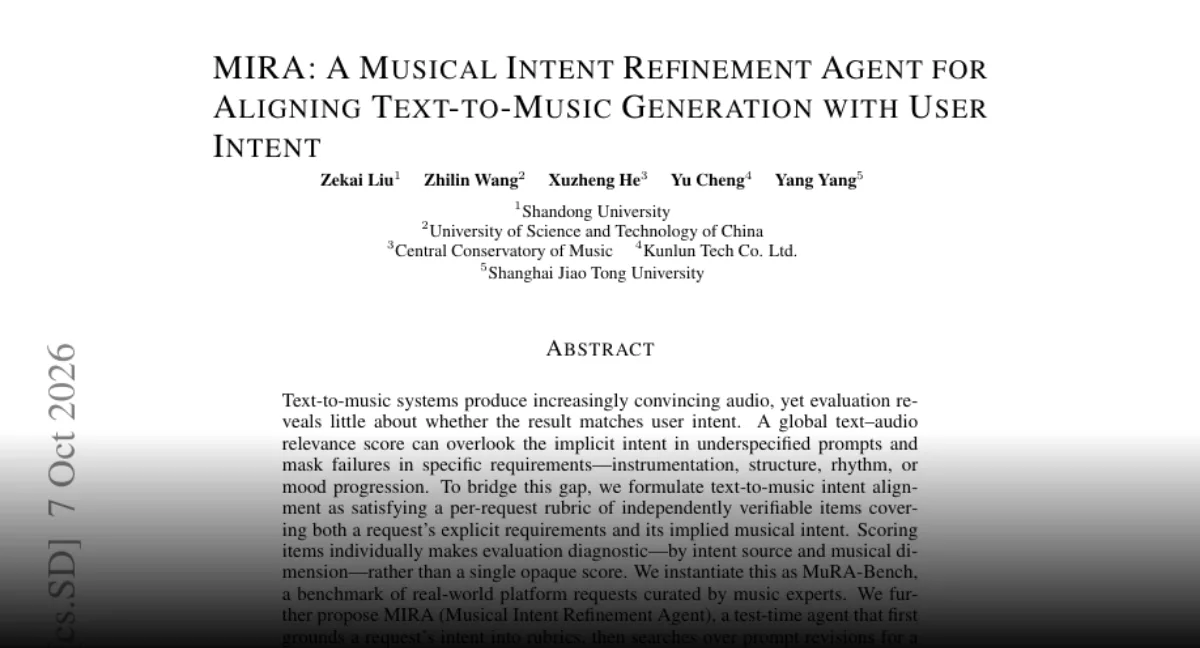
MIRA aligns text-to-music output with explicit and implied intent using MuRA-Bench and black-box refinement, improving alignment without retraining.
Key Takeaways
- MIRA addresses a key gap in text-to-music systems: aligning generated audio with user intent, including requirements implied but not explicitly stated in prompts.
- The project introduces MuRA-Bench, a 100-request benchmark with expert-revised rubrics covering both explicit and inferred musical intent, making intent alignment measurable.
- MIRA acts as a black-box refinement agent that improves output alignment without updating generator parameters, using tool-grounded intent completion, requirement-level audio verification, and budgeted tree search with branch-specific memory.
- Evaluation across three generation backends shows improved intent alignment, suggesting a practical workflow layer for users and teams already relying on existing music generators.
- Public examples are available on the project page, while the next challenge is scaling such refinement loops to everyday creative workflows where user goals may change during generation.
Meta Description: MIRA uses MuRA-Bench, 100 music requests, and three backends to improve text-to-music intent alignment without updating generator parameters.
Tags: MIRA, MuRA-Bench, text-to-music, AI music generation, black-box refinement
Featured Image: Abstract waveform mesh and prompt tokens over a dark gradient, with no visible text, no logos, and no people.
Background: The Missing Intent Check in Text-to-Music
Text-to-music systems have moved from novelty demos toward practical creative tools, but a user prompt can carry more than the words typed. A request may imply tempo range, mood, instrumentation, structure, or dynamics that the model must infer. MIRA text-to-music refinement starts from this practical question: how can these systems better capture what users actually intend, including requirements that are only implied by a prompt?
The work is introduced by Zekai Liu, the first author of MIRA. Instead of presenting a new music model alone, the project separates two problems: measuring intent alignment and improving alignment without changing the generator behind the curtain. That distinction matters for readers who already use music generators and cannot or do not want to retrain them.
Development Process: Building MuRA-Bench Before Building MIRA
The first stage is measurement. The team introduces MuRA-Bench, a benchmark of 100 music-generation requests. Each request is paired with expert-revised rubrics that cover explicit musical intent and inferred musical intent. Explicit intent is what the prompt directly states. Inferred intent is what a human would reasonably expect from the request, even if the prompt does not spell it out.
By fixing the number of requests at 100 and revising the rubrics with expert input, MuRA-Bench creates a clearer test bed than a vague list of favorite prompts. It gives the project a concrete way to ask whether a generated track satisfies the stated brief and the unstated expectations. For a reader evaluating text-to-music tools, the benchmark signals that intent alignment is now a measurable question, not just a subjective impression of whether a song sounds good.
Latest Progress: A Black-Box Refinement Loop Across Three Backends
The second stage is intervention. MIRA is described as a black-box refinement agent. In this setting, black-box means the refinement layer does not update generator parameters. It operates around the music generator rather than inside its training process.
MIRA combines three mechanisms. Tool-grounded intent completion uses tools to fill in task requirements before generation, rather than relying only on the model's own assumptions. Requirement-level audio verification checks generated audio against individual rubric items instead of judging the whole track at once. Budgeted tree search with branch-specific memory explores candidate refinements under a limited search budget while remembering what happened in each branch.
The evaluation covers three generation backends. The reported result is improved intent alignment without updating generator parameters. That is the key practical claim: the method improves how well outputs match user intent, including implied requirements, while keeping the underlying generators unchanged. For teams using existing music models, this suggests a workflow layer rather than a new model stack.
Current Stage: Public Examples and the Next Evaluation Question
The latest public step is a project page that includes more details and audio examples. The page is available at https://mirareview.github.io/. This is where readers can inspect how MuRA-Bench requests and MIRA refinements translate into audible results.
The project currently sits at the stage of benchmarked, black-box refinement evaluation. The 100-request MuRA-Bench suite, the three backend tests, and the project-page examples form the visible foundation. The next practical question is whether such refinement loops can scale beyond curated benchmark prompts into everyday creative workflows, where users change their intent mid-process and expect music systems to keep up.
Comments
No comments yet. Be the first to comment.