
Trainable Vectors Reveal the Geometry of RLVR in LLMs: Learning to Steer, Steering to See
RLVR gains map to low-dimensional activation geometry; Alpha-Stabler steers harmful directions to stabilize LLM training across 5 models and 6 tasks.
Key Takeaways
- RLVR improves LLM reasoning but suffers from high-dimensional training instability, making failures hard to diagnose and control.
- Vector steering analysis shows that RLVR gains are carried by a low-dimensional effective manifold rather than the full activation space.
- Useful control directions mainly lie in the low-variance complement of the activation principal subspace, not in the most dominant statistical directions.
- Alpha-Stabler is a plug-and-play framework that predicts harmful principal-subspace intrusion and corrects activation gradients during backpropagation.
- Tested on 5 LLMs and 6 verifiable-reward tasks, the method stabilizes training for 2,000 steps and consistently improves RL gains.
Reinforcement learning with verifiable rewards, or RLVR, has become a major way to sharpen the reasoning of large language models, but its training updates live in such high-dimensional spaces that failures are hard to diagnose. A new study reframes the problem around activation geometry and introduces Alpha-Stabler, a plug-and-play framework that monitors and corrects harmful directions during backpropagation. The work matters because it turns RLVR's opaque optimization process into a measurable structure, with findings tested on 5 LLMs and 6 verifiable-reward tasks.
Background: RLVR brings high-dimensional instability
RLVR differs from open-ended preference optimization because rewards can be checked against verifiable outcomes, such as whether an answer matches a required format or a test result. That property makes it useful for reasoning-heavy post-training. The downside is that reinforcement learning updates touch many parameters at once, and the resulting activation changes can be difficult to separate from noise, drift, or collapse.
The study therefore starts from a practical question: when RLVR improves a model, does the improvement occupy the full activation space, or is it carried by a smaller set of directions? If the latter, researchers may be able to track, intervene, and stabilize training without changing the whole model.
Development: vector steering maps RL gains to low-dimensional geometry
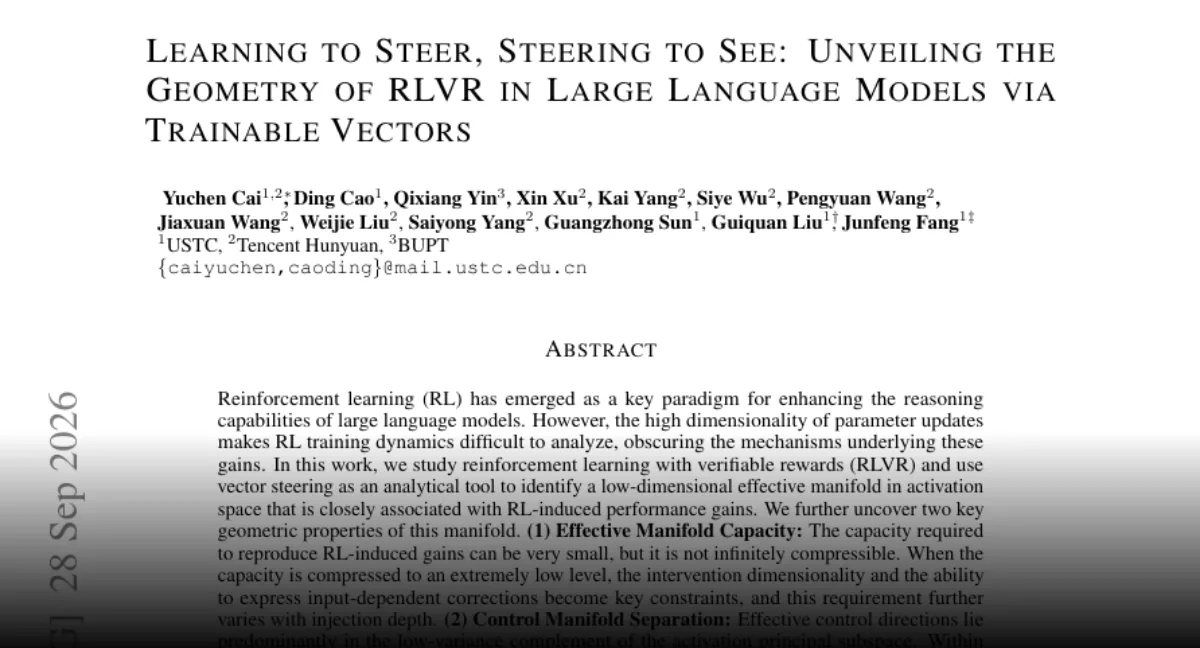
To answer that question, the authors use vector steering, a method that injects or modifies activation vectors to test whether specific directions reproduce reinforcement-learning gains. The analysis identifies a low-dimensional effective manifold associated with RL-induced improvements. Two geometric properties emerge.
The first is Effective Manifold Capacity. The capacity needed to reproduce RL gains can be very small, but it is not infinitely compressible. At extremely low capacity, intervention dimensionality and input-dependent expressiveness become key constraints. The required capacity also varies with injection depth, meaning that where the steering vector is applied inside the model changes how much structure is needed to recover the same effect.
The second is Control Manifold Separation. Effective control directions do not mainly live in the highest-variance parts of activation space. Instead, they lie mainly in the low-variance complement of the activation principal subspace. In plain terms, the most dominant statistical directions are not always the most useful places for control. The geometry learned by RLVR stays largely consistent across training configurations within a task and base model, and across tasks its alignment correlates with capability transfer. These findings were observed across experiments on 5 LLMs and 6 verifiable-reward tasks.
Latest: Alpha-Stabler turns geometry into a training stabilizer
Building on that geometry, the authors propose Alpha-Stabler, a framework designed to be inserted into existing RLVR pipelines without redesigning the base training objective. It has two components. The Predictor monitors principal-subspace intrusion, giving early warnings when activation updates begin to move into dominant directions that may signal collapse. The Controller acts during backpropagation, the gradient-computation step of training. It removes the principal-subspace component of activation gradients while preserving the orthogonal complement.
The reported effect is that Alpha-Stabler stabilizes training for 2,000 steps and consistently improves RL gains. That matters for practitioners because long-run instability is one of the failure modes that makes reinforcement learning post-training expensive and hard to reproduce. The code is available at https://github.com/caiyuchen-ustc/On_Policy_Vector_Training.
Current stage: a diagnostic layer, not a finished replacement
The study places RLVR analysis at an early-to-mid stage. The central contribution is not a new reward design or a new model architecture, but a way to describe where reinforcement-learning gains live in activation space and how to keep training from drifting into harmful dominant directions. The 5 LLMs and 6 verifiable-reward tasks give evidence that the geometry is not a single-model artifact, while the 2,000-step result shows a concrete stabilization window.
The next question is whether principal-subspace intrusion remains a reliable warning signal beyond the tested tasks and injection depths, and whether the low-variance complement continues to carry useful control directions as models scale. For now, Alpha-Stabler offers a practical lens: RLVR gains can be small in geometric capacity, yet fragile when the wrong activation directions are allowed to dominate.
Meta description: Alpha-Stabler analyzes RLVR geometry in 5 LLMs and 6 tasks, stabilizing training for 2,000 steps using vector steering, a predictor, and a controller.
Tags:
- RLVR
- Alpha-Stabler
- reinforcement learning
- large language models
- activation geometry
Featured image: abstract technology style, low-dimensional glowing manifold over dark neural network field, no real people, no company logos, no text
Comments
No comments yet. Be the first to comment.