
Learning Dynamic Spatial Correspondence Enables Immersive Joint Video-Audio Generation That Lets Users Hear the World in Stereo
StereoBind links motion tracks to stereo audio for immersive video, benchmarked on StereoWorld-29K, beating Veo 3 and Sora 2.0.
Key Takeaways
- StereoBind generates stereo audio from video by using visual motion tracks to guide spatial sound placement.
- It addresses a key gap in joint video-audio models: strong semantic and timing alignment but weak stereo/spatial audio generation.
- The framework combines motion tracking, left/right audio synthesis, and temporal alignment to create immersive audio that matches moving visual events.
- Evaluated on StereoWorld-29K, a 29K-video stereo audio benchmark, StereoBind outperformed Veo 3 and Sora 2.0 with win rates of 61.8% and 67.2%.
Meta description: StereoBind links visual motion tracks to stereo audio generation and is evaluated on StereoWorld-29K, reporting win rates over Veo 3 and Sora 2.0.
Tags: StereoBind, stereo audio generation, video-audio models, StereoWorld-29K, spatial audio
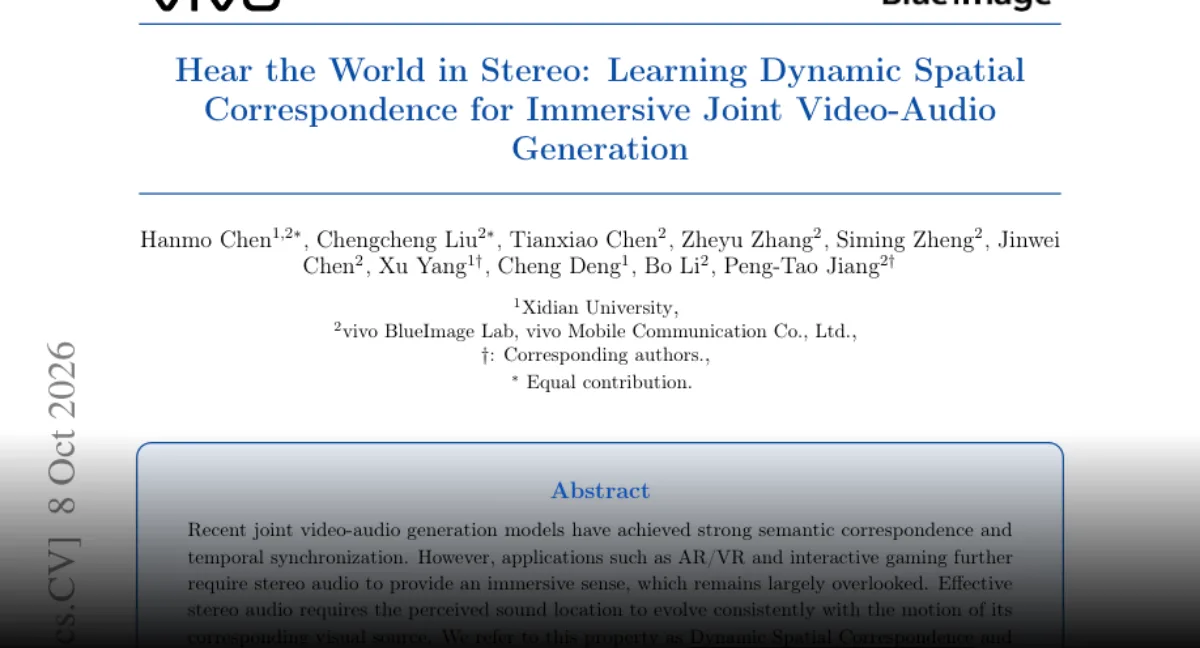
Featured image: abstract stereo waveform and motion-track network on dark gradient, no people, logos, or text
Background: Joint Video-Audio Models Reached Semantic and Timing Milestones
StereoBind is a framework for generating stereo audio from video by following visual motion tracks. It matters because recent joint video-audio generation models have already achieved strong semantic correspondence and temporal synchronization, but they still struggle to place sound in a stereo field. That gap becomes important for immersive applications such as augmented reality, virtual reality, and interactive gaming, where sound must help a viewer understand where events happen.
The first stage is a model that is already coherent but not yet spatial. Recent joint video-audio generation models can match the meaning of a scene with the sound it should produce, and they can keep that sound aligned with visual events over time. The missing layer is stereo audio. In mono sound, each event is usually tied to one flat audio channel, while stereo audio uses separate left and right channels to create directional cues. Without that layer, a video can be semantically accurate and still feel disconnected from the visual scene.
Development: Visual Motion Tracks Guide Stereo Audio Generation
StereoBind builds that missing layer around visual motion tracks. The framework uses three complementary mechanisms. Visual Motion Tracks turns moving objects and events in a video into a structured sequence that can be followed over time. Stereo Audio Generation maps those motion tracks into left and right audio signals, so the sound can reflect the position of moving events. Temporal Alignment keeps the generated stereo audio synchronized with the visual motion, preserving the timing strength that earlier video-audio models already had.
This design changes the generation task from “produce sound that matches the video” to “produce stereo sound that also matches where motion happens.” For immersive media, that shift is practical: a viewer needs to perceive not only what is happening, but where it is happening. Visual motion tracks provide a bridge between the visual scene and the spatial audio output.
Evaluation: StereoWorld-29K Tests Direction, Motion, and Timing
The evaluation stage introduced StereoWorld-29K, a large-scale stereo video-audio dataset with 29K high-quality videos and synchronized spatial audio. The dataset is important because it gives models a concrete test of whether sound direction, motion, and timing agree with the visual scene.
On StereoWorld-29K, StereoBind beat leading baselines on both objective metrics and human preference. The reported average win rate was 61.8% over Veo 3 and 67.2% over Sora 2.0. These results show that the framework is not just adding an extra audio channel, but improving the spatial relationship between generated sound and generated video.
Current Stage: A Spatial Upgrade for Immersive Video-Audio Workflows
The current stage is a spatial upgrade for joint video-audio generation, not a claim that the problem is solved. StereoBind shows that visual motion tracks can serve as a practical control signal for stereo audio generation, and StereoWorld-29K provides a benchmark for testing that claim.
What to watch next is whether motion-track conditioned stereo audio becomes a standard part of immersive media workflows. Interactive applications may need that signal first, because they depend on sound that moves with the scene and helps users perceive direction, timing, and spatial context.
Comments
No comments yet. Be the first to comment.