
We Rethink the Transfer of Relative Policy Differences in On-Policy Distillation
Study shows on-policy distillation can transfer expert-reference gaps, not stronger teachers, with training-induced gaps working best.
Key Takeaways
- The paper questions the common assumption that on-policy distillation requires a stronger teacher, instead using the relative policy difference between a proxy expert and a proxy reference as the transfer signal.
- The method treats the log-probability gap between expert and reference as an implicit reward, guiding the target model during its own rollouts rather than relying only on fixed demonstrations.
- The proposed “any-to-any” formulation does not require one model to be strictly stronger or larger; standard teacher-student distillation is just a special case within this broader framework.
- Transfer success depends more on how the behavioral gap is created than on model size: gaps produced by reinforcement learning or supervised fine-tuning transfer more reliably than gaps from scale alone.
- Practical takeaway: choosing a meaningful expert-reference pair can be more important than choosing the strongest teacher, because changing the reference model can turn a failed transfer into a successful one.
Meta Description: New research tests on-policy distillation that transfers gains without a stronger teacher using relative policy differences between expert and reference models.
Tags: On-Policy Distillation, Model Improvement, Reinforcement Learning, Supervised Fine-Tuning, AI Research
Featured Image: An abstract diagram of model updates connecting a source pair to a target model, with no people, logos, or text.
Background: The Question Behind the Paper
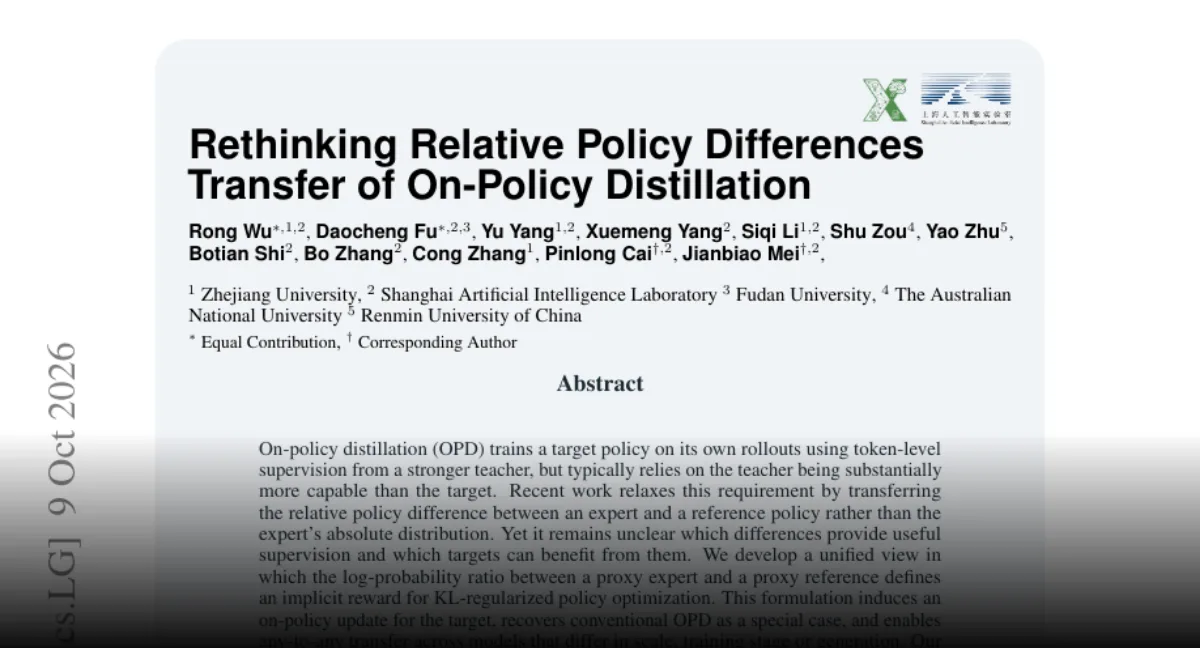
On-policy distillation is usually discussed as a way for a model to learn from a stronger teacher while generating its own responses. The paper Rethinking Relative Policy Differences Transfer of On-Policy Distillation asks whether that stronger-teacher assumption is necessary. Instead of treating the teacher alone as the source of improvement, the work studies the gap between two auxiliary models: a proxy expert and a proxy reference. The target model then follows updates based on that gap during its own rollouts, meaning it learns from the answers it produces rather than only from fixed demonstrations. This matters because transfer success can depend on the comparison design, not just model size. If the stronger-teacher assumption is not always required, the design question becomes less about picking the largest model and more about choosing a meaningful comparison pair.
Development: How Relative Policy Differences Became a Transfer Signal
The method centers on the log-probability difference between the proxy expert and the proxy reference. That difference is not used as a final answer; it is used as an implicit reward that guides the target model. The researchers call their broader setup an any-to-any formulation because it does not require one model to be simply larger or stronger than the other. The setup treats the expert and reference as a pair rather than ranking one as the winner. Conventional on-policy distillation appears as a special case inside this formulation, which makes the study useful as a way to separate two ideas: where a capability comes from, and how that capability is narrowed into a transferable signal.
Findings: What Transfers and What Does Not
The results point to three roles in the transfer process. The expert supplies the capability being studied. The reference helps isolate the part of that capability that should move to the target. The target must still be able to learn and generalize the resulting update. In practice, not every source pair produces the same outcome. The paper finds that differences created by reinforcement learning or supervised fine-tuning transfer more reliably than differences that arise only from model scale. The paper does not say that scale is useless. It places less trust in scale-only gaps and more trust in gaps created by training procedures. This suggests that the origin of the behavioral gap matters more than a simple size gap between models.
Current Stage: Practical Choices for Source Models and Targets
The most concrete implication is that a failed transfer may not mean the target is incapable. It may mean the reference model is not isolating the right part of the expert's behavior. The paper reports cases where changing the reference turns a failed transfer into a successful one. That shifts attention from choosing only the strongest possible teacher to choosing a source pair whose relative difference is meaningful for the target. The public code repository at https://github.com/KnowledgeXLab/A2-OPD gives the method a concrete implementation path, while the paper frames the next open question: how broadly any-to-any transfer can work across different source pairs and targets.
Comments
No comments yet. Be the first to comment.