
Representations Are Learned to Guide Pixel Diffusion Transformers
Representation Guidance enables plain Transformers to generate high-quality pixel images without an autoencoder by shaping useful internal features.
Key Takeaways
- Representation Guidance shows that a plain Transformer can generate high-quality images directly in pixel space without relying on a VAE or a specialized pixel decoder, as long as its internal representation is properly formed and actively used.
- The method introduces a low-dimensional bottleneck and modifies the flow-matching target using the difference between decoder predictions with and without the representation, forcing the model to depend on generation-relevant features.
- On ImageNet 256, RG-XL/16 achieves FID 1.55 with 725M parameters, while RG-L/16 uses only 459M parameters but outperforms much larger pixel diffusion Transformers such as the 2B JiT-G.
- Representation Guidance also improves training efficiency, reaching comparable FID with roughly 4× fewer epochs, and extends to higher-resolution and text-to-image settings with competitive scores.
Representation Guidance Enables Plain Transformers to Generate High-Quality Pixel Images
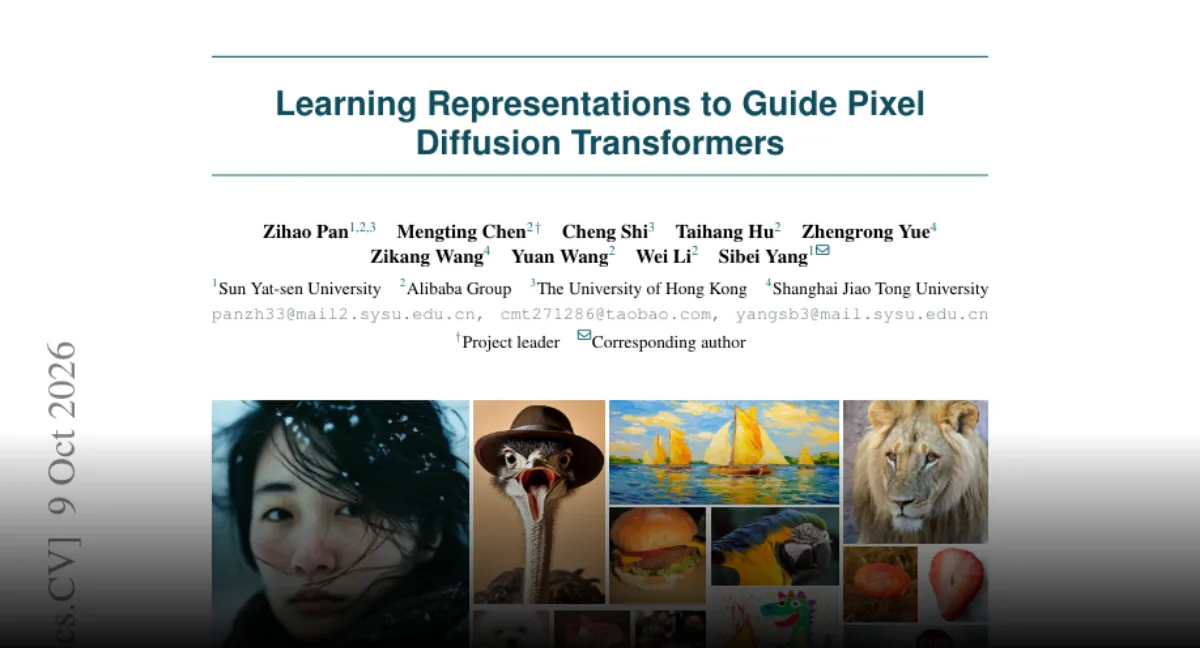
Meta Description: Representation Guidance lets plain Transformers generate high-quality images in pixel space without a VAE or specialized pixel decoder, improving FID.
Tags: Representation Guidance, Transformer, Flow Matching, ImageNet, FID
Featured Image: Abstract technology style with pixel grid, transformer blocks, latent bottleneck, and velocity arrows; no real people, no company logos, no text.
A method called Representation Guidance suggests that a plain Transformer can generate high-quality images directly in pixel space without a VAE or a specialized pixel decoder, if its internal representation is both properly formed and actively exploited. The result matters because it questions whether pixel-space generation needs extra architectural machinery, and it reports better scores than some much larger pixel DiTs.
Background: The Pixel-Space Question
The research question starts from a gap: prior work improved either representation alignment or decoder structure, but the source argues those changes did not make the representation itself better suited to generation. The project asks whether a plain Transformer can work directly in pixel space without a VAE and without a specialized pixel decoder. Its answer is yes, but only when the model’s internal representation is properly formed and actively used during generation.
Development: What Earlier Work Showed
The source points to two limitations. First, better representations do not automatically produce better generation. REPA-style alignment improves semantics at the aligned layer, but the gain fades in later layers and does not improve final FID. Second, pixel decoders mostly shift work around. PixelDiT, DiP, and DeCo change how semantic and spatial modeling is split between encoder and decoder, but they do not yield representations better suited to generation.
Latest Progress: How Representation Guidance Works
Representation Guidance, or RG, uses a low-dimensional bottleneck to pack generation-relevant information into a compact implicit latent. The method compares the decoder’s velocity with the representation and without the representation, producing an offset. That offset is used to modify the flow-matching target: v_RG = v + (s-1)·sg(Δv_rep).
The change forces the decoder to depend on the representation, and that dependency shapes the encoder toward what synthesis needs. The source describes the effect as similar to self-distillation in SSL, because the representation is bootstrapped from the model’s own predictions.
Results and Current Stage
On ImageNet 256, RG-XL/16 reaches FID 1.55 with 725M parameters. RG-L/16 uses only 459M parameters but beats much larger pixel DiTs, including the 2B JiT-G. Convergence is reported as 4× faster: RG-B reaches JiT-B’s 600-epoch FID in 150 epochs. At ImageNet 512, the method records FID 1.74. For text-to-image, the reported scores are GenEval 0.89 and DPG-Bench 87.1.
Project and code links are listed at https://pan-zihao.github.io/Representation-Guidance/ and https://github.com/Pan-Zihao/Representation-Guidance. The development is currently at the research stage: a method, benchmark results, and public links. The next signal to watch is whether pixel-space generation can rely on Representation Guidance rather than added decoders.
Comments
No comments yet. Be the first to comment.