
Reflex Provides Visually Grounded Reactive Control for Humanoid Robots
Reflex learns humanoid catching through whole-body control, dynamics inference, and egocentric vision, achieving 85.7 percent simulated success.
Key Takeaways
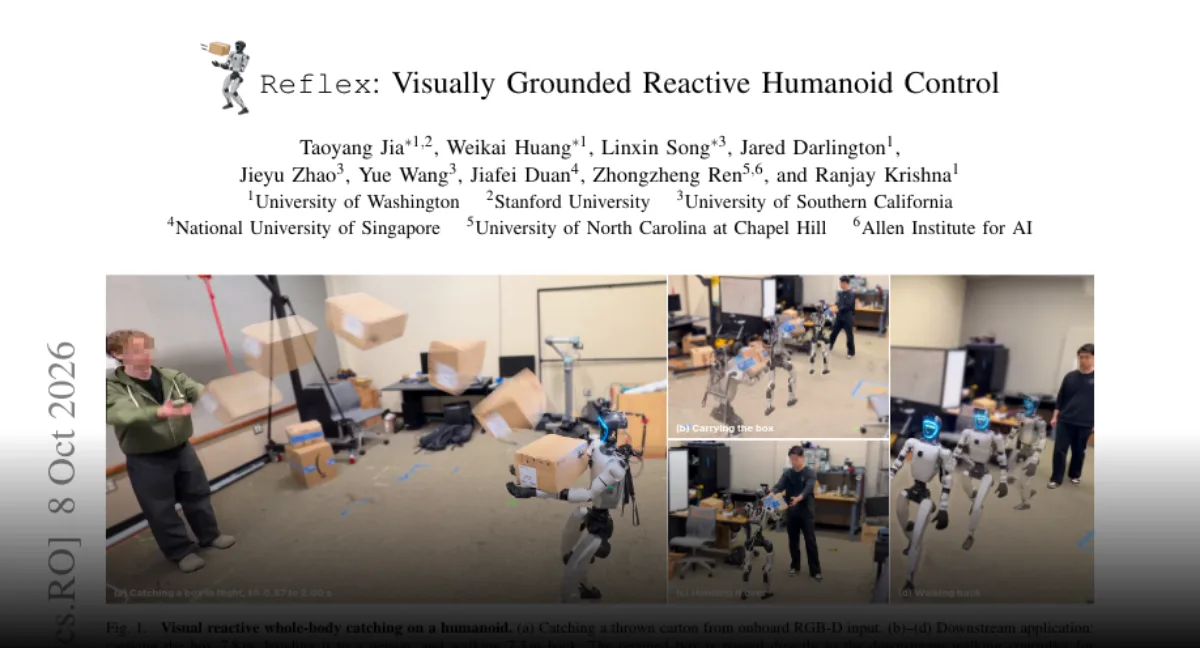
- Reflex is a three-stage framework for humanoid robot catching that combines whole-body control, real-time reaction to object motion, and egocentric RGB-D vision.
- It learns in stages: first training a state-based whole-body controller, then inferring object dynamics from delayed observations, and finally grounding those dynamics in visual input.
- In simulation, Reflex reaches 85.7% catch success with egocentric RGB-D input, close to the 87.9% success achieved with privileged object observations.
- Temporal visual history is critical: removing it causes large performance drops, showing that a single snapshot is not enough for reliable catching.
- On a real Unitree G1 humanoid, Reflex catches thrown boxes at 65% success from 2.5 meters and 40% from 5 meters, indicating progress but also remaining limits in real-world robustness.
Meta Description:
Reflex uses a three-stage framework to help humanoid robots catch boxes with egocentric color and depth vision, reaching 85.7 percent success in simulation.
Tags: humanoid robots, Reflex, robot catching, reinforcement learning, egocentric vision
Featured image: abstract humanoid robot silhouette catching a box in a simulated vision pipeline, no text, no logos, no real people.
Reflex is a three-stage framework for humanoid robot catching of thrown boxes. It combines whole-body control, real-time reaction to object dynamics, and egocentric RGB-D, an observation format combining color and depth, to address a task that closely resembles everyday physical work. The result is not just a robot that can catch; it is a test of whether humanoids can learn reactive control from vision in a scalable way.
Background: The Humanoid Catching Problem
Humans routinely perform fast visual reactions. They return a tennis shot, catch a falling cup, step aside from a passing cart, or pass a box tossed during truck unloading. Each action depends on anticipating a moving target and responding with the whole body within about a second.
For humanoid robots, the same task is difficult because it requires three capabilities at once. A system must coordinate whole-body control, react to object dynamics in real time, and ground perception in egocentric vision. Catching a thrown box is useful as a representative task because it demands all three.
Previous approaches have covered only part of the problem. Some rely on end-effectors, others on motion capture, and others on marked objects. Those shortcuts reduce the challenge but avoid the full task of visual reactive whole-body control.
Development: Reflex Builds the Skills in Three Stages
Reflex addresses the challenge by learning the required capabilities stage by stage. The stages are connected through a compact representation of object dynamics, which serves as a bridge between low-level control and visual perception.
The first stage trains a state-based policy to learn whole-body catching with reinforcement learning. At this point, the controller focuses on the mechanics of moving the robot body to intercept a box.
The second stage teaches the policy to infer the dynamics of a moving box from delayed and incomplete observations. This step adds the ability to estimate how the object is moving even when the available sensory signal is imperfect.
The third stage replaces privileged state information with vision. An egocentric RGB-D encoder learns to recover the dynamics representation directly from visual observations, while the whole-body controller remains fixed. This decomposition gives each capability a direct training signal and makes visual learning substantially more scalable.
Latest Progress: Simulation Results and Real Robot Performance
In simulation, Reflex reaches 85.7 percent catch success when using egocentric RGB-D input. That is close to the 87.9 percent success rate observed when the system is given privileged box observations, which provide more direct access to the object state.
The results also show that temporal visual history is critical. When the temporal history is removed, success falls by 35.6 points on centered throws and by 39.8 points on laterally offset throws. In other words, the robot needs more than a single visual snapshot to track a moving object reliably.
On a real Unitree G1 humanoid, Reflex catches human-thrown boxes with 65 percent success at 2.5 meters and 40 percent success at 5 meters. These rates correspond to 76 percent and 59 percent of human catchers success at the same distances.
Current Stage: Vision-Based Reactive Control Still Needs Room to Grow
The reported results place Reflex at a transition point: whole-body catching can be learned, and visual inference of object dynamics can be connected to a fixed controller. The framework demonstrates that a compact dynamics representation can support reactive behavior from egocentric color and depth observations.
The remaining gap appears in real-world robustness, especially at longer throwing distances. The system is closer to privileged simulation performance than to human-level visual catching, but it provides a clear path for scaling visual learning without retraining the entire whole-body controller.
Comments
No comments yet. Be the first to comment.