
Benchmarks for Coding Agents Should Align with Their Users' Task Workflows
A JetBrains study uses 4,782 sessions to show coding agent benchmarks must align with real developer task flows via SWE-TaskFlow.
Key Takeaways
- A JetBrains study analyzed 4,782 real production coding agent sessions to show that developer-agent interactions are often multi-turn and varied, not just single issue-to-fix tasks.
- Real coding sessions include questions, planning, review, refactoring, and execution, and users frequently switch between these task types, revealing gaps in traditional issue-derived benchmarks.
- The study proposes SWE-TaskFlow, a method to transform issue-based benchmarks into realistic task workflows by aligning interaction patterns with target user behavior.
- A pilot on 700 SWE-Bench Pro tasks found that longer, step-by-step interaction protocols can roughly double agent cost without clearly improving resolve rates.
- The key implication is that coding agent benchmark results should account for task workflow and interaction protocol, not only final code correctness.
Meta Description: A JetBrains study uses 4,782 production coding agent sessions to introduce SWE-TaskFlow, showing interaction protocols shape agent benchmarks.
Tags: coding agent evaluation, JetBrains, SWE-TaskFlow, SWE-Bench Pro, TaskFlow Alignment Score
Featured Image: Abstract technology style visualization of software agent sessions, task flows, and benchmark pipelines, no people, logos, or text.
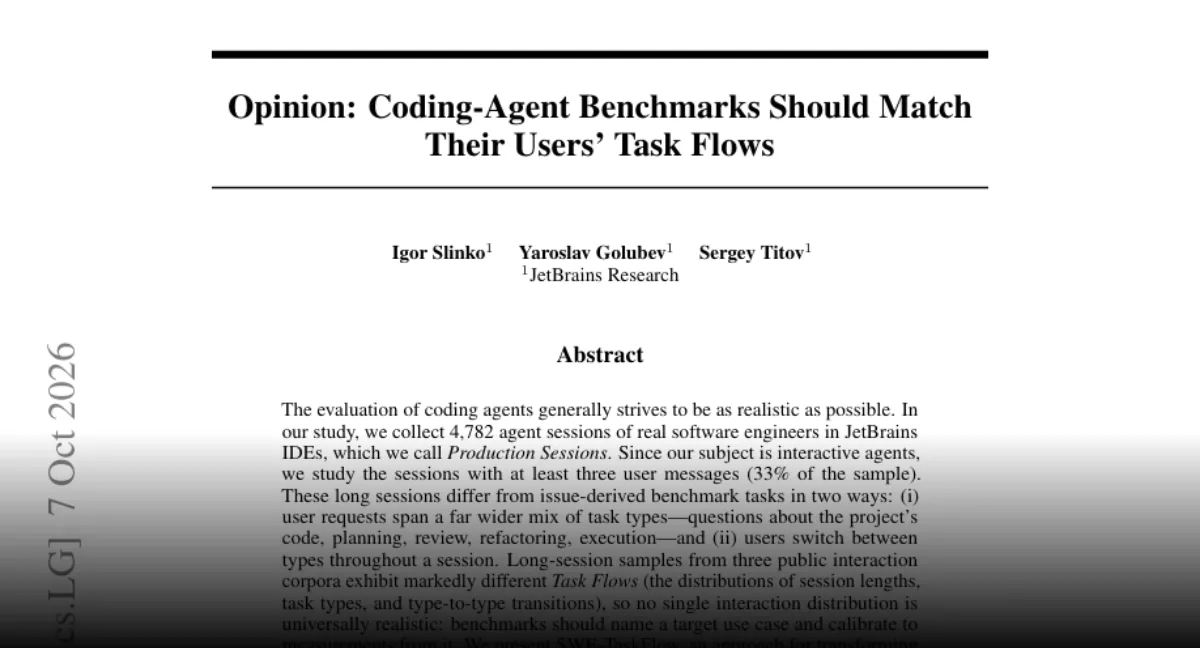
Coding agent evaluation is moving closer to real developer work after a study collected 4,782 agent sessions from software engineers using JetBrains integrated development environments. The dataset, named Production Sessions, gives researchers a way to compare how interactive coding agents behave outside narrow benchmark tasks. The study treats coding agents as interactive subjects, so it selects sessions with at least three user messages, which cover 33% of the sample. Those longer exchanges show how real requests evolve over time, rather than ending after a single command.
Background: Real Coding Agent Sessions Meet Issue Benchmarks
Most benchmark tasks for coding agents come from issue-derived tasks, where a problem statement is supplied as a single entry point and the agent must produce a fix. That setup is useful for repeatable testing, but it can make evaluation look more stable than everyday practice. In the Production Sessions data, user requests include a broader mix of activities: questions about a project's code, planning, review, refactoring, and execution. The study also observes that users switch between these task types during a session, so the interaction is not a straight line from one request to one solution.
Development: Production Sessions and Task Flows Define the Gap
The researchers organize these patterns through Task Flows, meaning the distributions of session lengths, task types, and transitions from one type to another. When long-session samples from three public interaction corpora are compared, their Task Flows differ markedly. That result means no single interaction distribution can be called universally realistic. A benchmark that wants to model a particular workflow needs to state its target use case and calibrate its tasks to measurements from that use case.
The study introduces SWE-TaskFlow as a method for transforming any issue-derived benchmark. It keeps the original verified tasks and tests, then steers the interaction toward a chosen Task Flow. The process uses prompt splitting and verifiable repository question answering. It also uses a TaskFlow Alignment Score to choose among generated trajectories. The goal is to make benchmark evaluation reflect the way sessions unfold, not only whether the final code passes tests.
Latest Progress: SWE-TaskFlow and the SWE-Bench Pro Pilot
A pilot on 700 SWE-Bench Pro tasks tested how the interaction protocol affects results. When the same task is solved sequentially in several steps, agent cost approximately doubles compared with a shorter, more direct protocol, while the resolve rate shows no stable change. The finding places the conversation protocol itself among the important dimensions of evaluation. For benchmark users, this means reported scores may depend not only on task quality or agent capability, but also on how the task is presented and solved.
The current stage of the work is a framework and pilot: Production Sessions and Task Flows describe real interaction patterns, and SWE-TaskFlow offers a way to bring those patterns into issue-derived benchmarks. What to watch next is how benchmark designers align tasks, costs, and success rates to the target workflows they intend to measure.
Comments
No comments yet. Be the first to comment.