
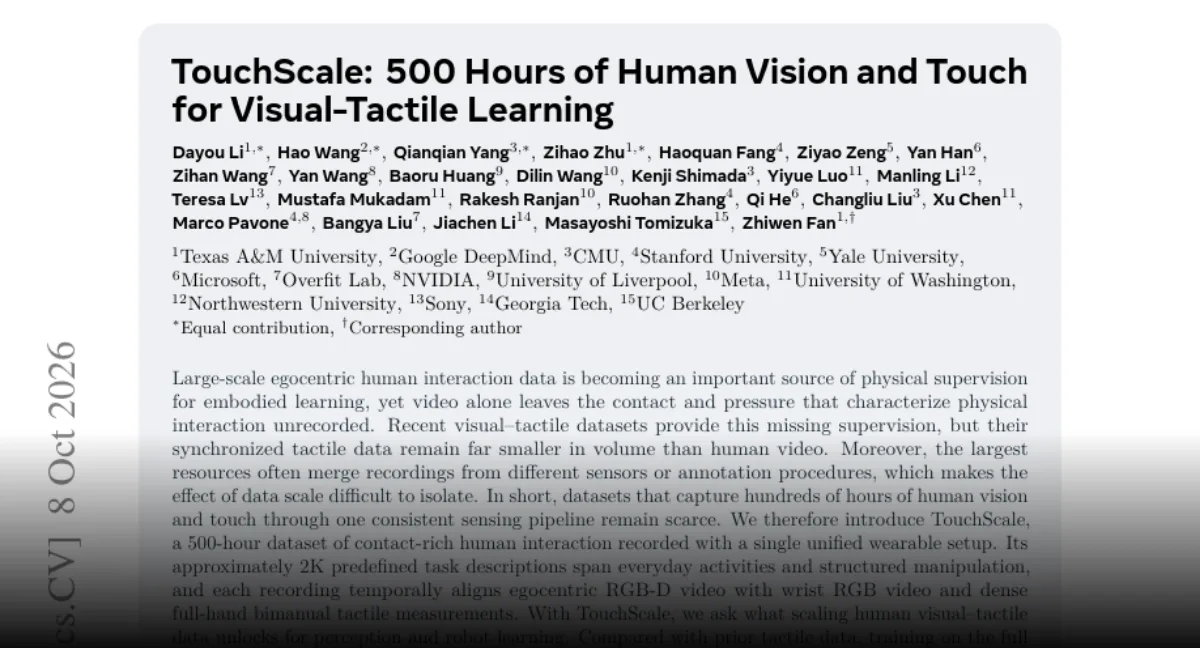
TouchScale presents 500 hours of human vision and touch for visual-tactile learning.
TouchScale pairs 500 hours of egocentric vision and full-hand touch data to improve contact prediction, action recognition, and robot manipulation.
Key Takeaways
- TouchScale is a 500-hour human vision-and-touch dataset that pairs egocentric RGB-D, wrist RGB video, and dense full-hand tactile measurements across about 2,000 tasks.
- The dataset uses a unified wearable setup and collection protocol to test whether scaling paired visual-tactile data improves perception and robot learning.
- Experiments show stronger results in contact prediction, action recognition, and real-world robot manipulation, including improving zero-shot contact IoU from 0.134 to 0.383 and raising manipulation success from 22.5% to 57.5%.
- Larger training subsets under the same setup generally improve tactile prediction and robot success, supporting the value of scaling human visual-tactile data.
- A 100-hour subset is already available on Hugging Face, with the full 500-hour release planned.
Meta description: TouchScale introduces 500 hours of paired egocentric vision and full-hand touch data, improving contact prediction, action recognition, and robot manipulation.
Tags: TouchScale, robot learning, tactile data, vision touch, manipulation
Featured image: abstract technology illustration of paired camera streams and tactile sensor grids, no real people, no company logos, no text.
TouchScale is a human vision and touch dataset that pairs first-person RGB-D, meaning color and depth video, with wrist RGB video and dense full-hand tactile measurements from both hands. The collection spans approximately 2,000 predefined task descriptions and was recorded with a unified wearable setup and collection protocol. The work asks whether scaling visual-tactile human data can improve both perception tasks and robot manipulation.
Background: Why Vision and Touch Need to Grow Together
A robot that grasps, pushes, or inserts an object does not only need to see where things are. It also needs evidence of contact: when the hand touches a surface, how the contact changes, and whether the result is stable or slipping. Visual streams provide task context and hand position, while tactile streams provide contact signals close to the point of interaction.
TouchScale places these two signal types together in one collection design, pairing egocentric RGB-D video, wrist RGB video, and full-hand tactile measurements.
Development Process: A Unified Protocol, Then a Scaling Test
The project evaluates whether more paired visual-tactile data helps across three directions.
For cross-sensor contact prediction, the model is tested on an unseen tactile sensor and evaluated with zero-shot contact IoU, a contact prediction score. Compared with training on prior tactile data, the score improves from 0.134 to 0.383.
For action recognition, TouchScale pretraining reaches the highest accuracy on three benchmarks among the visual-tactile datasets compared. This points to the value of tactile information as part of pretraining, not just as a separate sensor channel.
For robot manipulation, visual-tactile mid-training raises average real-world success from 22.5% to 57.5% across four contact-rich tasks. The result shows an improvement in real-world success, not only in offline metrics.
The collection also tests scaling while keeping the sensing and collection setup fixed. Under that condition, larger TouchScale training subsets generally improve tactile prediction and robot success.
Latest Progress: A 100-Hour First Release Before the Full 500-Hour Dataset
An initial 100-hour subset is available on Hugging Face under the dataset access conditions. The full 500-hour release is planned. The project page is https://touch-scale.github.io/, the dataset is at https://huggingface.co/datasets/2077AIDataFoundation/TouchScale, and the code is at https://github.com/phai-lab/touchscale.
The next milestone is the full release and how its scale behaves when training subsets grow under the same wearable setup. The available evidence already links larger paired human visual-tactile data to better contact prediction, stronger action recognition, and higher success in real manipulation tasks.
Comments
No comments yet. Be the first to comment.