
HumanoidToolBench is a benchmark for evaluating humanoid tool use from selecting tools to executing them while mobile.
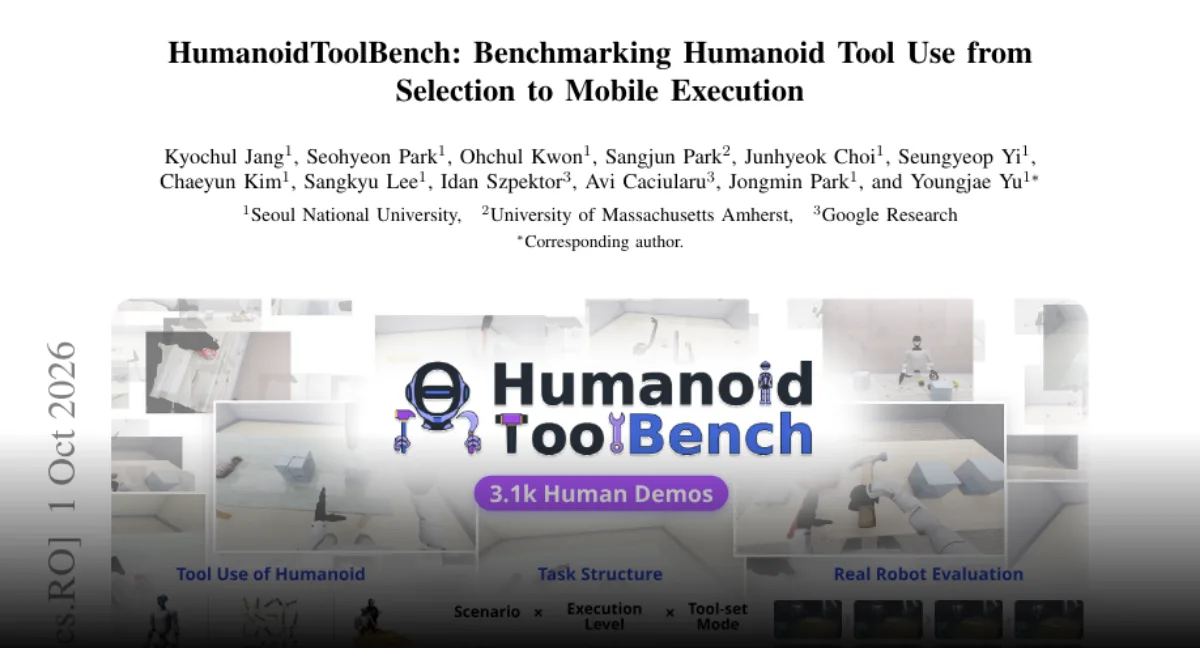
HumanoidToolBench tests whether humanoid robots can select and execute tools across 18 tasks, using ToolBook demonstrations, simulation, Unitree G1.
Key Takeaways
- HumanoidToolBench evaluates whether humanoid robots can both select appropriate tools and successfully execute tasks while mobile.
- The benchmark covers 18 tasks across three scenarios, three execution levels, and two tool-set modes.
- It includes ToolBook, a dataset of 3.1k demonstrations collected in simulation and on a real Unitree G1 robot.
- Evaluated policies reveal a substantial gap between choosing a suitable tool and completing the task.
- GR00T N1.7 probes examine generalization to unseen tools and behavior under unrelated instructions.
Meta description: HumanoidToolBench uses 18 tasks and ToolBook 3.1k demos to test humanoid tool selection and execution, including Unitree G1 and GR00T N1.7 probes.
Tags: HumanoidToolBench, ToolBook, Unitree G1, GR00T N1.7, humanoid tool use
Featured image: abstract humanoid workspace with tools, simulation overlays, and evaluation nodes, no real people, no company logos, no text.
HumanoidToolBench asks whether humanoid robots can choose a suitable tool and then use it to complete a task. The benchmark covers 18 tasks across three scenarios, three execution levels, and two tool-set modes.
Background: The Tool-Use Question
The central question is not only tool choice, but successful execution. HumanoidToolBench frames that gap as a measurable benchmark problem.
Development: Benchmark and Dataset
The project introduces ToolBook, a dataset of 3.1k demonstrations collected in simulation and on a real Unitree G1. The benchmark and dataset together support evaluation of tool selection and execution.
Latest Progress: Evaluation Gaps
Seven policies were evaluated in simulation, and three were evaluated on the real robot. The results show a substantial gap between selecting a suitable tool and completing the task. Additional GR00T N1.7 probes examine generalization to unseen tools and behavior under unrelated instructions.
The benchmark and demonstrations are available on the project page, and the project welcomes feedback from the humanoid learning and tool-use communities. The current stage is diagnostic: it identifies where humanoid tool-use systems still fall short.
Comments
No comments yet. Be the first to comment.