
Agentic Post-Training Guided by Feedback Enables Text-to-Image Generation
Agentic post-training uses three agents to automatically evaluate text-to-image models, diagnose failures, and generate adaptive prompts.
Key Takeaways
- APT is an adaptive post-training framework for text-to-image models, designed to address the limitation of static prompt sets that cannot track changing model strengths and weaknesses.
- It replaces manual prompt curation with a closed training loop built around three agents: Evaluation Set Generation, Diagnosis, and RL Data Generation.
- The system evaluates the current model, identifies failure patterns, and prioritizes training prompts that target weaker capabilities.
- After each model update, APT re-evaluates and reshapes the next training round, allowing the training distribution to adapt continuously to the model’s evolving behavior.
- APT is model-agnostic, benchmark-agnostic, architecture-agnostic, and fully automated, removing the need for manually curated post-training data.
APT Uses Three Agents to Make Post-Training Adaptive
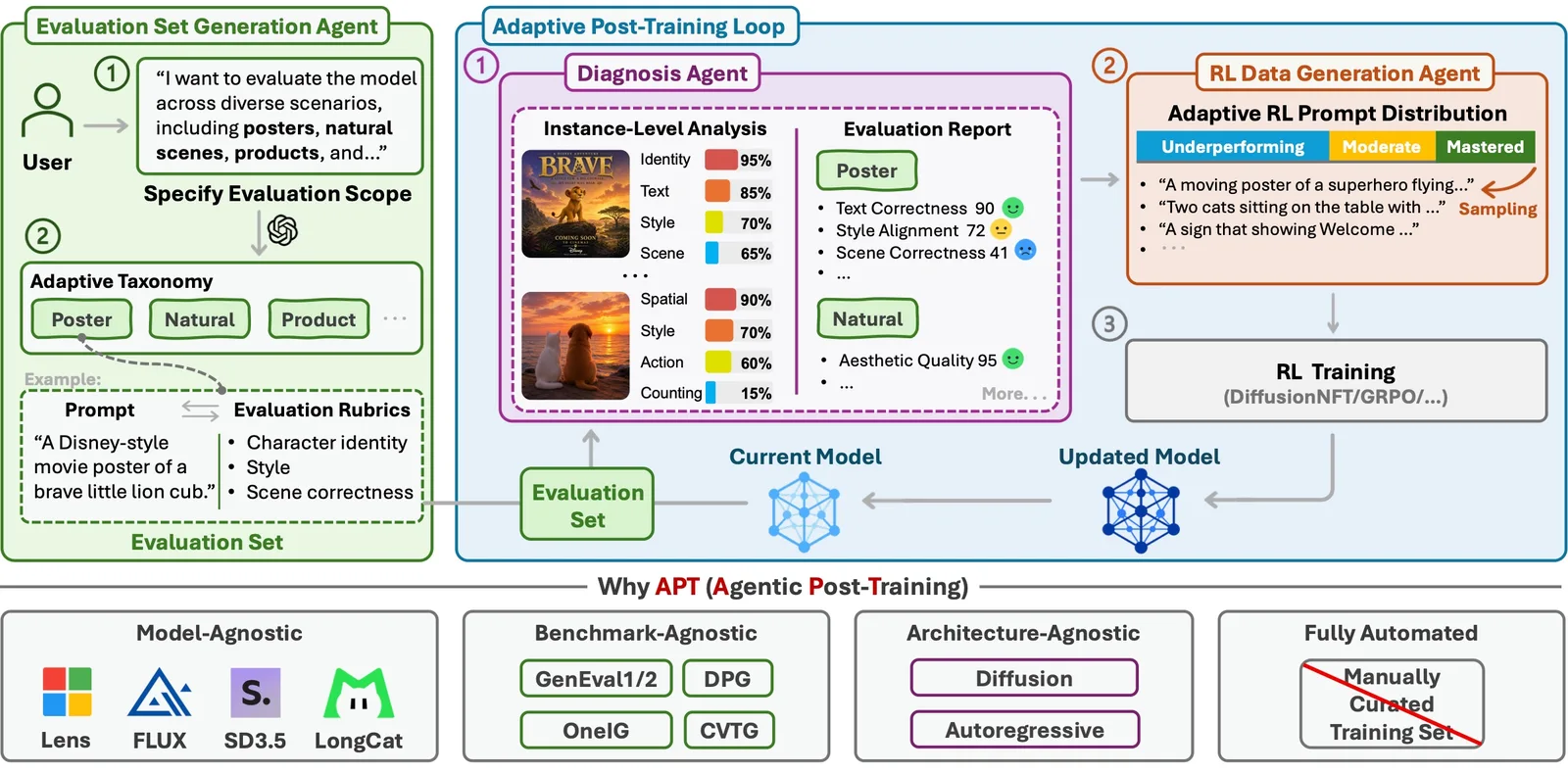
Background: Static Data Cannot Match Changing Model Behavior
APT is an adaptive post-training framework. Image models tend to fail in different areas, and a single fixed prompt set cannot track the strengths and weaknesses that change as models update. More suitable training prompts are therefore needed to keep post-training aligned with current model behavior.
Development Process: Three Agents Build a Closed Training Loop
APT, short for Agentic Post-Training, replaces manual prompt curation with an automated evaluation loop built around three agents. First, a user defines the evaluation scope. The Evaluation Set Generation Agent creates a varied set of prompt-evaluation rubric pairs. The Diagnosis Agent runs the current model against those pairs and records what it handles well and where it fails. The reinforcement learning data generation agent, referred to as the RL Data Generation Agent, uses those failure patterns to sample prompts for the next training round, with priority given to weaker capabilities.
Latest Progress: Updated Models Enter the Next Evaluation Round
After each model update, the process begins again. The new model is evaluated, diagnosed, and used to shape the next training prompts. This lets the training distribution adapt continuously to the model's evolving capability profile. APT is model-agnostic, benchmark-agnostic, architecture-agnostic, and fully automated, and it removes the need for manually curated post-training data. APT's current stage is an automated, adaptive post-training loop rather than a fixed one-time data set.
Meta Description: APT uses three agents for evaluation-driven adaptive post-training, generating smarter training prompts from model weaknesses without manual curation.
Tags: APT, adaptive post-training, evaluation-driven training, reinforcement learning, image models
Featured Image: Abstract technology style loop diagram with three glowing nodes around a central model profile, no real people, no company logos, no text.
Comments
No comments yet. Be the first to comment.