
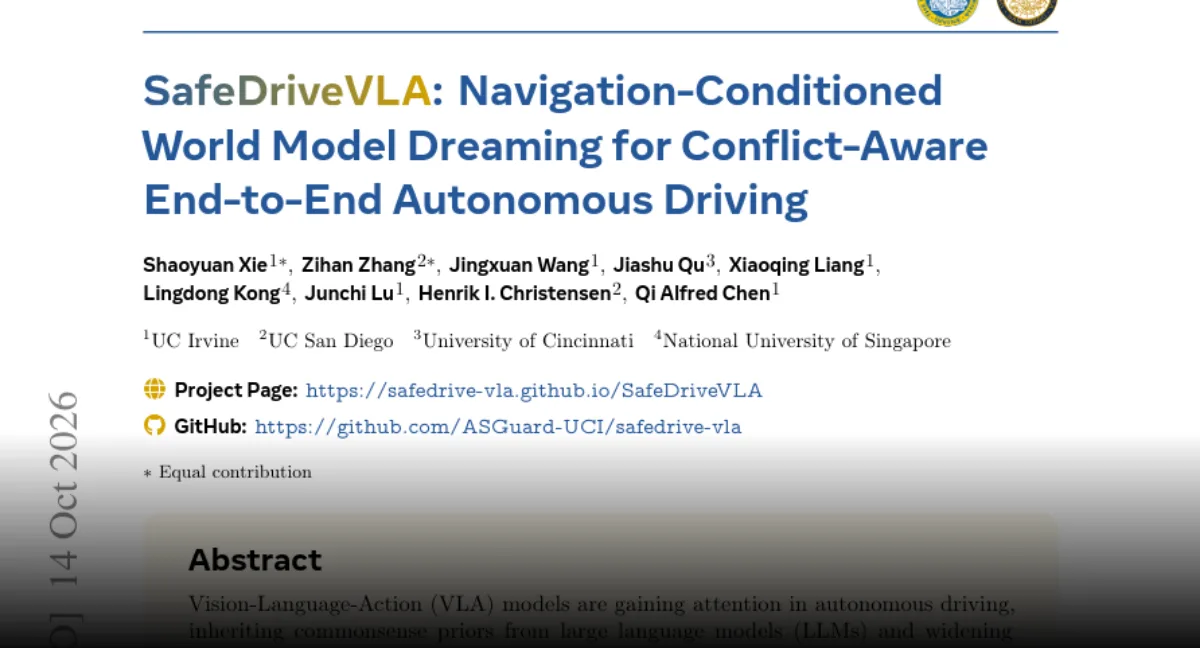
SafeDrive Vision-Language-Action enables conflict-aware end-to-end autonomous driving through navigation-conditioned world model dreaming.
SafeDrive uses world model dreaming to detect unsafe navigation conflicts, improving language-guided autonomous driving safety.
Summary of Key Points
- Natural-language navigation in driving VLA models increases flexibility but creates safety risks, because systems must judge whether instructions are safe for the current scene, not just whether they can be executed.
- A new benchmark evaluates navigation following, conflict awareness, and adversarial robustness together, showing that existing VLAs struggle when instructions conflict with scene requirements.
- SafeDriveVLA introduces a three-level navigation-compliance mode and navigation-conditioned world model dreaming to separate conflict reasoning from action generation.
- On Bench2Drive, SafeDriveVLA reaches 88.16 Driving Score and 68.64% Success Rate, improves closed-loop language following by 49.3%, and reduces collisions under unsafe instructions from 60 to 38.
- The work frames conflict awareness as a core problem for driving VLAs, raising the need to test whether these mechanisms generalize beyond the benchmark and become standard in evaluation pipelines.
Vision-Language-Action (VLA) models are moving into autonomous driving, borrowing commonsense priors from large language models (LLMs) and replacing fixed command sets with free-form natural-language instructions. That open interface creates a new vulnerability surface: a distracted driver might issue an instruction that is unsafe for the current scene, and a malicious user might issue a dangerous one deliberately. A new benchmark suite evaluates navigation following, conflict awareness, and adversarial robustness together, and finds existing VLAs lacking on both fronts.
Background: Why Natural-Language Navigation Opens a Risk Surface
Traditional driving interfaces rely on a fixed command set, which limits what a driver can ask the vehicle to do. VLA models widen that interface to free-form natural language, inheriting commonsense priors from LLMs. The benefit is flexibility. The cost is that the system must now judge whether an instruction is safe in context, not merely whether it can be executed. The benchmark suite introduced here is described as the first to evaluate navigation following and conflict awareness together, alongside adversarial robustness.
Development: How Current VLAs Perform Under Conflict
The results are stark. SimLingo, a VLA variant, completes no language-instructed lane change in closed loop. Across all models tested, performance degrades sharply under conflicting signals. In other words, when the navigation instruction conflicts with what the scene requires, current systems struggle to recognize the conflict, let alone resolve it safely.
The Proposed Fix: SafeDriveVLA
The authors propose SafeDriveVLA, described as the first driving VLA that explicitly predicts a three-level navigation-compliance mode to decouple conflict reasoning from action generation. It also uses navigation-conditioned world model dreaming to inform this prediction. Unlike prior world models that roll out expert or planned actions, this one dreams of strictly following the navigation signal, showing when following is safe.
Results: Scores and Safety Gains
SafeDriveVLA reaches 88.16 Driving Score (DS) and 68.64% Success Rate (SR) on Bench2Drive. It lifts closed-loop language following by 49.3% and reduces collisions under unsafe instructions from 60 to 38 compared to the best SimLingo variant.
What to Watch Next
The gap between executing an instruction and judging whether it should be executed is now measurable. The benchmark suite and SafeDriveVLA together frame conflict awareness as a first-class problem for driving VLAs, rather than an afterthought to action generation. The next question is whether this three-level compliance mode and navigation-conditioned dreaming generalize beyond Bench2Drive, and whether other VLA teams adopt conflict-aware evaluation as a standard part of their pipelines.
Comments
No comments yet. Be the first to comment.