
Do Improved Visual Representations Always Result in Better End-to-End Autonomous Driving?
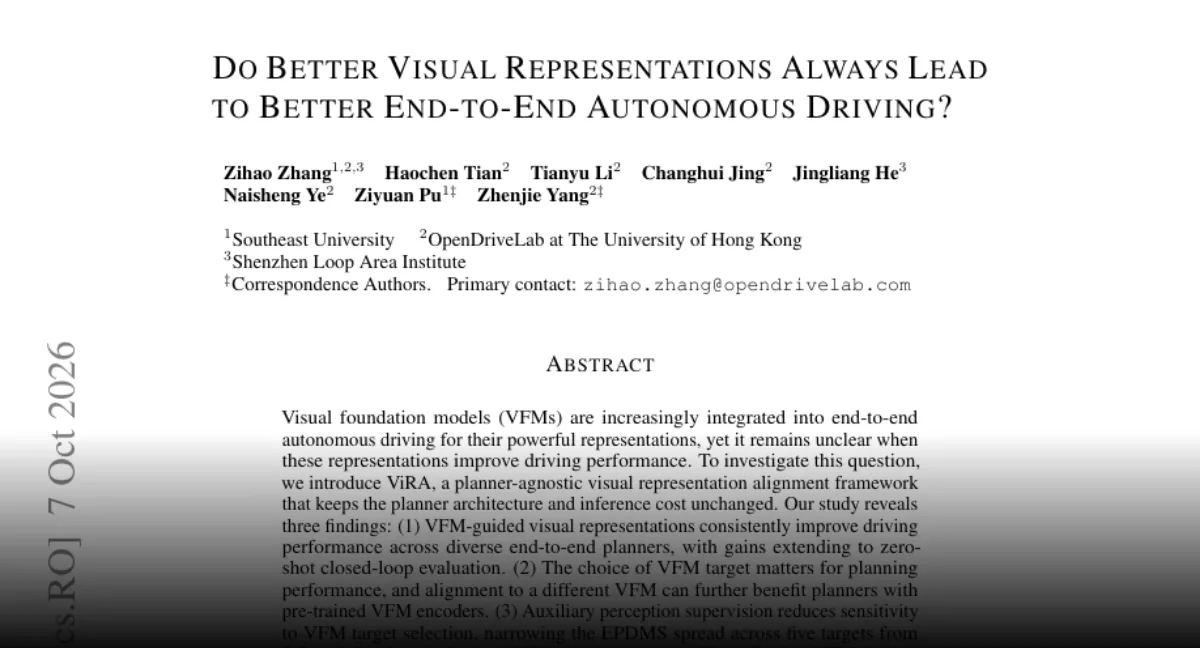
ViRA shows visual foundation model target choice and supervision shape end-to-end driving performance; ViRA-Diffusion scores 92.3 on NAVSIM v2.
Key Takeaways
- ViRA is a planner-agnostic visual representation alignment framework that keeps planner architecture and inference cost unchanged, allowing the effect of visual representations on end-to-end driving to be isolated.
- VFM-guided visual representations consistently improve driving performance across diverse end-to-end planners, including gains in zero-shot closed-loop evaluation.
- The choice of VFM alignment target matters: aligning to a different VFM can further benefit planners that already use pretrained visual foundation model encoders.
- Auxiliary perception supervision reduces sensitivity to VFM target selection, narrowing performance variation and potentially compensating for less effective VFM targets.
- Based on these findings, ViRA-Diffusion achieves 92.3 EPDMS on NAVSIM v2 navtest without auxiliary perception supervision, showing that VFM target selection and planner supervision should be considered jointly.
Visual foundation models (VFMs) have become a common ingredient in end-to-end autonomous driving, prized for the rich representations they produce. What has been less clear is when those representations actually translate into better driving. A new study introduces ViRA, a planner-agnostic visual representation alignment framework that leaves the planner architecture and inference cost untouched, and uses it to probe that question directly.
Background: Why Alignment, Not Replacement
End-to-end planners increasingly sit on top of pretrained visual encoders. The open question is whether the representations these encoders supply help or hinder the planning task, and whether the specific VFM chosen as an alignment target changes the outcome. ViRA is designed to isolate exactly that variable: it aligns visual representations toward a VFM target while keeping the planner itself fixed, so any performance change can be attributed to the representation rather than to added parameters or compute.
Three Findings From the Study
The study reports three results.
First, VFM-guided visual representations consistently improve driving performance across diverse end-to-end planners, and the gains extend to zero-shot closed-loop evaluation.
Second, the choice of VFM target matters for planning performance. Alignment to a different VFM can further benefit planners that already use pre-trained VFM encoders.
Third, auxiliary perception supervision reduces sensitivity to VFM target selection. It narrows the EPDMS spread across five targets from 2.7 to 0.5 points, and can potentially compensate for less effective VFM targets.
ViRA-Diffusion and the NAVSIM v2 Result
Guided by those findings, the team developed ViRA-Diffusion, a diffusion-based planner trained without auxiliary perception supervision. It reaches 92.3 EPDMS on NAVSIM v2 navtest, outperforming recent methods in the comparison by at least 1.9 points.
The takeaway the authors draw is that target selection and planner supervision should be considered jointly when integrating VFMs into end-to-end autonomous driving, rather than treated as independent design choices.
What to Watch Next
The results and a demo are available at https://github.com/OpenDriveLab/ViRA. For teams building end-to-end driving stacks, the practical implication is that the VFM target is a planning-relevant decision, and that auxiliary perception supervision changes how much that decision matters. The next question is how these alignment effects hold across additional planners and evaluation settings beyond the ones tested here.
Comments
No comments yet. Be the first to comment.