
MorphAct Introduces Robot Policies That Morph With the Worlds They Act In
MorphAct adapts robot policy parameters by context via coupled generators, gaining up to 16.30% on LIBERO, Meta-World and up to 14% over π0.5.
Key Takeaways
- MorphAct adapts robot policy parameters by interaction context, addressing the bottleneck where a single fixed parameter set may not serve all tasks equally well.
- It uses two coupled generators to create context-dependent low-rank updates for vision-language and action modules, with perception-side updates conditioning action-side adaptation.
- The framework is trained jointly through the native action objective, without requiring operation labels or separate expert-adapter targets.
- It reports gains of up to 16.30% on LIBERO and Meta-World across three vision-language-action backbones, and up to 14% over π0.5 in real-world evaluation.
Meta description: MorphAct adapts robot policy parameters by context, reaches up to 16.30% gains on LIBERO and Meta-World, and up to 14% over π0.5 in real-world tests.
Tags: MorphAct, robot policy adaptation, LIBERO, Meta-World, vision-language-action
Featured image: abstract technology style with no real people, no company logos, and no text
MorphAct is a contextual parameterization framework that adjusts robot policy parameters as interaction contexts change. Its reported gains, up to 16.30% on LIBERO and Meta-World and up to 14% over π0.5 in real-world evaluation, show how context-aware adaptation can address a known bottleneck in robot learning: one fixed set of parameters may not serve every task in the same way.
Background: Fixed Parameters Can Pull Robot Policies in Different Directions
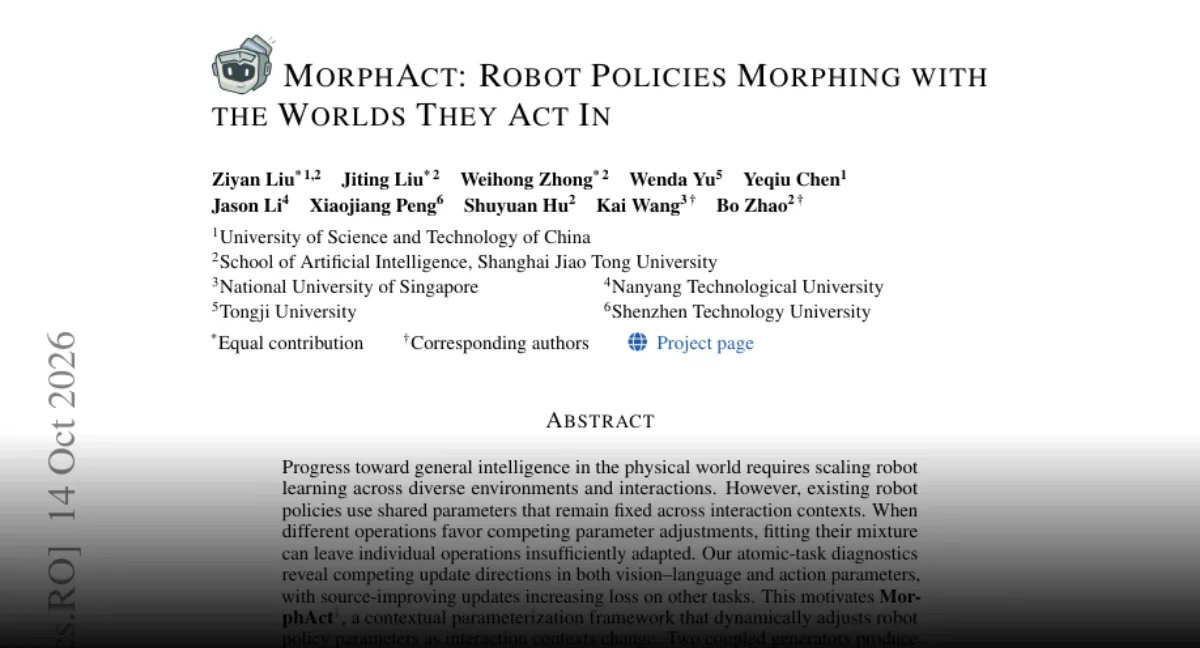
Progress toward general intelligence in the physical world requires scaling robot learning across diverse environments and interactions. Many robot policies are built around shared parameters that remain fixed across interaction contexts. That design can be efficient, but it can also create conflict. Different operations may favor competing parameter adjustments. When a training process fits their mixture, the resulting policy may leave individual operations insufficiently adapted.
The source material describes atomic-task diagnostics that expose this problem. The diagnostics reveal competing update directions in both vision-language and action parameters. They also show that source-improving updates can increase loss on other tasks. This gives a concrete reason to move beyond a single fixed parameter set: the policy needs to adapt when the context changes.
Development Process: Coupled Generators Create Context-Dependent Updates
MorphAct addresses the conflict by making the policy's parameters context-dependent rather than permanently shared. Two coupled generators produce context-dependent low-rank updates for the vision-language and action modules. Low-rank updates are compact adjustments that change behavior without replacing the full parameter set.
The coupling follows the policy's computational dependency. Vision-language updates shape the representations that condition action-side parameter generation. In practice, that means the perception and language side influences what the action side needs to adapt to. This order matters because a robot policy often transforms sensory and language inputs before producing actions.
Both generators are trained jointly through the native action objective. They do not require operation labels or expert-adapter targets. The framework is not built around separate adapters for each labeled operation. It learns contextual parameter adjustments from the action objective itself.
Latest Progress: Benchmark Gains and Real-World Evaluation
On three vision-language-action backbones, MorphAct improves performance on LIBERO and Meta-World, with gains of up to 16.30%. These benchmark results show that the method is not tied to a single base model. The reported real-world evaluation adds another layer: MorphAct achieves gains of up to 14% over π0.5.
Ablations support the benefits of contextual parameter generation and representation coupling. The source material provides internal evidence that both parts of the design matter: generating updates based on context, and coupling the vision-language and action sides through the policy's computation.
Current Stage: A Shift From Fixed Policies to Contextual Adaptation
The work sits at the transition point between fixed robot policies and contextual parameterization. The main contribution is not a new benchmark alone; it is a way to adjust parameters when interaction contexts change, using two coupled generators and a shared training signal. For readers following robot learning, the key number is the reported up to 16.30% improvement on LIBERO and Meta-World, alongside the up to 14% real-world gain over π0.5.
What to watch next is how the approach behaves across more interaction contexts and whether the same coupling logic holds outside the reported three vision-language-action backbones, LIBERO, Meta-World, and the π0.5 comparison. The current evidence points to contextual parameter generation as a practical response to competing update directions in robot policies.
Comments
No comments yet. Be the first to comment.