
Long-Horizon Reinforcement Learning Requires Muon
Muon and auxiliary loss terms support asynchronous long-horizon agent training for repository issue resolution across two model families.
Key Takeaways
- A single-rollout asynchronous training recipe combines Muon, token-averaged loss, truncated importance sampling, and length/tool-error penalties.
- It supports long-horizon repository agents by updating policy while rollouts are still being collected.
- The method targets repository-level issue resolution and was evaluated across two model families.
- Full-recipe training runs showed higher success than baselines in comparative evaluation.
Title: Muon Recipe Supports Asynchronous Training For Repository Agents Across Two Model Families
Meta description
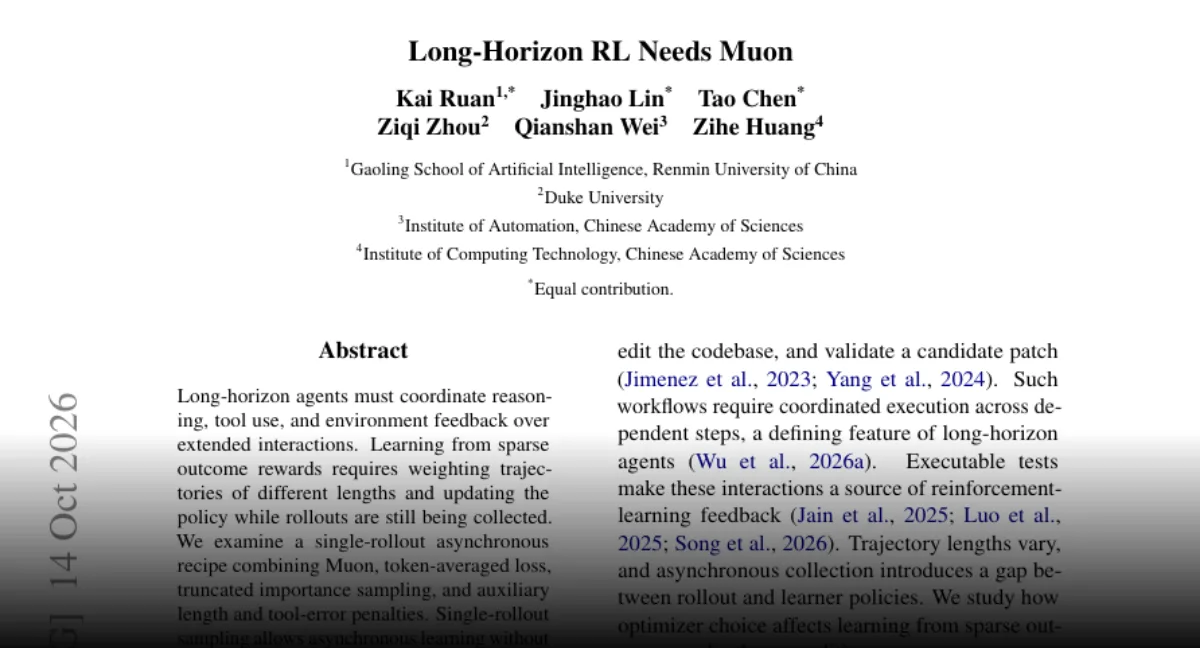
Asynchronous training with Muon, token-averaged loss, truncated importance sampling, and penalties supports long-horizon agents across two model families.
Tags: Muon, asynchronous training, long-horizon agents, repository issue resolution, importance sampling
Featured image
Abstract technology style, no real people, no company logos, no text.
Asynchronous training for long-horizon agents gains a practical path through a single-rollout recipe that combines Muon, token-averaged loss, truncated importance sampling, and auxiliary length and tool-error penalties. The approach targets repository-level issue resolution across two model families and aims to update policy while rollouts are still being collected.
Background
Long-horizon agents must coordinate reasoning, tool use, and environment feedback over extended interactions. Learning from sparse outcome rewards requires weighting trajectories of different lengths while updating the policy. Single-rollout sampling allows asynchronous learning without waiting for multiple trajectories for the same issue.
Development
The examined recipe combines Muon, token-averaged loss, truncated importance sampling, and auxiliary length and tool-error penalties. It is studied for repository-level issue resolution across two model families. The design keeps policy updates moving while rollouts are still being collected.
Latest Progress
Evaluated training runs show higher training success with the full recipe than with the baselines. The comparison focuses on optimizer choices and recipe components.
Current Stage
The current stage is comparative evaluation: single-rollout asynchronous learning is tested across two model families for repository-level issue resolution, with the full recipe showing higher training success than baselines in the evaluated training runs.
Comments
No comments yet. Be the first to comment.