
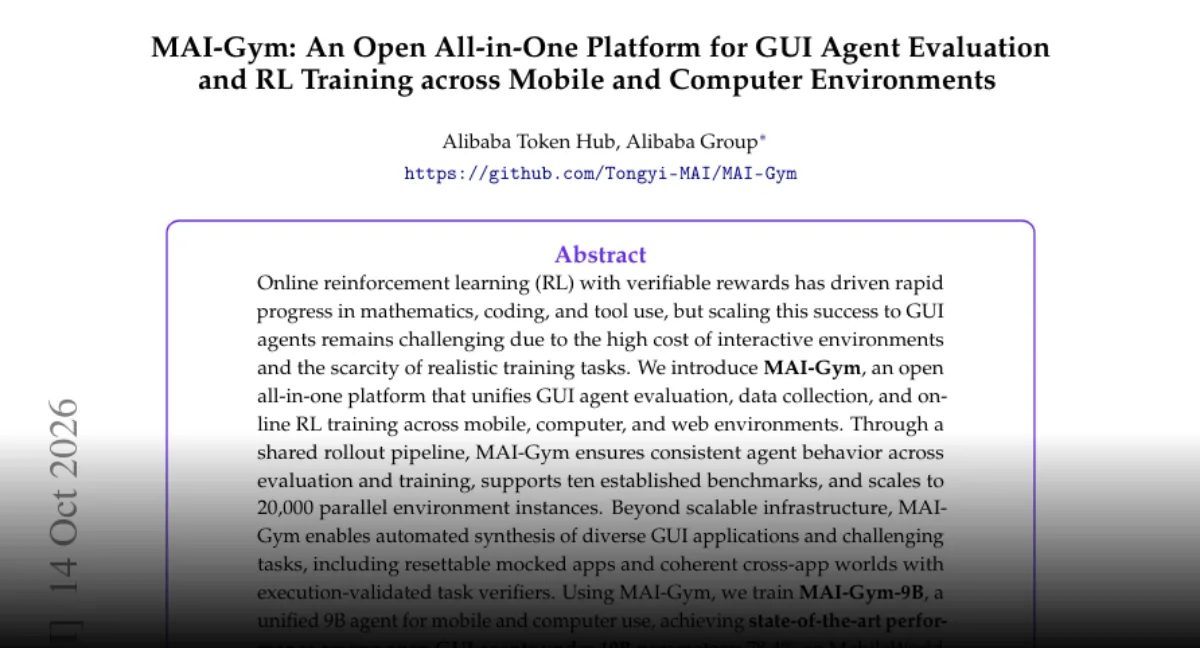
MAI-Gym is an open, all-in-one platform for evaluating graphical user interface agents and training reinforcement learning agents across mobile and computer environments.
MAI-Gym unifies GUI agent evaluation, task creation, data collection, and online reinforcement learning across mobile, desktop, and web environments.
Key Takeaways
- Tongyi-MAI released MAI-Gym, an open all-in-one platform for evaluating and training GUI agents across mobile, desktop, and web environments.
- It unifies benchmark evaluation, data collection, and large-scale online reinforcement learning under a single command interface, supporting 10 GUI benchmarks and resettable, code-verifiable tasks.
- The platform uses model weaknesses to guide task generation, connecting evaluation and training in one reproducible pipeline for cross-app tasks.
- The release includes 49 simulated apps, 2,000 execution-verified tasks, reusable synthesis skills, and MAI-Gym-9B, a single model for mobile and desktop trained with joint online reinforcement learning.
- MAI-Gym-9B reports 78.4% on MobileWorld and 76.2% on OSWorld-Verified, presented as state-of-the-art results among open GUI agents under 10 billion parameters, with code, weights, and report publicly available.
Meta description: Tongyi-MAI releases MAI-Gym, an open platform for evaluating and training GUI agents across mobile, desktop, and web, with MAI-Gym-9B weights and tasks.
Tags: MAI-Gym, GUI agents, Tongyi-MAI, online reinforcement learning, open research
Featured image: abstract technology style illustration of mobile, desktop, and web interfaces connected by evaluation pipelines, no real people, no company logos, no text.
Tongyi-MAI has released MAI-Gym, an open platform for evaluating and training agents that operate graphical user interfaces across mobile, desktop, and web environments. The project brings benchmark evaluation, data collection, and large-scale online reinforcement learning under a single command interface, while also publishing a model named MAI-Gym-9B. For researchers working on GUI agents, the release matters because it packages benchmark access, task creation, and training in one executable workflow instead of treating them as separate tools.
Background: Cross-Platform Interface Agents Need Repeatable Tests
Agents that click, type, and navigate applications across mobile, desktop, and web need evaluation environments that can be reset after each attempt and checked with objective code. Without a shared pipeline, teams can end up maintaining separate paths for testing, collecting training data, and running reinforcement learning. MAI-Gym places those steps inside one agent execution pipeline. The platform supports evaluations across 10 GUI benchmarks, and a single command can launch large-scale online reinforcement learning. Its workflow also brings together resettable apps, cross-app tasks, and code-based verifiers.
Development: Weakness-Guided Tasks and Shared Execution
The platform's release materials describe a workflow in which task generation is guided by model weaknesses. This approach connects evaluation and training: an agent can be tested on a benchmark, the resulting gaps can inform new tasks, and those tasks can be executed and verified inside the same pipeline. The design is intended to make evaluation and training reproducible rather than separate one-off workflows. Because cross-app tasks can involve state changes across multiple applications, resettable apps and code-based verifiers provide a clearer way to judge whether an agent completed a task.
Latest Release: 49 Apps, 2,000 Tasks, and MAI-Gym-9B
The release includes 49 simulated apps, 2,000 execution-verified tasks, and reusable synthesis skills. The MAI-Gym-9B model is described as one model for mobile and desktop. It is trained with joint online reinforcement learning. The project reports 78.4% on MobileWorld and 76.2% on OSWorld-Verified. These scores are presented as state-of-the-art results among open GUI agents under 10 billion parameters on both benchmarks. The benchmark names and scores give a concrete snapshot of the model's release-time performance.
Open Research Release and Current Stage
Tongyi-MAI is releasing the framework, synthesis skills, apps, tasks, and model weights to support reproducible research and help the community build better GUI agents. The project page is tongyi-mai.github.io/MAI-Gym, the model weights are at huggingface.co/Tongyi-MAI/MAI-Gym-9B, the report is at arxiv.org/abs/2610.20939, and the code is at github.com/Tongyi-MAI/MAI-Gym. The project is currently in an open research release stage: the evaluation and training platform, synthesis materials, and MAI-Gym-9B weights are available for the community to test, reuse, and extend.
Comments
No comments yet. Be the first to comment.