
PhotoGuider delivers composition-aware cropping and 360-degree view framing through explainable photographic assessments.
PhotoGuider measures composition, selects 360-degree views, refines crops, and explains framing, winning 53.2% of a 120-person blind ranking.
Key Points
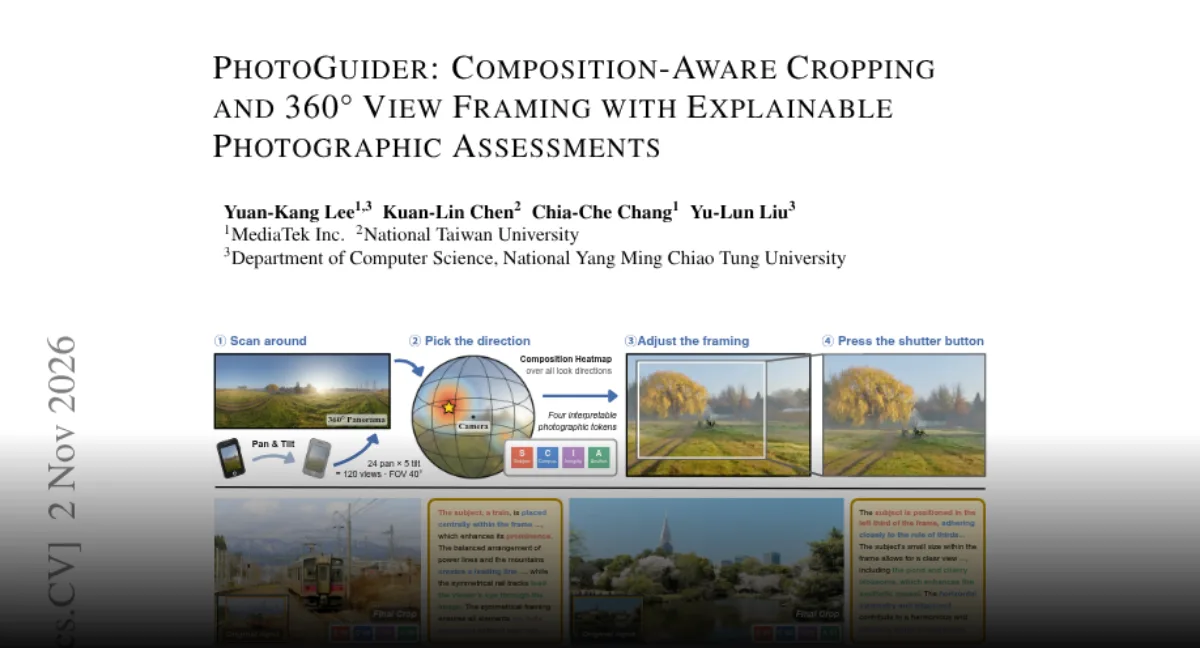
- PhotoGuider solves 360° panorama framing by separating view-direction selection from crop framing while using shared composition evidence.
- It uses a measure-then-frame pipeline with composition-aware features structured into Subject, Composition, Aesthetics, and Integrity tokens.
- A fine-tuned multimodal LLM explainer generates reasons for why the selected view and crop are compositionally appropriate.
- PhotoGuider reports top average mIoU on 2D cropping benchmarks and was ranked first in 53.2% of a 120-participant blind study.
- The method combines explicit composition-based direction selection, refined framing, camera-parameter output, and measurement-conditioned explanations.
Meta description: PhotoGuider measures composition before framing 360 panoramas, leading benchmark scores and winning first place in 53.2% of a 120 participant blind ranking.
Tags: 360 panoramas, image cropping, PhotoGuider, composition scoring, multimodal large language models
Featured image: Abstract panoramic photography interface with geometric composition guides and no people, logos, or text.
Background: 360 Degree Scenes Need a View Direction Before a Crop
Traditional image cropping starts from a photograph that already contains the composition worth keeping; the remaining question is where to crop. A full 360° scene removes that assumption. Before any framing can be chosen, a system must discover which viewing direction inside the panorama should be used. PhotoGuider addresses this two-part problem by treating direction selection and framing as separate decisions that still share the same composition evidence.
Development Process: A Measure Then Frame Pipeline
The method is described as a measure-then-frame approach. Instead of relying on one direct crop prediction, it uses compact learned scorers over one shared set of composition-aware features. Those features are extracted with foundation and task-specific vision models, then structured into four photographic tokens: Subject, Composition, Aesthetics, and Integrity.
A multimodal large language model explainer is fine-tuned to generate composition-related explanations from the image together with the measured token assessments. This gives the system a way to describe why a selected view and crop are compositionally reasonable, rather than only returning a cropped result.
Latest Progress: Benchmark and Human Ranking Results
On two standard 2D cropping benchmarks, PhotoGuider is reported to achieve the highest average mean intersection over union (mIoU) performance against ground-truth crops. The project also positions the method as, to the authors' knowledge, the first approach that combines explicit composition-based direction selection in 360° panoramas with refined framing, camera-parameter output for native re-rendering, and measurement-conditioned explanations.
A blind ranking study tested the practical result on 100 panoramic scenes from the public Poly Haven HDRI library. With 120 participants comparing three cropping methods, PhotoGuider framings were placed first in 53.2% of cases. The two strong alternatives received 27.3% and 19.5% first-place rates.
Current Stage: Method Available for Review
The work is currently presented through the reported method and its evaluations. The project page is available at https://ntuneillee.github.io/research/photoguider/, and the evidence highlighted in the source text remains the benchmark results and the 120 participant blind ranking over 100 panoramic scenes.
Comments
No comments yet. Be the first to comment.