
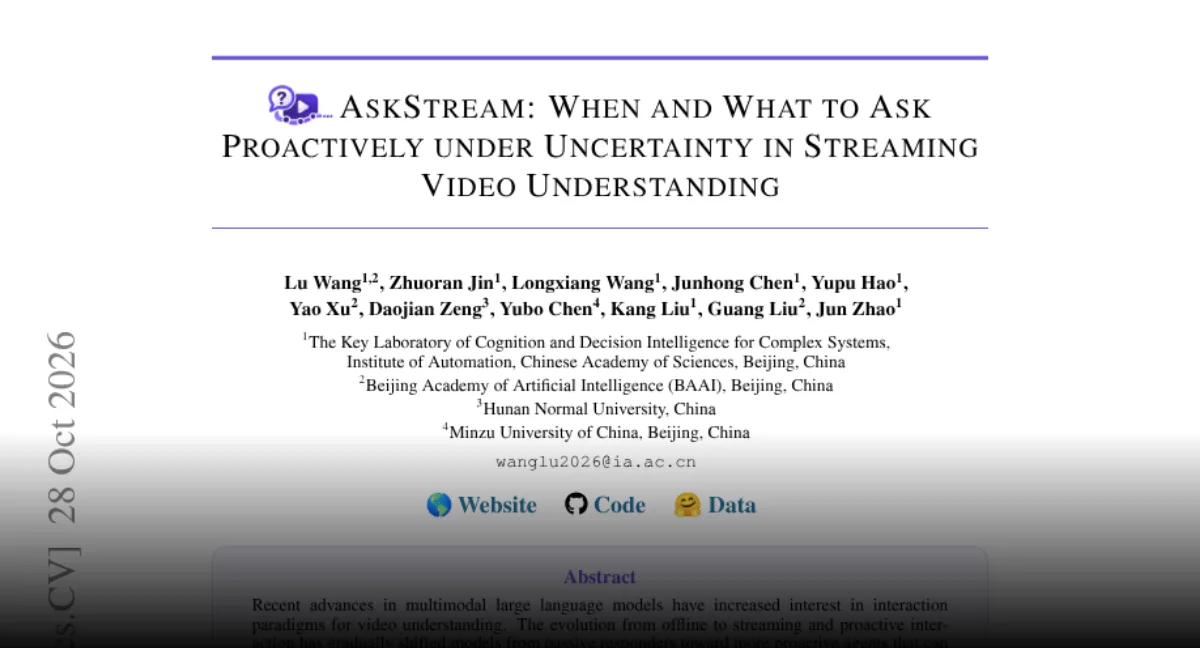
AskStream determines when and what to ask proactively under uncertainty in streaming video understanding.
AskStream tests if video agents can wait, ask, or answer under uncertainty. Using 438 videos and 2,714 windows, the best model reaches 52.18% Ask-F1.
Key Takeaways
- AskStream is the first multi-turn benchmark for streaming video understanding that tests proactive interaction under both video and user uncertainty.
- It expands the model’s action space from “wait” and “answer” to include “ask,” allowing the system to request missing information when needed.
- The benchmark contains 438 videos and 2,714 manually annotated frame-level time windows across 4 task categories and 8 subtasks.
- The strongest evaluated model reaches only 52.18% on the Ask-F1 metric, showing that proactive information seeking remains challenging.
- AskStream shifts proactive video interaction from a conceptual idea to a measurable research target.
Meta Description: AskStream benchmark tests wait, ask, and answer actions across 438 videos, with strongest model scoring 52.18% under video and user uncertainty.
Tags: AskStream, streaming video understanding, multimodal large language models, proactive interaction, benchmark
Featured image: abstract streaming video frames and time-window markers, no real people, no company logos, no text.
Background: From Offline Responses to Proactive Video Agents
Recent advances in multimodal large language models have raised interest in how AI systems should interact with continuous video rather than static clips. The field has moved through three broad stages: offline video understanding, streaming video understanding, and proactive interaction. In the earlier passive stage, a model waited for a complete input and then replied. In streaming settings, it receives video over time, but it still often behaves like a responder. Proactive interaction changes that role: the model can decide when to answer. That decision matters because real-world video and real-world users do not always supply complete information.
Development: AskStream Adds Ask to Wait and Answer
The gap between passive answering and proactive questioning is now being measured. AskStream is the first multi-turn benchmark spanning video and user uncertainty for streaming video understanding. Its design is built around four task categories and eight subtasks. The benchmark includes 438 videos and 2,714 manually annotated frame-level time windows. These annotations are divided into three action types: wait, ask, and answer. The core argument is that existing proactive paradigms usually assume the information needed to answer a query is already complete. Under that assumption, a model can only wait or answer. AskStream expands the action space with a third option: ask. That allows a model to actively request missing information when uncertainty comes from either the video itself or the user.
Latest Progress: Strongest Model Reaches 52.18% on Ask-F1
The results show that adding ask is not a solved problem. Across both multiple-choice and open-ended settings, the strongest model reaches only 52.18% on the Ask-F1 metric proposed with AskStream. The benchmark is designed to study when models should ask, what they should ask, and when they should answer before providing a final response. The score highlights substantial limitations in proactive information seeking under uncertainty. In practical terms, a model that cannot reliably choose among wait, ask, and answer may either stall indefinitely or produce highly hallucinatory responses when key visual or user information is missing.
Current Stage: A Measured Benchmark for Proactive Asking
AskStream marks a shift from describing proactive video interaction to testing it. The current stage is defined by three numbers: 438 videos, 2,714 annotated time windows, and 52.18% as the top Ask-F1 result across the evaluated settings. Those figures place proactive asking inside a measurable research target rather than an assumed capability. The benchmark also reframes uncertainty as something a model should act on, not merely tolerate. Future progress will be visible when models can choose the correct action—wait, ask, or answer—more consistently across the eight subtasks and four task categories.
Comments
No comments yet. Be the first to comment.