
AutoCompress automatically performs hardware-guided model compression.
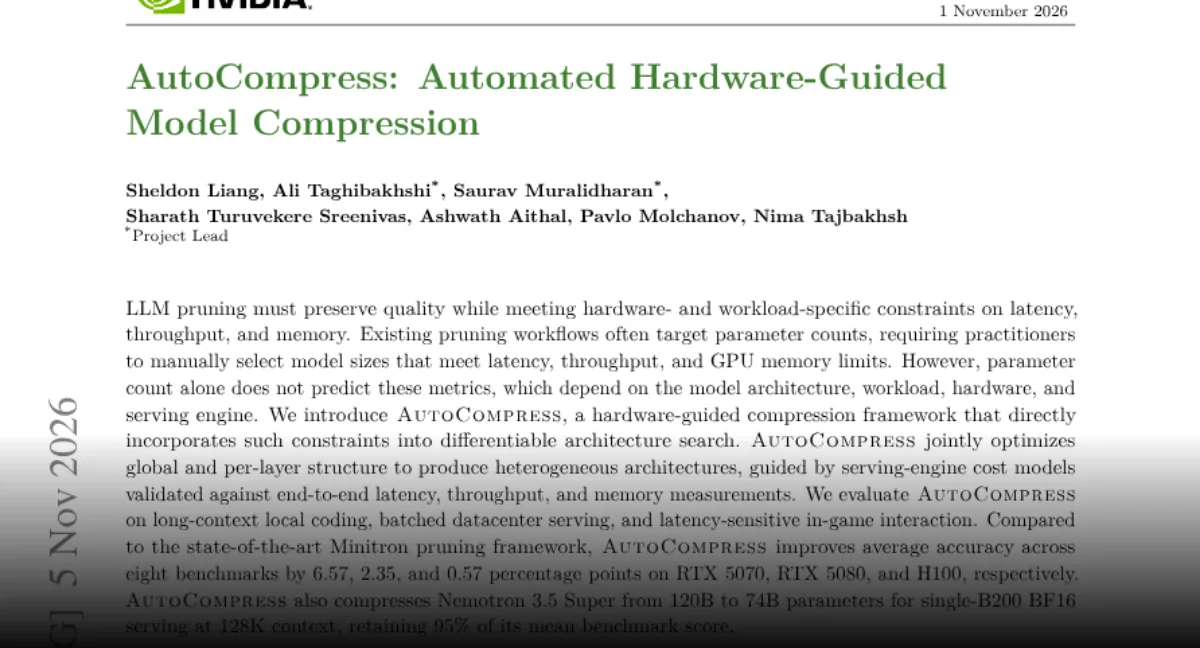
AutoCompress automates model compression by profiling GPUs, searching architectures, pruning, and distilling models to meet latency and memory limits.
Key Takeaways
- AutoCompress automates model compression by using target-GPU latency and memory constraints as the main deployment goals.
- It profiles the target GPU to build cost models, then applies differentiable architecture search, pruning, and distillation to produce a compressed model.
- The workflow is end-to-end and constraint-driven, replacing manual architecture design with hardware-aware compression.
- Reported results cover RTX 5070, RTX 5080, 8×H100 serving, and compressing Nemotron 3.5 Super from 120B to 74B parameters while retaining about 95% benchmark performance.
- The claims are specific to the listed GPUs, workloads, and cases, and are not presented as universal for all models or deployment settings.
Meta description: AutoCompress profiles target GPUs, uses differentiable architecture search, pruning, and distillation to meet latency and memory constraints in deployment.
Tags: AutoCompress, model compression, GPU, architecture search, distillation
Featured image: abstract technology style with GPU circuit patterns, compression arrows, and no real people, company logos, or text.
Background: Hardware Limits Define the Compression Goal
AutoCompress is presented as an automated, hardware-guided model compression tool. It takes a model and latency/memory constraints, then produces a compressed model meeting them. This removes manual architecture design and makes the output depend on target GPU and limits rather than a fixed compression recipe. Because compression trades off size, speed, and accuracy, explicit deployment limits give the workflow a practical target.
Development Process: Profiling Before Search
On the target GPU, AutoCompress builds cost models by profiling the model efficiently and accurately. These cost models judge candidate architectures against the same latency and memory limits. Differentiable architecture search then selects an architecture that fits the limits, pruning the model to that architecture. Distillation recovers accuracy after pruning.
Latest Results: Three Target Deployments
Reported cases cover an on-device game NPC on RTX 5070, a long-context coding agent on RTX 5080, and batched datacenter serving on 8×H100 GPUs. Across these cases, AutoCompress improves average accuracy by +6.6 / +2.4 / +0.6 points over Minitron, the best baseline, and reports 2–3.3× fewer architecture-search tokens. Gains are listed separately. A larger-scale result compresses Nemotron 3.5 Super from 120B to 74B parameters while keeping about 95% of its mean benchmark score.
Current Stage: Constraint-Driven Automation
The described workflow is end-to-end: hardware profiling on the target GPU, constraint-aware architecture search, pruning, and distillation. Applications span small on-device workloads, coding-agent tasks, datacenter serving, and Nemotron 3.5 Super. Results apply to the listed GPUs, workloads, and the large-scale case; they are not a general claim for every model or deployment, and do not show accuracy under other constraints. The source does not state whether the workflow applies beyond RTX 5070, RTX 5080, and 8×H100, or beyond Nemotron 3.5 Super.
Comments
No comments yet. Be the first to comment.